Like a joke,
like a blade
He arrived at art at forty — and spent the next four decadesmaking the world laugh, then flinch, with a thousand-won worth of materials.
A late start, a lasting practice —
forty years of wit that cuts to the bone
Ju Jae-hwan was born in 1940 in Seoul. He entered Hongik University's Department of Fine Arts in 1960 but left after a single semester — spending the registration money on art supplies instead. The next two decades were not spent in studios or galleries but in the texture of ordinary Korean life: salesman, street vendor, civil patrol officer, art teacher at a citizens' school, publishing worker. He was, by his own telling, a man who had not yet found his form.
The form arrived in 1979. In December of that year, Ju became a founding member of 현실과 발언 (Reality and Utterance) — a collective of artists and critics who sought to reconnect Korean art with social reality at a moment when the dominant culture of abstraction had largely severed that connection. He participated in the group's landmark 1980 founding exhibition. In a scene defined by gravity, Ju brought something different: wit, parody, and the knowingly absurd. He described himself as the group's “lubricant” — the one who kept the atmosphere alive.
Through the 1980s he contributed to 현실과 발언 and served the minjung art movement in wider organizational roles — becoming a founding member of 민족미술협의회 (the National Artists' Association) in 1985 and co-chair in 1987–88. But his artistic practice developed slowly, on his own terms. It was not until the early 1990s that he committed fully to making art, and not until 2000 — at age sixty — that he held his first solo exhibition, at Art Sonje Center: 이 유쾌한 씨를 보라 (Look at This Mr. Funny).
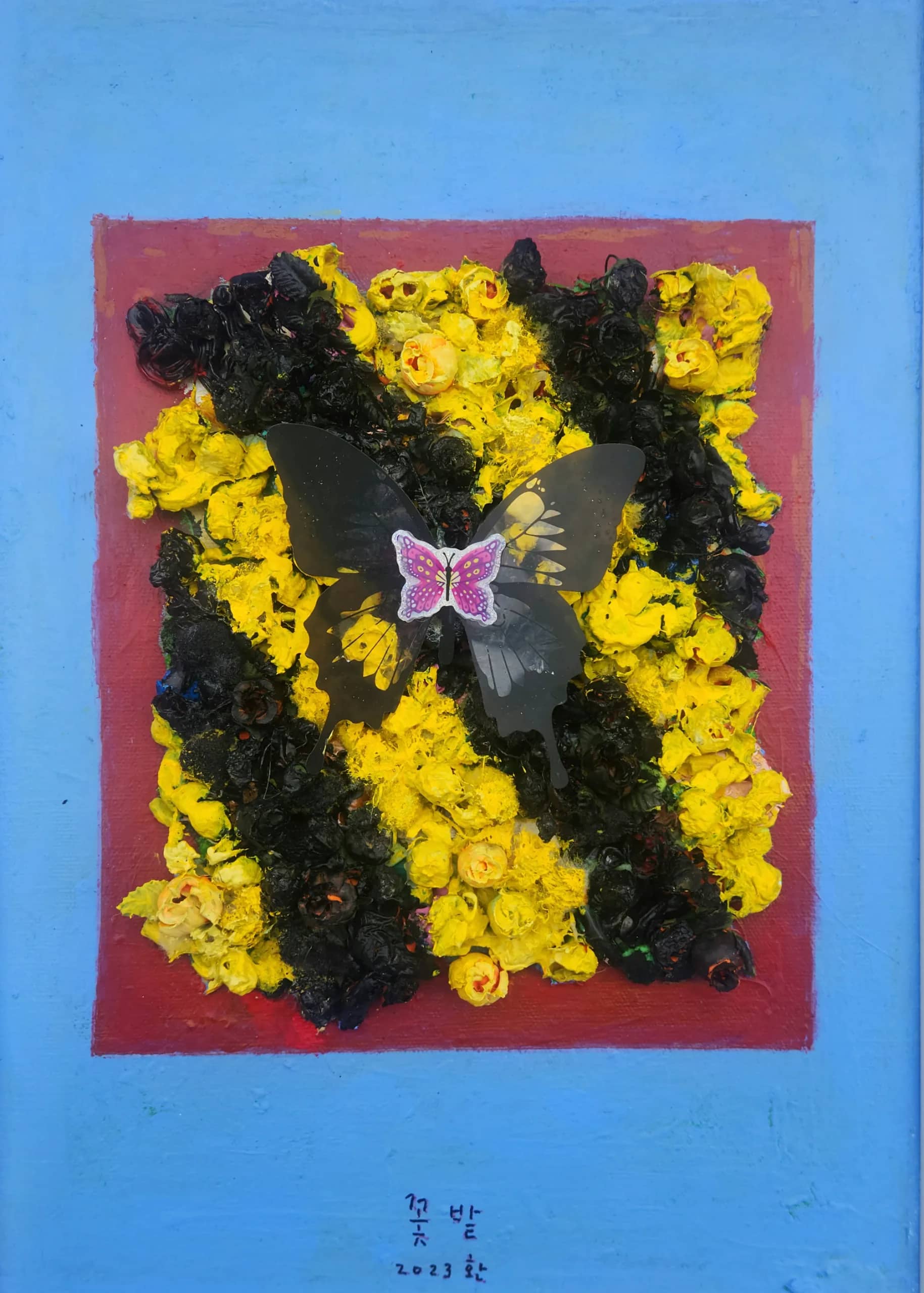
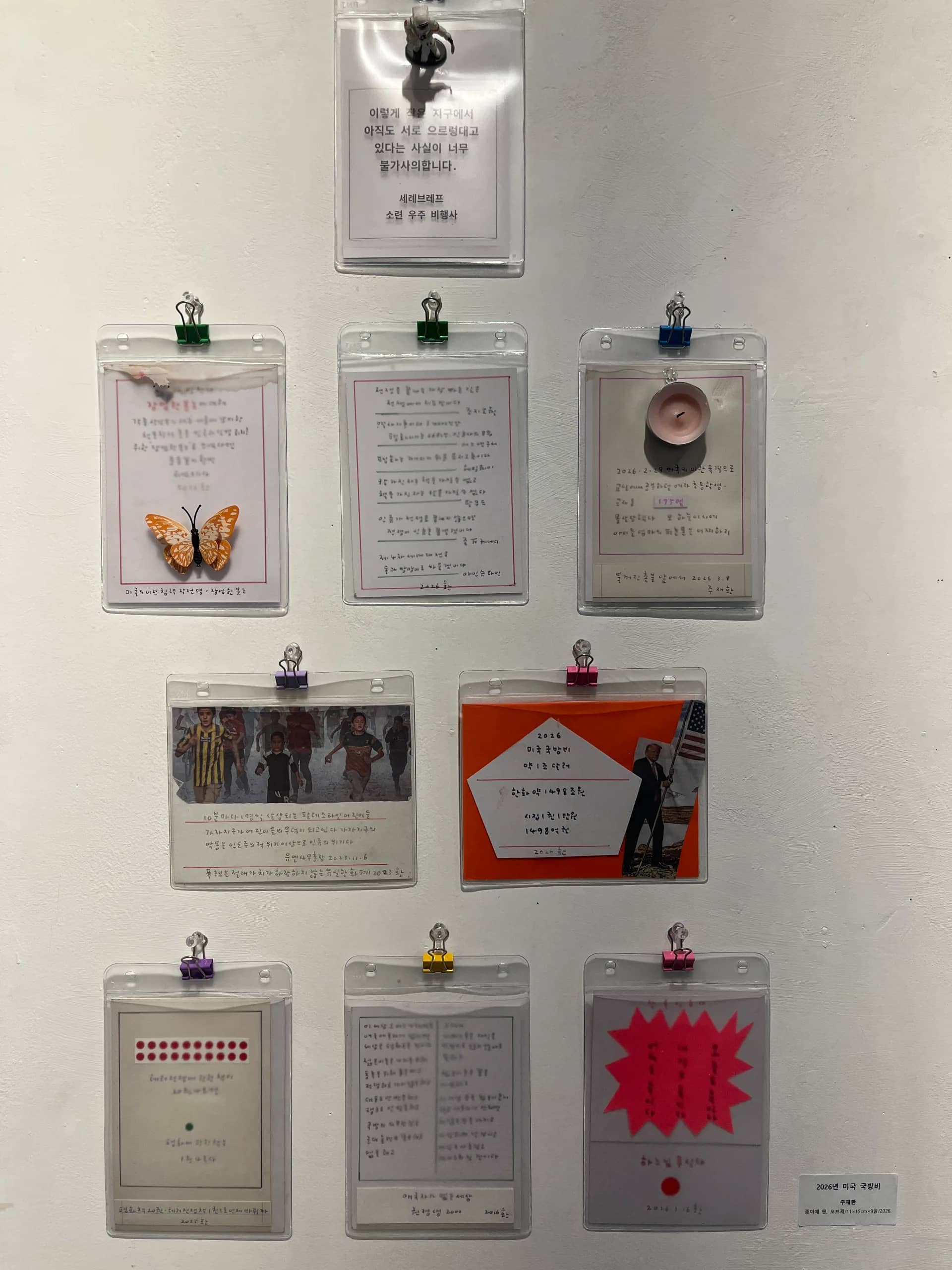
The materials he uses are resolutely everyday — discarded objects, cheap printed matter, the detritus of consumer culture. He calls his practice “1,000-won art” and himself a “clown-type artist.” But the clown has always had targets. Whether parodying the Western art canon (「몬드리안 호텔」, 1980), skewering social hierarchy through bodily humor (「계단을 내려오는 봄비」), or turning mass-consumer imagery back on itself (「쇼핑맨」, 「짜장면 배달」), his works are at once instantly accessible and genuinely unsettling.
In 2016, the retrospective 주재환: 어둠 속의 변신 (Ju Jae-hwan: Transformation in Darkness) at Hakgojae Gallery gathered some fifty works spanning his career. In 2021, Seoul Museum of Art presented 호민과 재환 (Homin and Jaehwan) — a joint exhibition with his son, the webtoon artist Ju Ho-min — tracing how the instinct for storytelling had passed across a generation, and taken entirely different form. He remains one of the most singular figures in Korean contemporary art: the artist who made seriousness palatable by refusing, for forty years, to be serious about anything at all.
Major themes
- 1
1,000-won art
Everyday found objects and discarded materials become art. The low cost is the point: critique can be made from anything, by anyone.
- 2
Satire and parody
From the Western art canon to military power to consumer culture — his targets are taken apart through humor, not polemic.
- 3
The clown who cuts
Self-described as a "clown-type artist": the joke is the vehicle, not the destination. The laughter lands, then something sharper follows.
The artist's timeline
- 1940Born in Seoul (Gyeongseong). Family registry records 1941-01-01.
- 1960Enters Hongik University, Dept. of Fine Arts; leaves after one semester.
- 1961–Works as salesman, street vendor, civil patrol officer, art teacher, publishing worker — two decades outside art.
- 1979Becomes a founding member of 현실과 발언 (Reality and Utterance), December.
- 1980Participates in 현실과 발언 founding exhibition; 「몬드리안 호텔」 produced.
- 1985Founding member of 민족미술협의회 (National Artists' Association); co-chair 1987–88.
- 2000First solo exhibition 《이 유쾌한 씨를 보라》 at Art Sonje Center, age 60.
- 2001Reportedly receives the 10th 민족예술인상 (National Artists Award).
- 2016Retrospective 《주재환: 어둠 속의 변신》 (Transformation in Darkness), Hakgojae Gallery — ~50 works.
- 2021《호민과 재환》 (Homin and Jaehwan), Seoul Museum of Art — joint exhibition with son, webtoon artist Ju Ho-min (May–Aug).
Selected exhibitions & collections
- 《이 유쾌한 씨를 보라》, Art Sonje Center (2000) — first solo exhibition; Art Sonje Center collection: 「몬드리안 호텔」, 「계단을 내려오는 봄비」, 「복사실패」, 「칼 맑스」
- 《주재환: 어둠 속의 변신》 (Transformation in Darkness), Hakgojae Gallery (2016) — ~50-work retrospective
- Joint exhibition 《호민과 재환》, Seoul Museum of Art (2021, May–Aug)
- 10th 민족예술인상 (National Artists Award), 2001 (per artist CV)
Three essays —
on the joke that stays sharp
1현실과 발언 — the collective that reconnected Korean art with the world
When 현실과 발언 (Reality and Utterance) was founded in December 1979, Korean art was dominated by a culture of abstraction that had largely insulated itself from the social upheavals of the era. The group — bringing together artists and critics who believed art had a responsibility to engage with political and everyday reality — held its landmark founding exhibition in 1980. It became one of the defining moments in the history of Korean minjung art.
Ju Jae-hwan was among the founding members. He came to the collective not as a trained painter with an established practice, but as a man who had spent two decades in ordinary Korean life — who had worked as a salesman, a street vendor, a civil patrol officer. He brought, accordingly, a sensibility grounded in the texture of daily existence rather than the conventions of studio art. Within the collective, he served as what he called the “lubricant” — the figure who kept the atmosphere of the group alive, who made it possible for serious people to continue working together. The role suited his temperament and his method: comedy as a form of solidarity.
현실과 발언 remained active through the 1980s, and Ju continued alongside it. When 민족미술협의회 was founded in 1985 as the broader organizational expression of the minjung art movement, he was a founding member there too — and served as co-chair in 1987–88. The institutional commitments were real, but they did not define his practice. What defined his practice was the specific quality of attention he brought to everyday life: an eye that found, in the cheapest materials and the most familiar objects, the precise image needed to make a point.
2The politics of the joke — satire, parody, and the art canon
「몬드리안 호텔」 (Mondrian Hotel), produced in 1980, is one of Ju Jae-hwan's earliest and most cited works. It takes the grid system of Piet Mondrian — the canonical language of Western geometric abstraction — and turns it into a hotel room: a space not of pure vision but of commercial transaction, leisure, and the mundane. The move is characteristically economical. Rather than delivering a polemic about the dominance of Western formalism in Korean art, it offers an image — and lets the image do the work of argument.
「계단을 내려오는 봄비」 (Spring Rain Descending the Stairs) performs a similar operation on Marcel Duchamp's canonical Nude Descending a Staircase. Duchamp represented the motion of a body through the staircase by multiplying its geometric traces; Ju replaces the body with the stream of urine moving downstairs. The substitution is deliberately scatological and deliberately funny — and it makes a point about social hierarchy and the power relations embedded in the very architecture of staircases that the formal language of Duchamp's original does not touch. The bodily replaces the canonical; the low replaces the elevated. The joke is the argument.
Across his career, Ju has applied the same method to the imagery of consumer culture — 「쇼핑맨」 (Shopping Man), 「짜장면 배달」 (Jajangmyeon Delivery), 「미제점 송가」 (Ode to the American Goods Store). The materials are the materials of the world he actually inhabits; the humor is not decorative but structural. He calls it “1,000-won art” — a name that is itself a critique of the mythology of artistic preciousness. Anyone can afford a thousand won. That is the point.
3From everyday materials — the late start as a resource
There is something worth examining in the shape of Ju Jae-hwan's career. He did not come to art from within the institution of art. He left Hongik University after a single semester; he spent two decades in jobs that had nothing to do with galleries or exhibitions; he held his first solo show at sixty. That trajectory is not incidental to his practice — it is the practice.
An artist who has worked as a salesman, a street vendor, a civil patrol officer, a publishing worker knows the texture of Korean commercial and social life from the inside. The consumer culture he parodies — the “American goods store,” the jajangmyeon delivery, the shopping man — is not observed from a distance but remembered from within. The cheapness of his materials is not a provocation directed at the art world; it is fidelity to the world he actually inhabited before the art world had any claim on him.
The late solo debut — sixty years old, a first exhibition — has its own quality. It suggests an artist uninterested in career management, in the accumulation of institutional prestige. The 2000 exhibition at Art Sonje Center, titled 이 유쾌한 씨를 보라 (Look at This Mr. Funny), announced a sensibility rather than a retrospective: here is this amusing fellow, take a look. The following two decades sustained that sensibility — culminating in the 2021 joint exhibition with his son at Seoul Museum of Art, where the instinct for storytelling proved to be the most lasting inheritance of all. He calls himself a clown-type artist, and clowns, historically, have always been the ones who tell the king what no one else dares to say.
From the founding exhibition of 현실과 발언 in 1980 to the Seoul Museum of Art in 2021, Ju Jae-hwan's practice has pursued a single question: what happens when you take the cheapest materials, the most familiar objects, and the most accessible humor — and use them to say the thing that costs everything? The answer, built across forty years, is one of the most singular acts in Korean contemporary art. He joins this campaign not as a subject of its cause but as a fellow artist in solidarity — so that those who come after might work without the weight he has carried.
Selected Works
3 works are featured here.
Ju Jae-hwan joined this campaign in solidarity with fellow artists. Every work sold flows directly into the artists' mutual-aid loan fund— a purchase becomes the next month's lifeline for an artist navigating financial exclusion today.