Painting the Korean Land
into Memory
Five decades of monumental canvases.The Korean countryside, remembered before it vanishes.
At the 2018 inter-Korean summit at Panmunjeom, Min Joung-ki's “Panoramic View of Bukhansan” hung at the Peace House — seen by the entire world.
From protest to panorama —
the land as witness
Min Joung-ki (b. 1949) co-founded Reality and Utterance (현실과 발언) alongside Oh Yoon and ten other artists and critics in late 1979. The collective's inaugural exhibition opened on 17 October 1980 at the Munye Jinheungwon Art Hall (now Arko Art Center) in Seoul — and when venue authorities cut the electricity on opening night, the artists lit candles and exhibited anyway. That act of refusal became the founding symbol of a generation.
Min's entry into the art world carried a deliberate provocation. In the early 1980s he began producing what he called “barber-shop paintings” — oil paintings that meticulously reproduced the unsophisticated, kitschy images typically found on the walls of ordinary Korean barbershops. Where the official art world prized abstract formalism and pure aesthetics, Min turned to mass-culture imagery as an act of anti-aesthetic critique, arguing that art must speak the language of the street.
In the winter of 1987, Min moved his studio to Yangpyeong, Gyeonggi province, converting a cowshed into a working space and setting up home beside it. That move proved decisive: direct encounter with the specific topography of the Han River basin and the mountains beyond it pulled his work away from urban social satire and toward the landscape itself — a turn that would define the second half of his career.
From the 1990s, Min developed a practice rooted in actual-scene landscape painting (실경 산수). His approach fused the traditional Korean concept of jinggyeong— painting from real, observed places — with a humanistic reading of the land's history and geography. The result is not topographic document but what he calls a space in which specific time and place accumulate into painterly form.
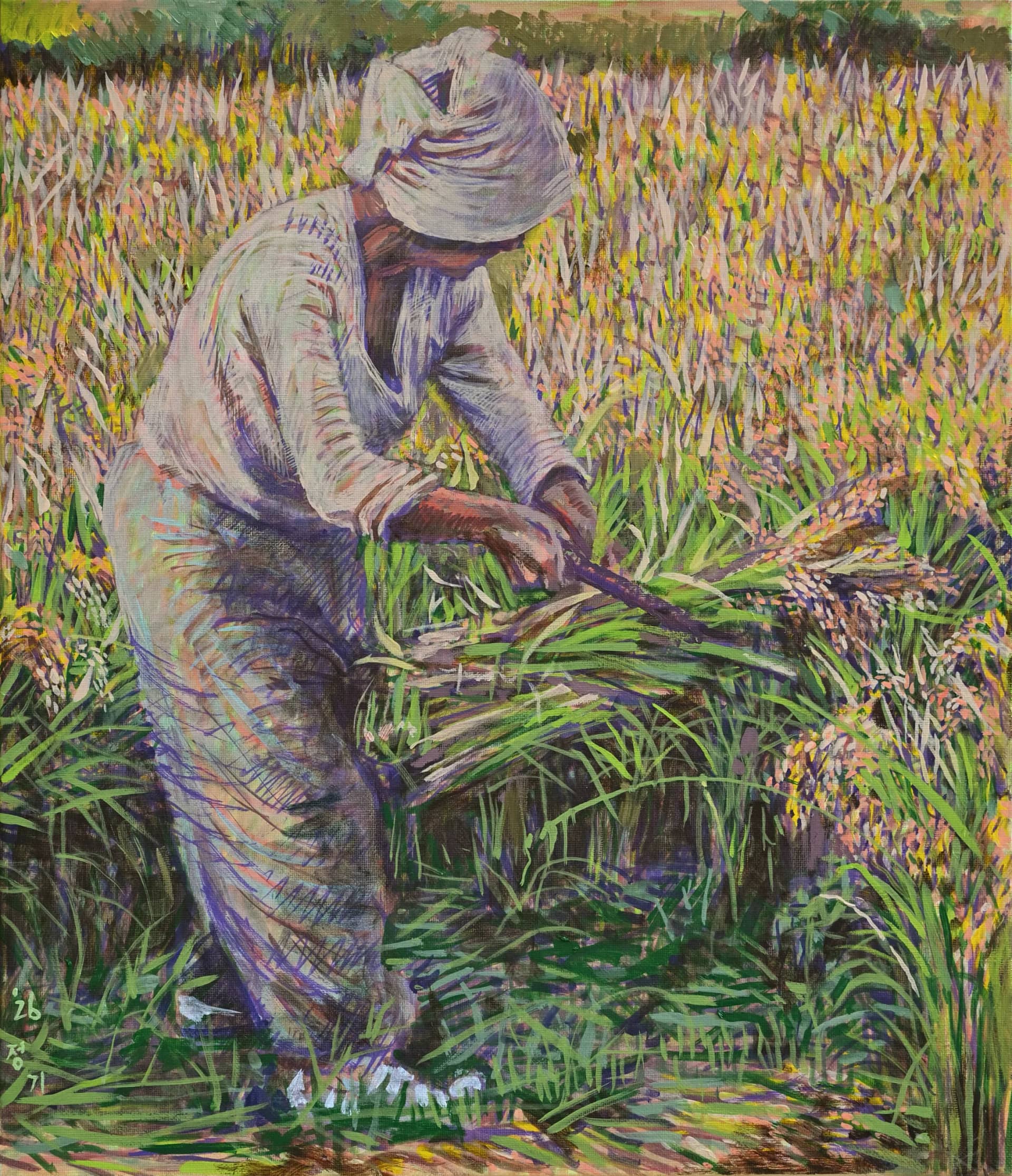
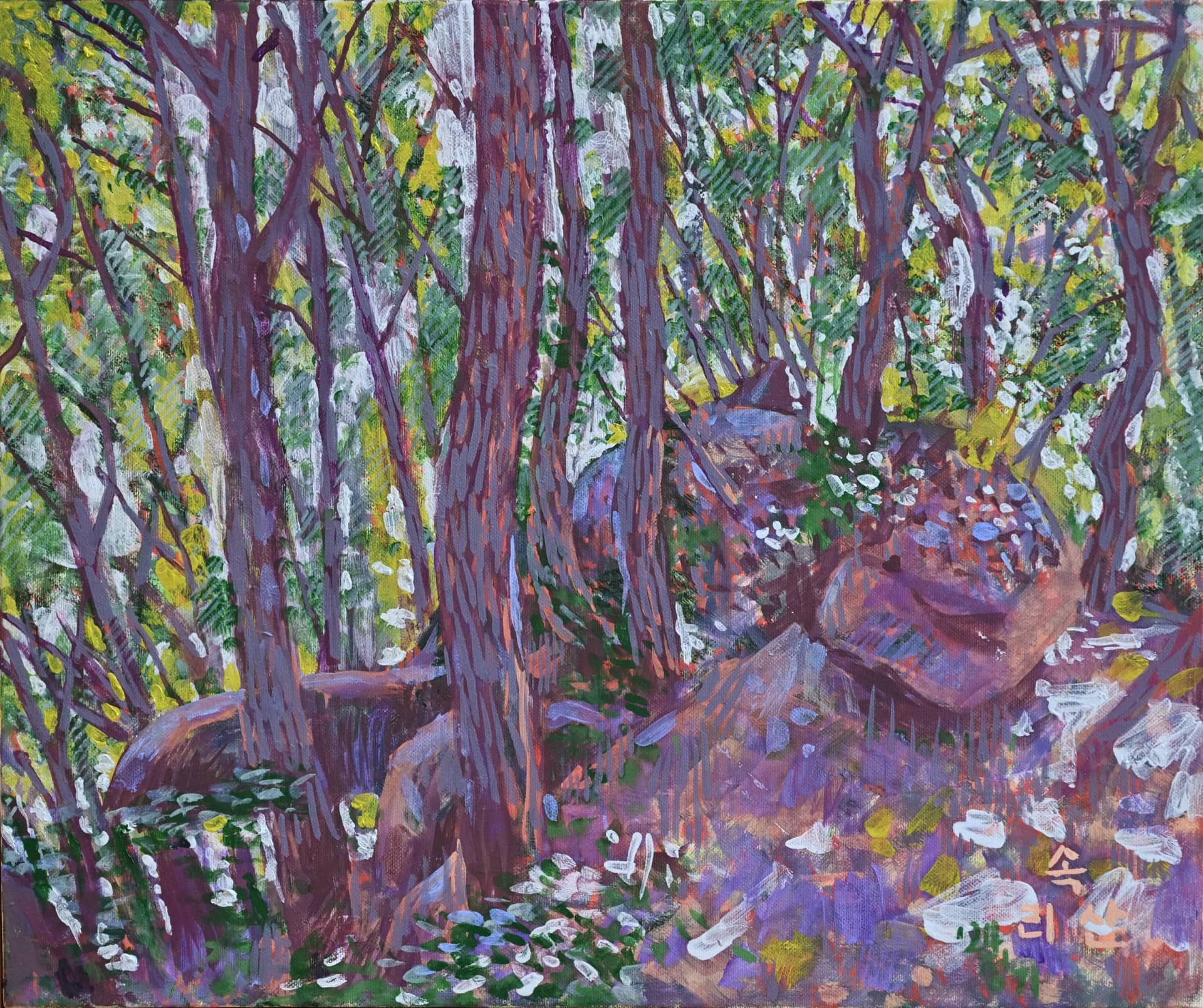
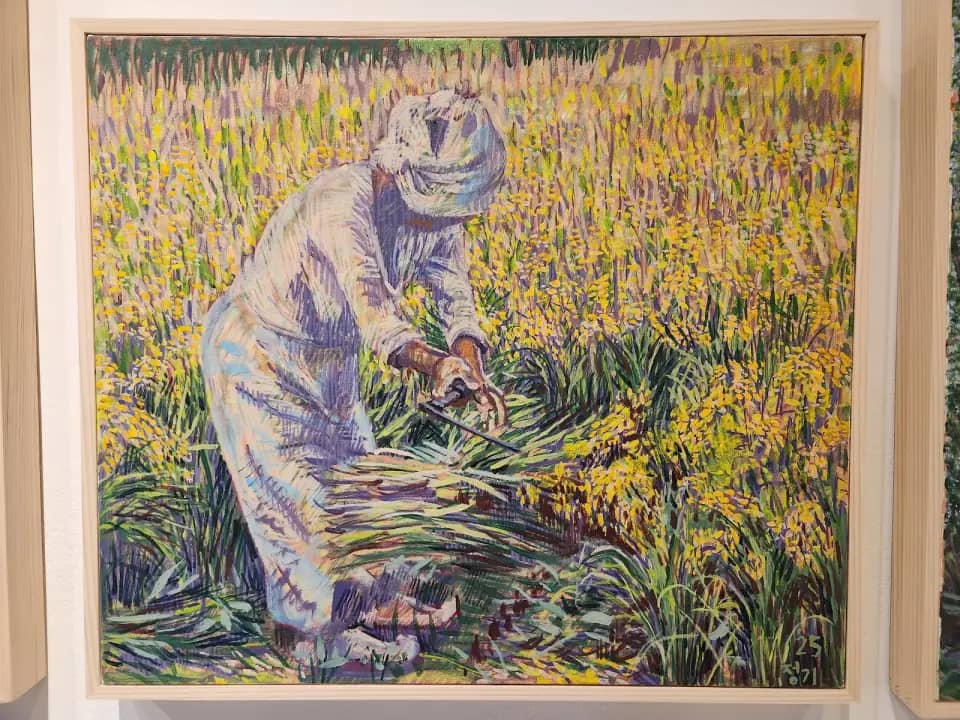
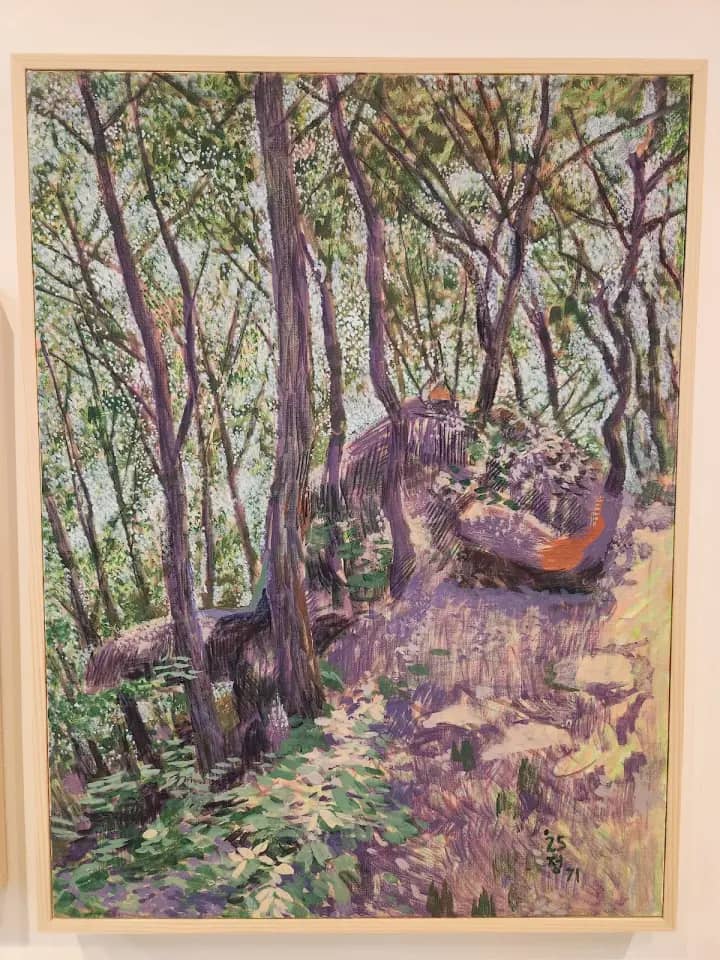
His signature works are panoramic landscape paintings: monumental canvases that stretch across entire walls and pull the viewer inside the hills, paddies, and villages of a Korea in swift transformation. These are not decorative views. They are acts of memory— an artist's refusal to let the agrarian life of ordinary Koreans be erased without record. The land in his paintings is alive with specific light, specific season, specific labor — and it asks us to slow down, look, and remember who built the country we stand in.
Major themes
- 1
Korean landscape
Panoramic canvases preserve the hills, paddies, and villages of a Korea in rapid transformation.
- 2
People's lives
The land is never empty — it carries the specific labor and memory of the people who worked it.
- 3
Reality and memory
Rooted in direct observation, his work transforms seen places into collective memory that outlasts the places themselves.
The artist's timeline
- 1949Born in Seoul (Seodaemun-gu).
- 1972Graduates from Seoul National University College of Fine Arts (Western Painting).
- 1979Co-founds Reality and Utterance (현실과 발언) alongside Oh Yoon and others; inaugural group exhibition opens 17 October 1980 at Munye Jinheungwon Art Hall — with candles, after venue authorities cut the electricity.
- 1980s"Barber-shop paintings" draw attention: anti-aesthetic oil paintings reproducing kitschy mass-culture imagery as critique of official abstract formalism.
- 1984Completes graduate studies (Western Painting) at Seoul National University.
- 1987Moves studio to Yangpyeong, Gyeonggi (winter 1987) — converts a cowshed into workspace; long-term immersion in actual landscape begins. Many artists subsequently established studios in the area.
- 1990sShifts to actual-scene landscape painting (실경 산수) — merging the jinggyeong tradition with humanistic reading of land history and geography.
- 2006Receives the 18th Lee Jung-seob Art Award; commemorative exhibition held at Chosun Ilbo Art Museum in 2007.
- 2018「Panoramic View of Bukhansan」 (2007, MMCA collection) displayed at Peace House, Panmunjeom, during the inter-Korean summit — seen worldwide behind the two heads of state.
- 현재Continues working in Yangpyeong. Works held in the National Museum of Modern and Contemporary Art (MMCA), Seoul Museum of Art, and other major institutions.
Selected exhibitions & collections
- Solo exhibition, Kumho Museum of Art (2016) — new and selected works including panoramic landscapes of Seoul waterways
- Solo exhibition, Kukje Gallery (Jan–Mar 2019) — retrospective and new works spanning 40 years of landscape practice
- Archive exhibition "Landscape I Cannot Let Go," Yangpyeong County Art Museum (2024)
- 18th Lee Jung-seob Art Award (2006); commemorative exhibition, Chosun Ilbo Art Museum (2007)
- Permanent collection: National Museum of Modern and Contemporary Art, Korea (MMCA) — including 「Panoramic View of Bukhansan」 (2007); also Seoul Museum of Art and other major institutions
Prints (woodblock, screenprint) offer a more accessible entry point alongside major paintings.
Three essays —
on the work and its witness
1Reality and Utterance — the 1980s, when art had to speak
In late 1979, as Korea's political climate lurched from the assassination of President Park Chung-hee into the military coup of December 12th, a group of young artists and critics gathered with a shared conviction: Korean art had grown blind to the world outside its studios. The collective they formed — twelve artists including Min Joung-ki, Oh Yoon, Im Ok-sang, and Ju Jae-hwan, together with four critics — called themselves Reality and Utterance (현실과 발언).
Their inaugural exhibition opened on 17 October 1980 at the Munye Jinheungwon Art Hall in Seoul. On the opening night, the venue authorities — deeming the works politically suspect — turned off all the electricity. The artists lit candles and exhibited anyway. That candlelight exhibition became one of the defining images of Korean minjung art: a refusal, in near darkness, to let art be silenced.
Min's contribution to those early years was his so-called “barber-shop paintings” — oil paintings that deliberately reproduced the unsophisticated, kitschy images typically found on the walls of ordinary Korean barbershops. The gesture was anti-aesthetic in the most precise sense: an argument that the official art world's devotion to abstract formalism was itself a form of cultural exclusion. If the art world prized refinement, Min would bring the street inside. Art, he argued, should communicate in the language ordinary people already knew.
Reality and Utterance remained active through the decade, producing a succession of thematic exhibitions, and dissolved officially in 1990. But its impact lasted far longer: it became the institutional seed of the minjung art movement that reshaped Korean contemporary art through the 1980s, and its archives are now held by the Seoul Museum of Art.
22018 Panmunjeom — 「Panoramic View of Bukhansan」 behind the heads of state
In April 2018, the historic inter-Korean summit between President Moon Jae-in and Chairman Kim Jong-un was held at the Peace House in Panmunjeom. The cameras of the world were fixed on the two men — and on the enormous painting behind them. Min Joung-ki's 「Panoramic View of Bukhansan」 (북한산 전도, 2007), held in the collection of the National Museum of Modern and Contemporary Art (MMCA), had been selected to hang in the ceremonial room.
The painting is a monumental work: over 500-ho in scale (264.5 × 452.5 cm), completed over more than six months. Its approach departs from Western single-point perspective — multiple viewpoints from different times are fused into a single image, so that the mountain is seen simultaneously as it appears from several vantage points and at several seasons. Kim Jong-un, it was reported, asked how the technique was achieved. The mountain in the painting is called Bukhansan — the great mountain that rises on Seoul's northern edge — but it is also, seen from the north, the ridge that signals the capital of the South. In that room, the painting became something it was not painted to be: a landscape of division and the possibility of its ending.
The episode crystallised what Min's landscape practice had long been about: painting the land not as scenery but as territory — as political and historical ground. A work made in Yangpyeong in 2007, from direct observation of a mountain north of Seoul, traveled to Panmunjeom in 2018 and became the backdrop for one of the most-watched diplomatic moments of the decade. The land, in Min's hands, carries more weight than paint.
3After Yangpyeong — painting the land again from scratch
In the winter of 1987, Min Joung-ki left Seoul. He had spent the early part of his career in the urban social satire of the Reality and Utterance years: barber-shop paintings, grotesque cityscapes, the language of mass-culture kitsch deployed as critique. He moved to Yangpyeong and converted a cowshed into a studio. He stayed.
What followed was a decade-long renegotiation with the landscape itself. Yangpyeong sits in the upper Han River basin, ringed by mountains. Direct encounter with that specific topography — walking the ridgelines, sketching in the fields, observing the light change across seasons — pulled his practice away from social allegory and toward actual-scene painting (실경화). From the 1990s, his work drew on the Korean tradition of jinggyeong sansuhwa— “true-view landscape painting” — the practice of painting places as they actually exist rather than as idealized or imaginary scenery.
But Min's approach departed from simple realism. His panoramic compositions fuse multiple viewpoints and time-layers into a single image: what appears on the canvas is not any single walk through a landscape but a humanistic synthesis — the history of the place, the labor embedded in its terrain, the slow accumulation of time that makes a mountain more than rock and light. The land in his paintings is read, not merely seen.
The effect of his move extended beyond his own practice. Over the years, more than three hundred artists established studios in the Yangpyeong area, drawn in part by the precedent he had set. He had opened the cowshed and stayed; they followed. In this respect too, Min Joung-ki embodies the spirit of this campaign — not as a subject of hardship but as someone who made conditions possible for those who came after.
From the candlelight exhibition of 1980 to the Peace House at Panmunjeom in 2018, Min Joung-ki's work has moved between the street and the mountain, between protest and panorama — always asking the same question: what does this land carry, and who has carried it? He joins this campaign not as a subject of financial hardship but as a fellow artist in solidarity, so that those who come after can do the work without the obstacles he had to clear.
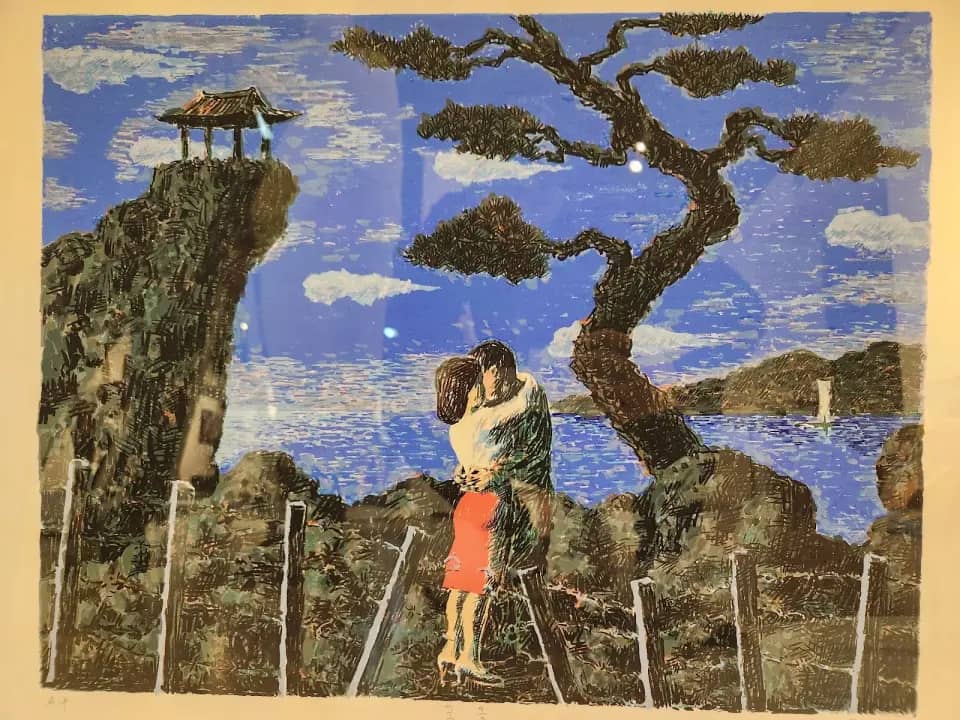
Selected Works
6 works are featured here.
Min Joung-ki joined this campaign in solidarity with fellow artists. Every work sold flows directly into the artists' mutual-aid loan fund— a purchase becomes the next month's lifeline for an artist navigating financial exclusion today.