Like Trees,
Like People
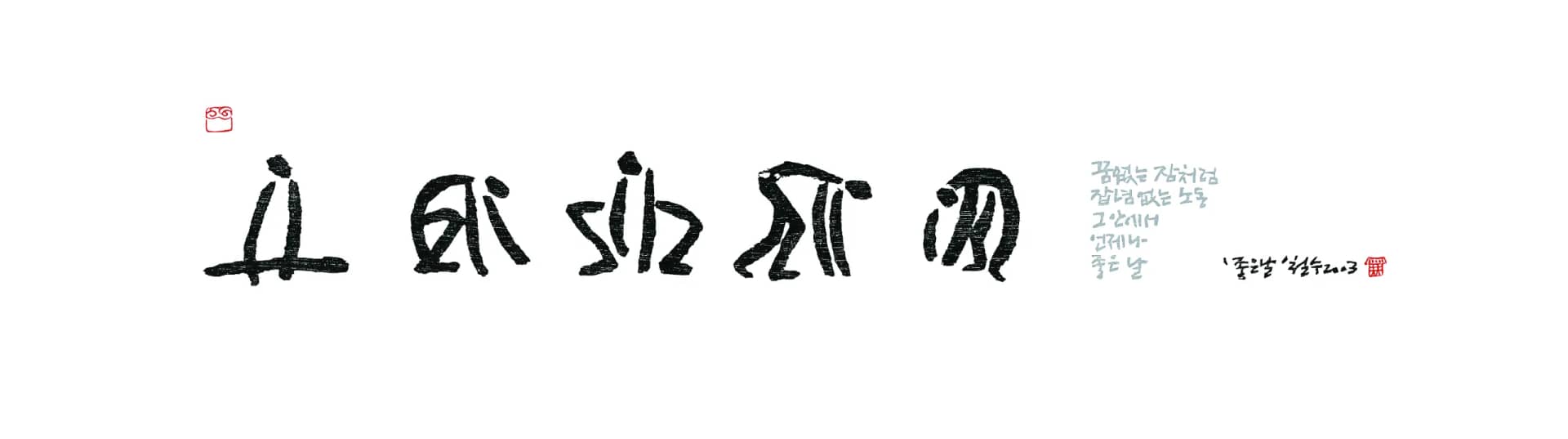
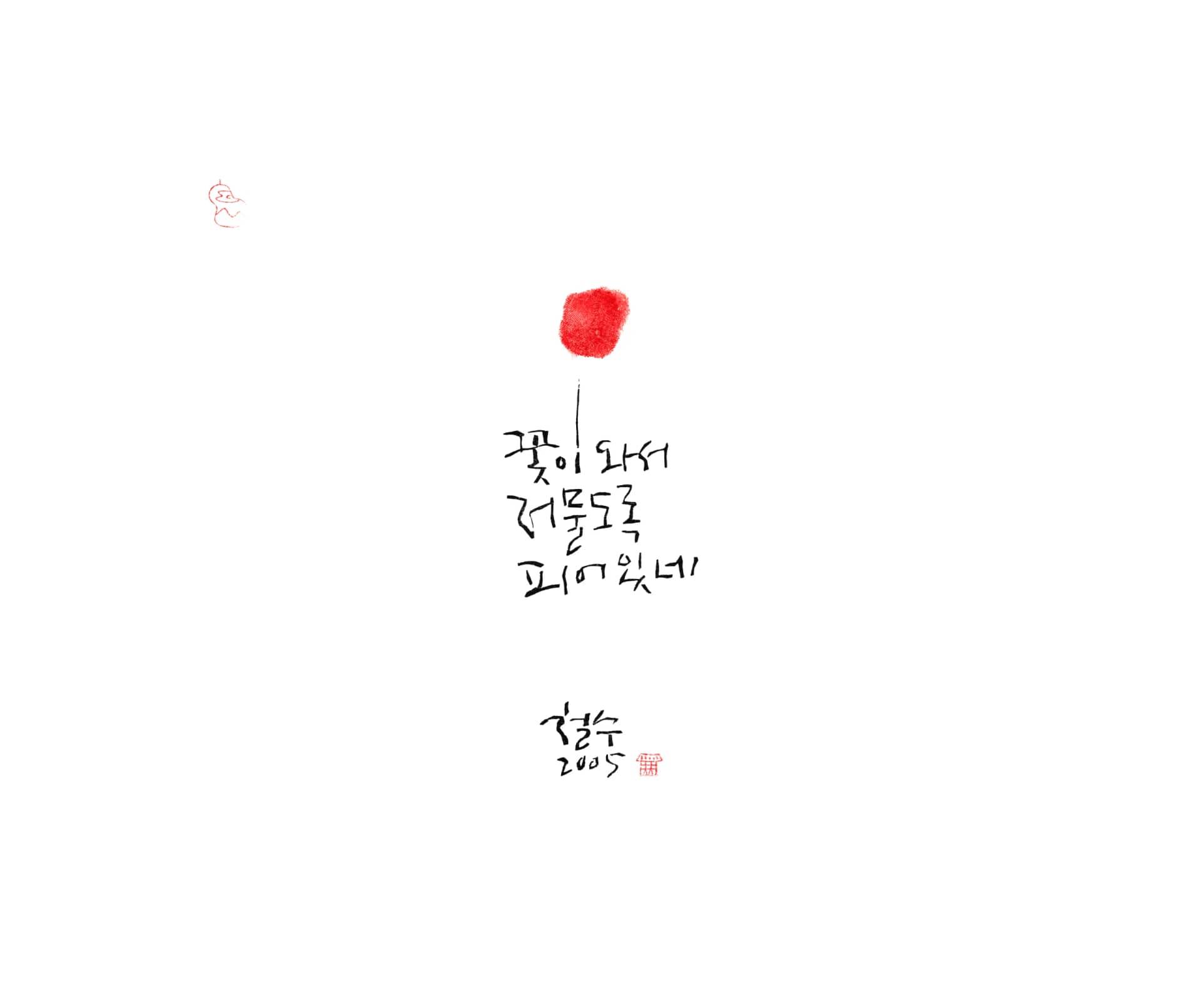
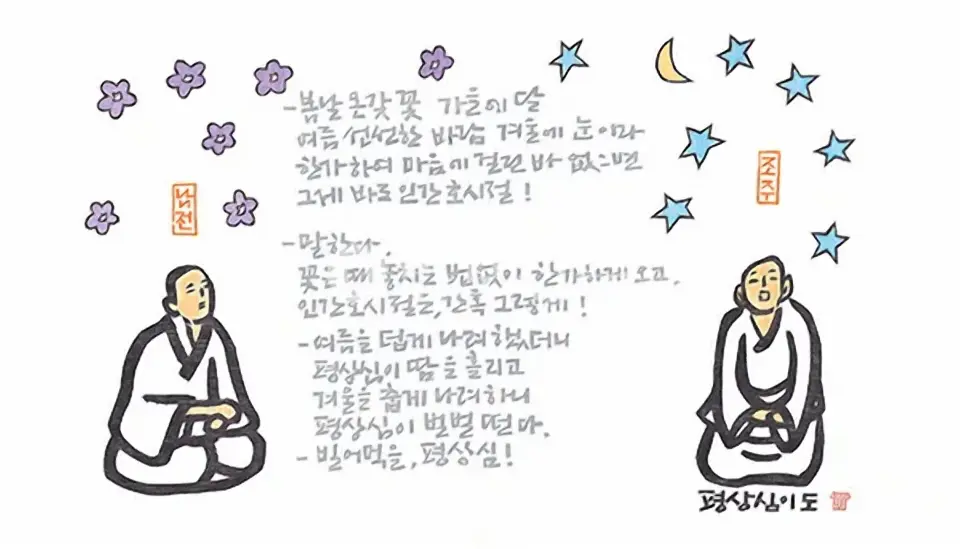
A single cut. A short phrase. A whole life.Lee Chul-soo's woodblock prints find you where you least expect them.
“I want to awaken inner stillness and reflection in a way anyone can feel in everyday life. This is returning art to those who are weary of living — and I think it is the affection I had long neglected for people.
One cut, one phrase —
art that lives outside museums
Lee Chul-soo (b. 1954, Seoul) occupies a singular place in Korean art: he is the artist whose work most Koreans have lived with, without necessarily knowing his name. His woodblock prints — a bird on a bare branch, two hands cupped together, a single leaf in wind — have appeared on calendars, postcards, book covers, and the walls of ordinary homes across the country for four decades.
He held his first solo exhibition at Gwanhun Gallery, Seoul, in 1981 — and the career that followed was built not through institutions but through persistence and reach. By the 1980s he was counted, alongside Oh Yun, as one of the generation's defining minjung printmakers: artists who understood the woodblock as a medium for speaking directly to people who had no reason to enter a gallery.
In 1987 he left Seoul and relocated to Baekun-myeon, Jecheon — a rural area in North Chungcheong province — to farm alongside his wife. It was a decisive move. From around 1988, the work began to shift: away from overt social critique and toward self-reflection, daily life, and the rhythms of the natural world. The blade still cut; the message became quieter and, for that reason, more widely heard.
What makes his work travel so far is precisely its restraint. Each print begins with stripping away: the image reduced to its simplest form, the accompanying phrase pared to its fewest syllables. The result is something that feels both complete and open — a frame the viewer can step into.
Over four decades of sustained practice, Lee has produced a vast body of woodblock prints — thousands of works — alongside murals and postcard illustrations. He describes his prints as “daily confession and self-examination.” The most democratic art, he has shown, is not one that argues — but one a market vendor, a factory worker, and a student can each quietly take home.
Major themes
- 1
Trees and people
Nature and humanity mirror each other — a single branch holds as much life as a human life does.
- 2
Text and image
Short calligraphic phrases and woodblock images fuse into one — each work a small, self-contained poem.
- 3
Folk lyricism
Simple lines carry the feelings most widely shared — his prints hang in homes precisely because they need no explanation.
The artist's timeline
- 1954Born in Seoul.
- 1981First solo woodblock print exhibition at Gwanhun Gallery, Seoul — launching a career defined by accessible, lyrical prints.
- 1980sWork rooted in minjung art sensibilities while charting an independent path in text-image fusion (서화).
- 1987Relocates to Baekun-myeon, Jecheon, North Chungcheong — farming alongside his wife; printmaking and daily life become inseparable.
- 1988–Work shifts from social critique toward self-reflection and nature. Annual print calendars and leaf-letter postcards reach a mass audience.
- 1989International solo exhibitions in Germany and Switzerland; group exhibition at Original Print Gallery, Dublin (Ireland).
- 2002“Leaf Letters” (나뭇잎편지) online community launched; membership grows to over 60,000 — bringing his prints directly into subscribers’ daily lives.
- 2021Solo exhibition 〈Was It a Door? — Back to the Road〉 (문인가 하였더니, 다시 길), Insa Art Center, Seoul — 98 works including the 〈Mugwangwan〉 series.
- 2024Solo exhibition for the Jeon Tae-il Medical Center building fund, Insa Art Center, Seoul (Nov 2024) — 58 works; continues working in Jecheon. Official shop: mokpan.com
Selected exhibitions & collections
- First solo exhibition, Gwanhun Gallery, Seoul (1981); second solo, same venue (1985)
- "Not a Trivial Life" solo exhibition (2020); "Was It a Door?" solo exhibition (2021)
- Solo exhibitions in Germany and Switzerland (1989); group exhibition at Original Print Gallery, Dublin, Ireland (1989); further international group exhibitions in Hungary, Spain, France, Belgium, Italy, Kazakhstan, United States and South Africa (first retrospective) and others
✦ Accessible entry points to the collection
Print postcards and annual print calendars are widely available — making Lee Chul-soo one of the most accessible artists in the collection. Original works also available via mokpan.com.
Three essays —
on the blade, the farm, and the letter
11980s — resistance carved with a blade
When Lee Chul-soo held his first solo exhibition at Gwanhun Gallery in 1981, Korean society was living under military authoritarian rule and the aftershock of the May 18 Gwangju Uprising of 1980. The woodblock print had emerged, for a generation of young artists, as the medium closest to the street: cheap to reproduce, durable, capable of being pressed onto cheap paper and handed directly to people. Lee was counted — alongside Oh Yun — as one of that generation's defining minjung printmakers.
What distinguished Lee's 1980s work was not spectacle but intimacy. Even in his most politically engaged period, the imagery tended toward the human figure in its ordinary postures: bent at labour, resting, reaching. The woodblock, for Lee, was never merely a political instrument — it was already a practice of paying attention, of looking carefully enough at a person or a tree or a gesture that it became worth cutting into wood.
By 1989 his work was traveling internationally. Solo exhibitions in Germany and Switzerland, and an invitation from the Original Print Gallery in Dublin, Ireland, signaled that the formal economy of the Korean minjung woodblock had a legibility beyond the peninsula — that a single cut, a single phrase, could cross language.
2Jecheon — the printmaker who farms
In 1987 Lee Chul-soo left Seoul and moved to Baekun-myeon, Jecheon — a small township in the mountains of North Chungcheong province — to farm alongside his wife. It was not a retreat from art but a redefinition of the conditions under which art could be made honestly.
From around 1988, the work shifted. Overt social critique gave way to self-reflection, to the daily rhythms of rural life, to what he has called the practice of ordinary days as contemplation. The images grew quieter: a mushroom after rain, the angle of a branch in winter, the weight of a bowl. The accompanying phrases grew shorter. He has described his prints of this period as “daily confession and self-examination” — the blade as a tool for honesty rather than argument.
The farm did not separate Lee from society; it relocated the terms of the encounter. Living outside the art-world economy of Seoul, growing food, cutting blocks in the same hours, he arrived at a practice that was both deeply rooted and surprisingly portable. Over four decades the Jecheon studio has produced thousands of woodblock prints — and a body of work that has found its way into more Korean homes than almost any other living artist.
3Calendars and letters — art that finds you outside the gallery
For most Koreans, the first encounter with Lee Chul-soo's work did not happen in a gallery. It happened on a kitchen wall — in the square of a print calendar — or in the palm of a hand holding a postcard. This is not accident. It reflects a conscious strategy, developed across decades, of placing the work where people already are.
The annual Lee Chul-soo print calendar, published continuously since at least the early 2000s, has become one of the longest-running artist-calendar traditions in Korean publishing. Each year a new set of woodblock prints structures the months, bringing seasonal imagery and a short phrase into hundreds of thousands of homes. In 2002 he launched the online “Leaf Letters” (나뭇잎편지) community — a digital extension of the postcard tradition — which grew to over 60,000 members, each receiving a print image and text directly into their daily life.
The effect has been to make Lee Chul-soo the most distributed artist in Korean everyday life — not through institutional acquisition but through the postal system, the bookshop, and the screen. His official shop mokpan.com continues this logic: original works available directly, without gallery mediation.
From the minjung galleries of 1981 to the Jecheon farm studio of today, Lee Chul-soo has pursued a single question: what is the simplest form in which a human truth can be cut into wood and handed to a stranger? Over forty years, that question has produced a body of work unlike any other in Korean art. He joins this campaign not as a subject of its cause but as a fellow artist in solidarity — so that those who come after might work without barriers he never chose.
Selected Works
3 works are featured here.
Lee Chul-soo joined this campaign in solidarity with fellow artists. Every work sold flows directly into the artists' mutual-aid loan fund— a purchase becomes the next month's lifeline for an artist navigating financial exclusion today.