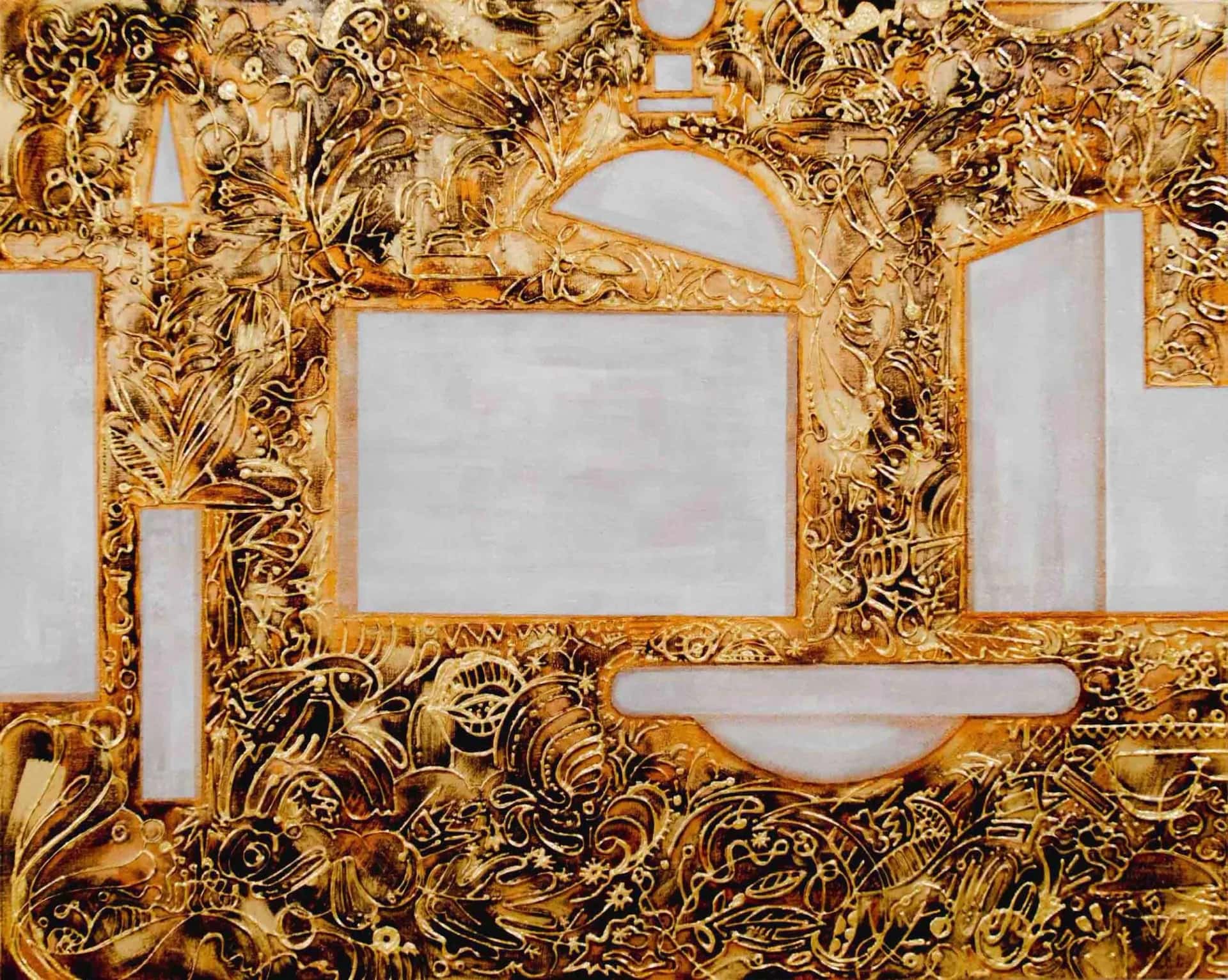
Gold leaf is real gold beaten to 0.0001mm. Following Korea's golden grain from Goryeo Buddhist paintings to Choi Hyesu's "Playground" and Joirak's "Golden Flower."
The Craft of Gold Leaf
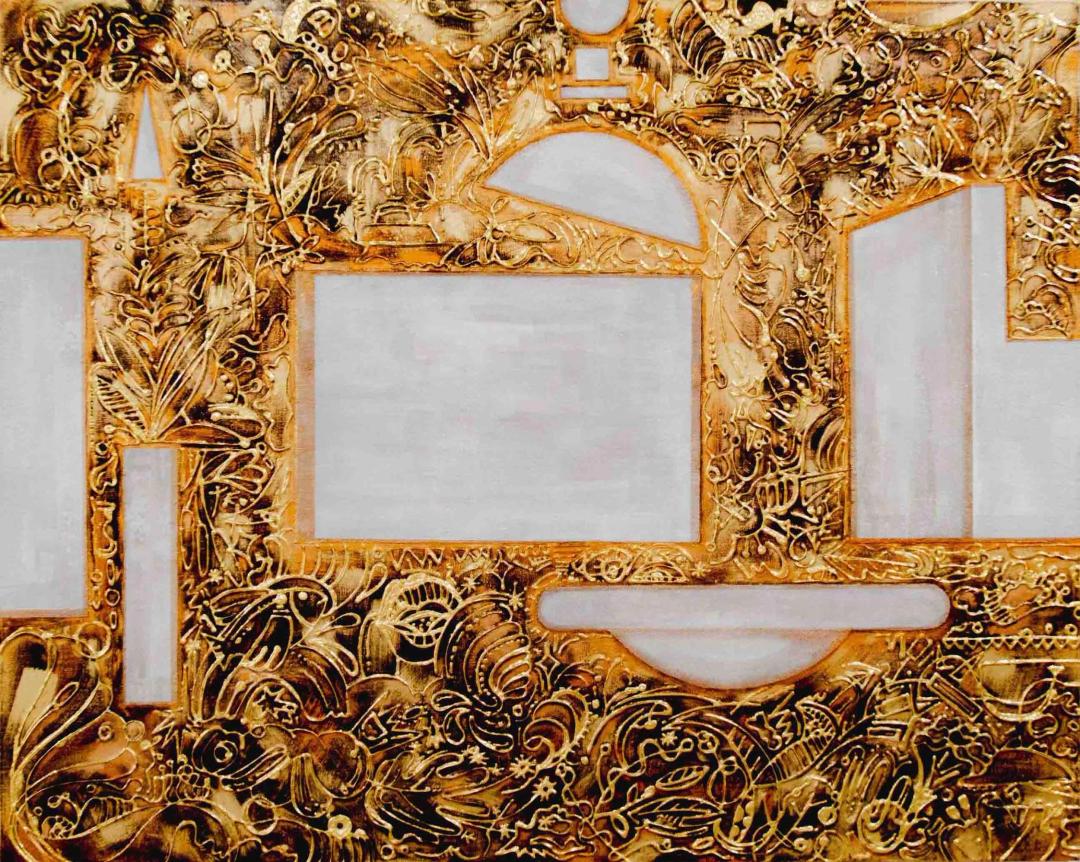
Gold leaf is real gold beaten down to 0.0001mm — a hundred nanometers thick. That is one seven-hundredth the diameter of a single human hair. So thin that it reflects light while still letting some pass through, this metal has been entering Korean art for more than a thousand years. The halos of Goryeo Buddhist paintings, the gilded objects of Joseon folk paintings, the golden grain in dancheong. And now, contemporary artists are laying that same gold leaf onto canvas once more.
This essay surveys the materiality of gold leaf, its thousand-year history in Korean art, and how it functions in contemporary works such as Choi Hyesu's Playground and Joirak's Golden Flower.
What Is Gold Leaf?
Real gold, beaten into paper
Gold leaf is a sheet of 24K (99.9%) or 22K pure gold hammered until extraordinarily thin. Kanazawa leaf in Japan, Jeonju and Jinan leaf in Korea, Florentine leaf in Italy — every place of origin carries traditions older than a millennium. A single standard sheet measures roughly 10x10cm, and one gram of gold can be beaten into 0.5 to 1 square meter of leaf.
Genuine vs. imitation leaf
Not every "gold leaf" is gold.
| Item | Genuine Gold Leaf | Imitation / Schlag Leaf |
|---|---|---|
| Material | 24K or 22K pure gold | Copper-zinc alloy (brass) |
| Color | Warm yellow, never oxidizes | Similar yellow, oxidizes and turns greenish over time |
| Price | KRW 5,000–10,000 per sheet | KRW 100–300 per sheet |
| Permanence | Over a thousand years | 5–20 years without protective coating |
| Handling | Extremely delicate; static and breath will lift it away | Comparatively easier to handle |
Because of gold's elemental stability, genuine leaf holds its color for thousands of years. Imitation leaf, being an alloy, oxidizes and discolors. Serious collectible work and cultural-property restoration always use genuine gold; in contemporary painting, where material costs are heavy, imitation leaf is more common.
How gold leaf is laid down — lacquer, hide glue, mixtion
Gold leaf does not adhere to a surface on its own. It needs an adhesive, and three have been principal in Korean tradition: lacquer, hide glue, and mixtion (an oil-based size).
- Lacquer: the most traditional, preserving gold for over a thousand years
- Hide glue: standard in Korean painting, often paired with mineral pigments (seokchae)
- Mixtion: a Western tradition, often used by contemporary artists as well
A Thousand Years of Gold Leaf in Korean Art
1. The halos of Goryeo Buddhist painting
The summit of gold leaf in Korean art is Goryeo Buddhist painting (13th–14th century). In the Buddhist paintings preserved in the museums of Kyoto and Nara, the gold leaf laid on the halos of Buddhas and Bodhisattvas still glows with warm light eight hundred years on. Its endurance through time comes from a triad: lacquer adhesive, silk ground, and layered gold leaf.
2. Gold pigment in Joseon folk and court painting
In the Joseon dynasty, a liquid form — geumni, finely ground gold powder mixed into hide glue — came into wide use. In the lavish objects of folk painting, the robes of court documentary painting, and palace ornament, geumni was no mere decoration but a promise: a color that would withstand time.
3. The golden grain of dancheong
The dancheong on the eaves and columns of Gyeongbokgung and Changdeokgung was made by combining mineral pigments with patches of gold leaf and geumni. The gold caught the sun so that its glow could be seen from far away — not an aesthetic flourish alone, but a political medium that made the dignity of the palace visible.
4. Gold leaf in temple architecture
In Korea's great temples — Tongdosa, Haeinsa, Songgwangsa — the dancheong of main halls and the gilding of Buddhist statues are still re-leafed on a regular cycle. Restoring leaf lifted by wind and weather every five to ten years is traditional Korean craftsmanship in its present continuous tense.
Two Registers of Gold Leaf in Contemporary Practice
1. Choi Hyesu — the collision of cement and imitation leaf
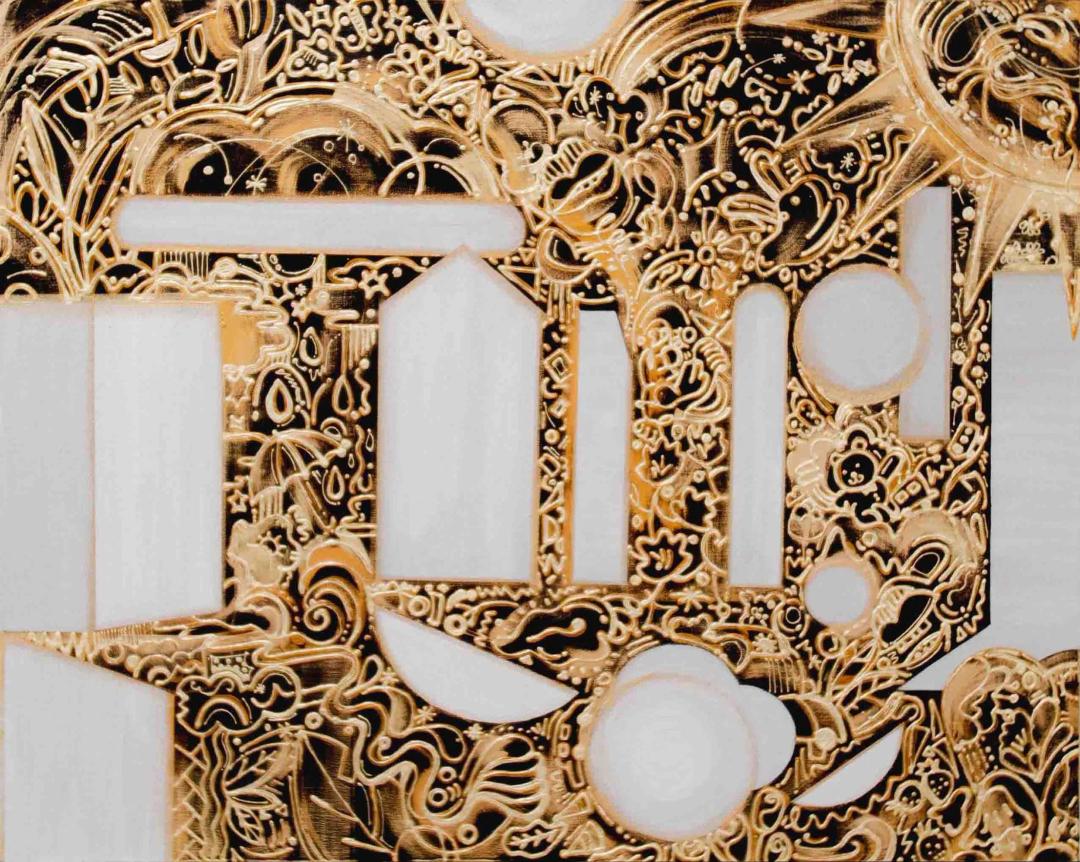
Choi Hyesu's Playground series lays imitation gold leaf onto cement, the most urban and industrial of materials. As warm gold collides with the cold gray of cement, the dryness of the city and the memory of childhood playgrounds meet on the same surface.
- The intent of material collision: cement (cold, industrial) ↔ imitation leaf (warm, traditional)
- Why imitation leaf: in a contemporary painting, the cost of genuine gold doesn't fit; imitation leaf better serves the concept (the false golden age of the playground)
- Surface treatment: a wax coating over the leaf slows oxidation and modulates surface sheen
2. Joirak — mineral pigment and gold on silk, the Korean tradition
The gold seen in Joirak's Golden Flower (mineral pigment on silk) is most likely geumni or genuine gold leaf. Combining mineral and metallic pigments on the most traditional of grounds — silk — places this work in a direct line of descent from Goryeo Buddhist painting and Joseon polychrome work. Read alongside Joirak's Poppies, it becomes clear how the artist carries a Korean traditional medium into contemporary flower-and-bird painting (hwajodo).
3. What the two registers reveal
Choi Hyesu's imitation leaf and Joirak's genuine gold are the same yellow metal, yet they belong to entirely different registers. One is the conceptual deployment of gold in contemporary urban painting; the other is direct inheritance of Korean tradition. Comparing the two makes plain that gold leaf is not merely a material but a medium that discloses the artist's position within art history.
Four Effects Gold Leaf Brings to a Work
1. Active reflection of light
Where every other pigment merely absorbs or scatters light, gold leaf reflects nearly the entire visible spectrum. The surface no longer simply receives light; it throws light back — a quality unique to gold among painting media.
2. The automatic register of sacred and authority
Historically, gold leaf was the medium of religion, kingship, and the sacred. When it enters a contemporary painting, it carries with it — regardless of the artist's intent — a religious, historical, and classical weight. Whether to use that weight or twist it is a contemporary artist's choice.
3. A promise that withstands time
A work bearing genuine gold leaf carries the character of a trans-generational asset. A century from now, when canvas pigments may have shifted, the gold will remain. This shows up in valuation as well.
4. A depth that cannot be carried into the digital
The core effect of gold leaf is a sheen that changes with the angle of light. A photograph captures only one angle, one moment — gold leaf must be encountered in person for its depth to come through. In the age of NFTs and digital painting, this is precisely what sets gold-leaf work apart.
Living with Gold-Leaf Work — Five Practical Notes
1. Genuine and imitation leaf require different care
- Genuine leaf: tolerates direct sunlight, heat, and humidity; an ordinary living room is fine
- Imitation leaf: even when the artist has applied a protective coating (wax, acrylic), keep it away from direct sunlight and high humidity to retard oxidation
2. Never touch the surface
Gold-leaf surfaces are extremely sensitive to fingerprints and oils. A single touch can leave a mark that lasts a lifetime. Cotton gloves are mandatory when moving or cleaning.
3. Clean only with a dry brush
If dust accumulates, brush it away gently in one direction with a soft, dry brush. Never use a damp cloth or any cleaning agent — they will scrape the leaf away.
4. Framing — keep glass and mat off the surface
The leaf is soft enough that direct contact with glass or matting will leave marks. A shadow box that holds a 3–5mm gap is essential.
5. Insurance is recommended
Genuine leaf carries significant material cost in itself. For works above KRW 10 million, fine-art insurance (e.g., Hanwha or Samsung Fire's fine-art comprehensive coverage) is worth considering.
Frequently Asked Questions
Q. Is gold-leaf work more expensive than ordinary painting? A. Genuine gold typically pushes prices 1.5–3 times higher, because both material cost (tens of thousands of won per gram) and difficulty rise. Contemporary work using imitation leaf sees a smaller premium, but the final price depends on the artist's intent and execution.
Q. Can a gold-leaf work be substituted by an NFT or a digital print? A. Not at all. The essence of gold leaf is the time-shifting play of physical light, which cannot be carried into digital media. If anything, the digital era only sharpens what makes gold-leaf work distinctive.
Q. What if a piece of leaf comes loose? A. Don't touch it — call the artist or a conservator. Amateur reattachment usually enlarges the damage. Many contemporary artists handle leaf repair on their own work, so contact them first.
Q. Is there a difference between Japanese and Korean gold leaf? A. Yes — in thickness, grain, and surface treatment. Japanese Kanazawa leaf is exceptionally smooth and uniform; Korean leaf from Jeonju and Jinan keeps a living grain and a warmer glow. Korean leaf is preferred for restoring traditional Korean works; Japanese leaf for Japanese-style work.
Q. Where can I see and buy gold-leaf work directly? A. Galleries specializing in Korean painting and Buddhist painting (Gana Art, Hakgojae, Gallery Hyundai and others) and contemporary painting galleries regularly handle gold-leaf work. Among the SAF entries, Choi Hyesu's Playground series and Joirak's Golden Flower are excellent starting points for encountering the contemporary registers of gold leaf in person.
Q. What's the difference between geumni and gold leaf? A. Gold leaf is a sheet (a paper-thin film); geumni is a liquid (finely ground gold powder dispersed in hide glue). Leaf is suited to covering planes; geumni to drawing lines and dots. Many works use both together.
In Closing
Gold leaf is the oldest promise we have inscribed across time. The leaf a Goryeo painter laid on silk a thousand years ago and the imitation leaf a contemporary artist lays on cement in 2025 are different temporal variations of the same element — gold.
When a single gold-leaf work throws its light into the corner of a living room, that light is more than sheen. It is the golden grain of a thousand years of Korean art, accumulated.
Related reading
If this piece helped, you may also enjoy these related articles:
Browse contemporary Korean works in gold at SAF →
Meet the Artists

Further Reading

Seed Art Festival
·
