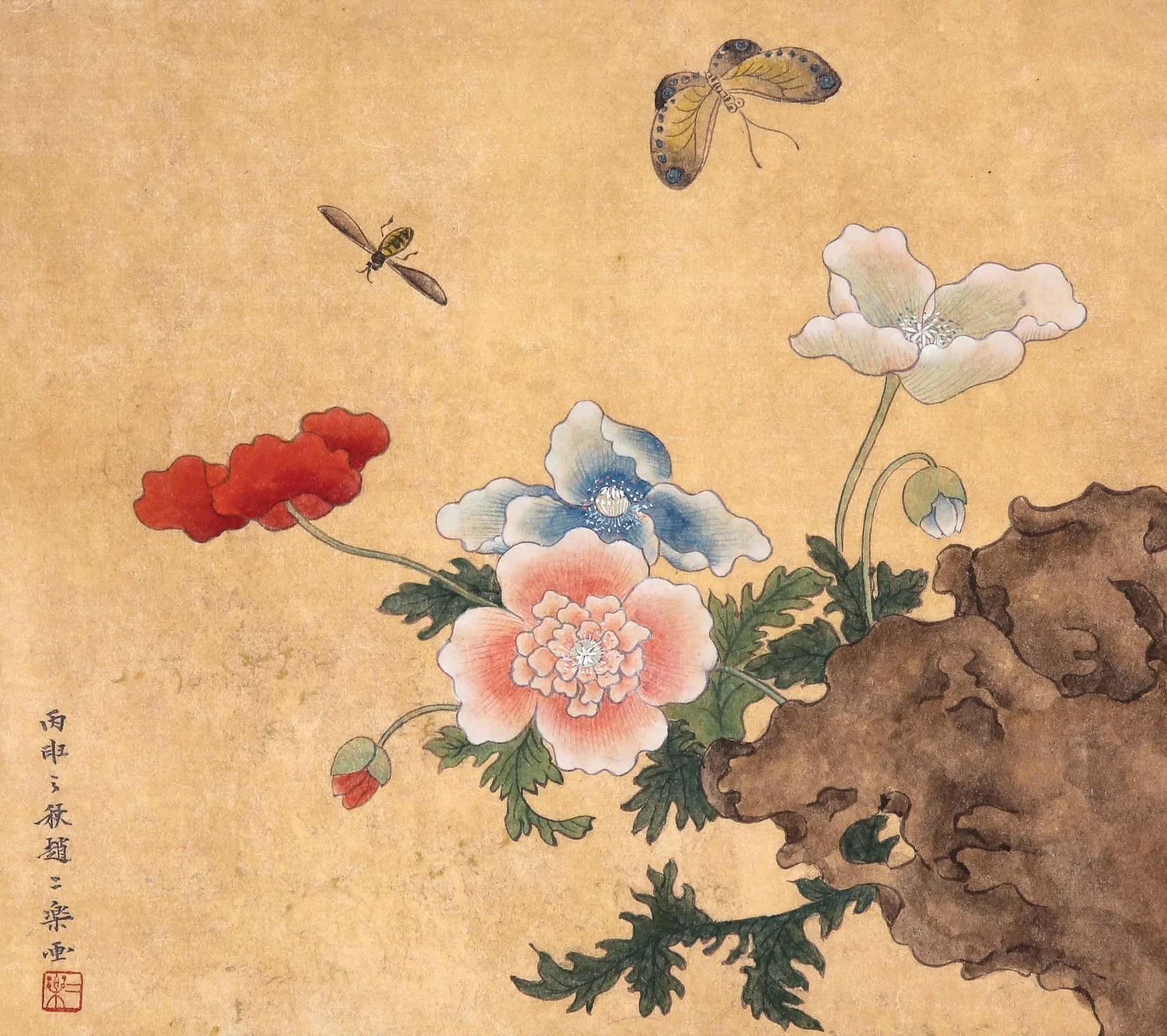
Seokchae (石彩) is pigment ground from minerals — cinnabar, lapis lazuli, malachite. Its colors do not fade in a thousand years. We read the depth of seokchae through Joirak's "Poppy" and "Golden Flower."
The World of Seokchae
Color cannot withstand time. The synthetic pigments in ordinary oil paint break down under light within 50 to 150 years; digital inkjet prints lose their color within 30 to 50. And yet there is a color that does not change after a thousand years — seokchae (石彩), pigment ground from minerals.
The reds, blues, and greens of Goryeo Buddhist paintings still alive after 800 years; the brilliant colors of Joseon court polychromy still untouched by fade — both depend on the physical properties of seokchae. This essay reads the mineralogy, color formation, conservation, and contemporary practice of seokchae through Joirak's Poppy and Golden Flower.
What Is Seokchae?
From mineral to pigment
Seokchae is a pigment made by grinding minerals (stones, crystals, metallic oxides) into powder. The mineral determines the color.
| Mineral | Korean name | Color |
|---|---|---|
| Cinnabar (辰砂) | jinsa | Deep crimson |
| Lapis lazuli (靑金石) | cheonggeum | Deep ultramarine |
| Malachite (孔雀石) | nokcheong | Dark green |
| Azurite (藍銅石) | gunchеong | Blue with violet undertone |
| Pearl powder (珍珠粉) | jinjubun | Subtly luminous white |
| Geumni (金泥) | geumni | Gold (actual gold) |
| Eunni (銀泥) | eunni | Silver (actual silver) |
These minerals are finely ground and graded by particle size, then dissolved in animal-glue water just before application. Seokchae is not a synthesis but a medium that carries the color nature itself made onto the picture plane.
Particle size determines the color
The same mineral produces different colors depending on the coarseness of the grind.
- Coarse particles (粗) — deep, dark colors
- Fine particles (細) — bright, transparent colors
- Ultra-fine particles (極細) — subtle pearlescence and sheen
A painter buys five to seven grades from a single mineral and uses them to build the work's light, shadow, intensity, and softness. From the same lapis lazuli, coarse particles yield a deep ultramarine, fine particles a sky-blue.
Seokchae versus bunchae
These two media are often confused in Korean painting.
| Feature | Seokchae (石彩) | Bunchae (粉彩) |
|---|---|---|
| Source | Natural minerals | Mixture of mineral, plant, animal, and synthetic pigments |
| Particle | Coarse, large | Very fine, small |
| Surface | Lustrous, textured | Flat, matte |
| Color | Deep, dimensional | Even, planar |
| Price | Very expensive (especially natural cinnabar and lapis) | Relatively affordable |
| Permanence | Verified beyond 1,000 years | 100–300 years |
Seokchae is far more expensive and difficult to handle than bunchae. One gram of fine natural lapis lazuli runs into the tens of thousands of won; natural cinnabar can reach hundreds of thousands per gram.
Joirak — Painting Flowers in Seokchae
Poppy — the depth of seokchae on hanji
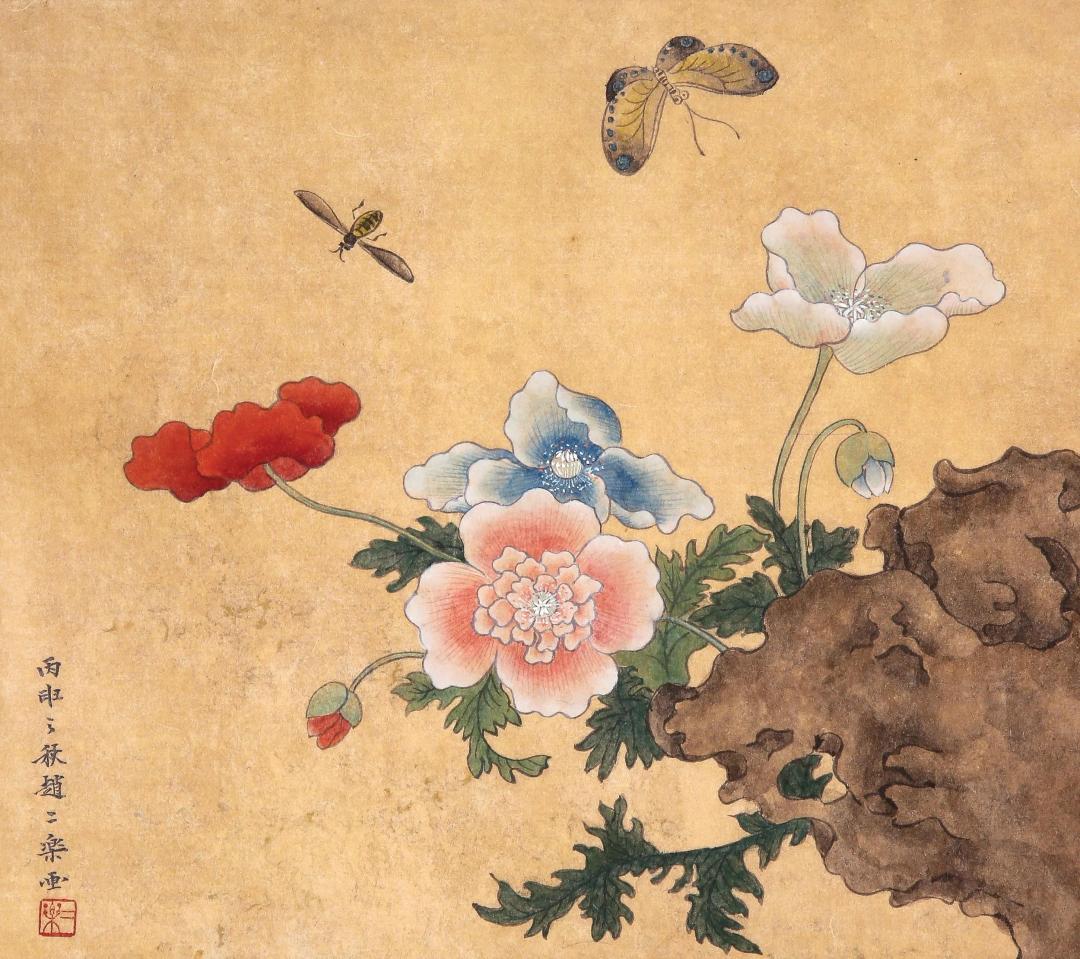
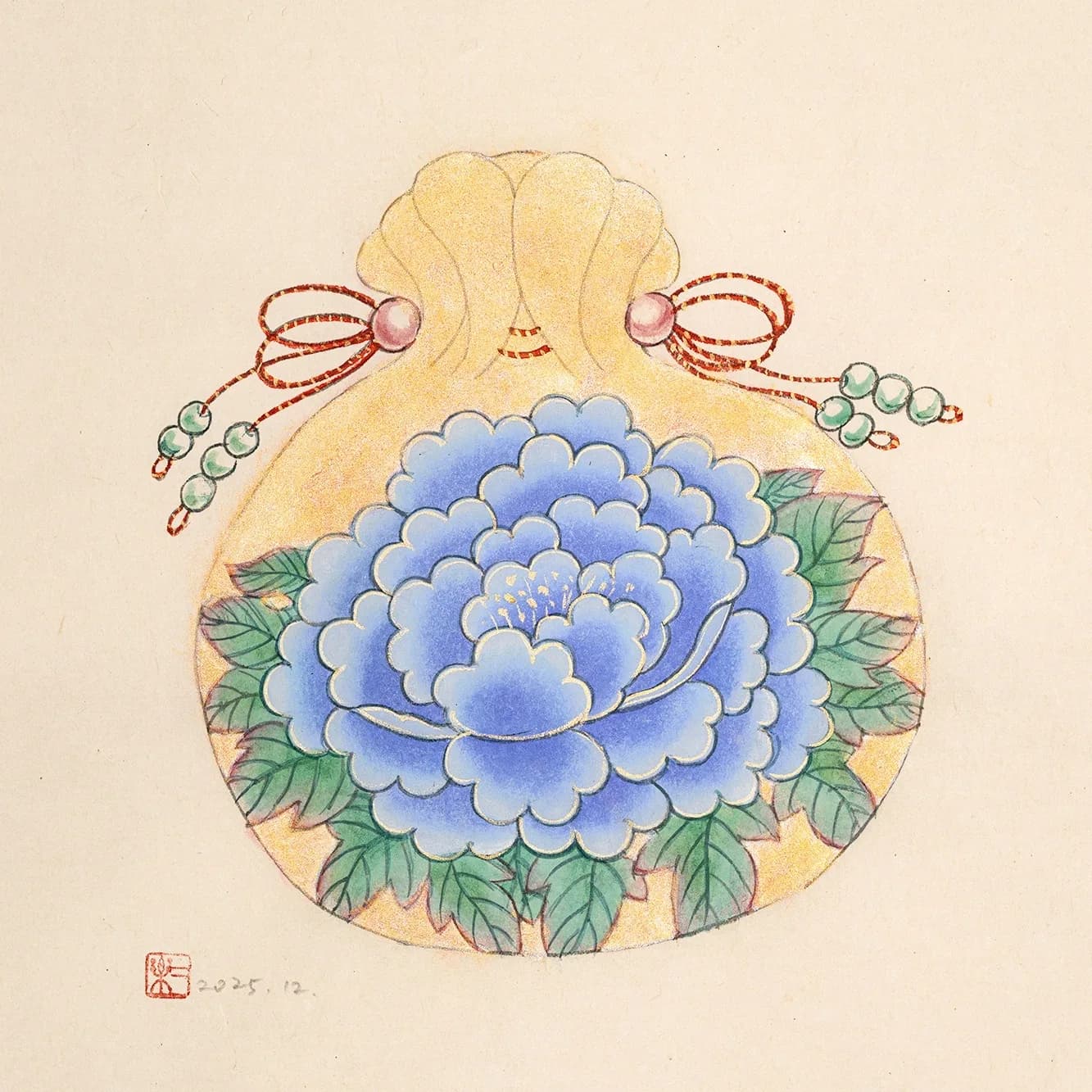
Joirak's Poppy is a contemporary work in the traditional Korean technique of seokchae on hanji. The deep red of the petals comes from cinnabar or its mineral relatives; the deep green of the leaves, from malachite or related greens.
The most striking feature of this work is the faint sheen on its surface. In a digital photograph it appears flat, but standing in front of the actual painting you sense the color shifting subtly with the angle of the light — an effect unique to mineral pigments. Five minutes under living-room light and five minutes under daylight reveal completely different depths in the same work.
Golden Flower — the most resplendent register: seokchae on silk
Joirak's Golden Flower takes another step further: seokchae on silk. Silk (絹) is the most refined surface in East Asian painting — smoother than hanji, and more directly reflective of mineral luster. The gold tones of Golden Flower most likely combine geumni (actual gold powder) with deep yellow minerals.
Silk + seokchae is the most expensive and most orthodox combination in East Asian painting. Goryeo Buddhist paintings and Joseon court polychromy used this same combination, which is why their colors remain alive a thousand years later.
The collecting value of Joirak's work
- Poppy (28x31.5cm, seokchae on hanji) and Golden Flower (27.5x40.5cm, seokchae on silk) are small in scale, but in material cost, technique, and labor they bear comparison with much larger canvas paintings.
- Seokchae works barely fade with time, giving them stronger conservation value than even the same artist's canvas work.
- The most recommended first acquisition for those entering Korean painting — a work carrying "the depth of tradition" makes a strong opening to the collection.
Contemporary Artists Working with Seokchae and Bunchae
Because seokchae is such a demanding material, even among contemporary Korean artists few use it as their primary medium. Among SAF participants who center their practice on mineral pigments (seokchae and bunchae):
- Joirak — seokchae on hanji and silk. Reinterprets the essence of traditional polychromy through contemporary flower-and-bird painting (hwajodo).
- Suh Gong-im — sugan bunchae on hanji. In works like Hero, she addresses figures and historical subjects in bunchae.
- Shin Yeri — bunchae on dyed hanji. Her Eagle, Chaekgeori, Yahyeong-hwajeop-do are contemporary variations on traditional iconography.
- Liho · Oah — bunchae on jangji. Daily life and inner emotion as their subjects (see Color on Jangji — Ahn Eun-kyung).
What each artist focuses on differs — color, texture, traditional iconography, everyday emotion.
Four Effects Seokchae Brings to a Work
1. Color that does not change with time
The core value of seokchae is that the mineral itself is the color. Synthetic pigments break down because their molecular structures collapse under light; minerals are already stable crystalline structures with nowhere left to break down. This is why Goryeo and Joseon paintings retain their colors after six to eight centuries.
2. Depth that shifts with light
The surface of a mineral particle is composed of microscopic crystalline facets that reflect light. These facets reflect light differently depending on angle, so the work's color shifts subtly with where it hangs and how it is lit. Synthetic pigments cannot produce this effect.
3. A faint dimensionality on the picture plane
Because seokchae particles are coarse, they create a delicate texture. Unlike the thick impasto of canvas oil painting, this is the slight relief of mineral grains lifting from the paper or silk. The effect is almost invisible in photographs and visible only in the work itself.
4. Material cost reflected in the work's price
Seokchae works are expensive at the level of the medium itself. The pigment alone for a 30x30cm work in natural lapis or cinnabar can cost hundreds of thousands of won. Adding the artist's labor and time, the price naturally rises — and this carries through into the asset value of the work.
Four Practical Tips for Collecting Seokchae
1. Confirm whether the mineral is natural or synthetic
Not every "seokchae" is from a natural mineral. Industrially manufactured synthetic mineral pigments are sometimes called "seokchae" as well. Natural minerals are vastly superior in permanence and color, but they are also five to ten times more expensive. When collecting, the most accurate path is to ask the artist directly: "Is this pigment from a natural mineral or synthetic?"
2. Framing — protect the mineral surface
The surface particles of a seokchae work can lift off. If glass and matboard touch the surface directly in a standard frame, particles may transfer to the mat or fall away. Always order a deep-cut mat or shadow box that leaves space between the glass and mat and the surface of the work.
3. Avoid direct sunlight and high heat
Mineral pigments are extremely strong against light, but high heat weakens the animal glue that binds them. Above 35°C for prolonged periods (a south-facing summer living room), the binder loosens and pigment can fall. In ordinary domestic conditions there is no problem, but vacation homes, storage spaces, and studios with extreme temperature swings should be avoided.
4. Watch out for vibration in transit
Mineral particles can dislodge under strong vibration. When transporting the work, lay it flat on a rigid surface and never roll it. Loading it into a car trunk without protection can shake fine pigment loose; a dedicated case or thick foam padding is essential.
Frequently Asked Questions
Q. Why are seokchae works so expensive? A. Three reasons. First, natural mineral pigments are very costly. Second, the artist's working time is long — minerals must be sorted by grain size, glue mixed for each session, and layers built one at a time waiting for each to dry. A single work can take months or even a year. Third, conservation value is overwhelmingly higher than for ordinary painting, which changes how the asset is appraised.
Q. Where do you buy seokchae? A. It's not easy for the general public. Artists import from specialist art-material shops in Japan and China, or source them from a small number of specialist workshops in Korea. Tens of thousands to hundreds of thousands of won per color means general art-supply stores do not stock them.
Q. I can't see the artist's signature on the seokchae work. A. In Korean painting tradition, signatures and seals are placed small in a corner of the work or on the back, unlike the conspicuous frontal signatures of Western painting. To a first-time viewer, the work may seem unsigned. Asking the artist for the location is best.
Q. Between seokchae and Dansaekhwa, which is the safer collecting asset? A. They differ. Dansaekhwa has an active market, so liquidity is good but price competition is fierce; seokchae has a narrower market and slower turnover. On the other hand, seokchae has overwhelmingly stronger physical permanence, making it safer as a multi-generational asset. "What you sell now" is Dansaekhwa; "what you pass down" is seokchae — that is the comparison.
Q. How do you clean dust off a seokchae work? A. Don't wipe it. Use a soft brush (sable or hair brush) and brush gently in one direction, or commission a professional conservator. A dry cloth or damp wipe will dislodge mineral or scratch the surface.
Q. For beginners, which is better — bunchae or seokchae? A. Start with bunchae is the usual answer. The price band is lower (₩500,000–₩2,000,000), the material is easier to handle, and you can fully experience the texture of contemporary Korean painting. Once accustomed to collecting Korean painting, the natural next step is seokchae.
In Closing
Seokchae is the most extreme case of material being part of the work. What was painted matters, but what it was painted with matters almost as much. Buying a seokchae work comes close to buying the mineral itself.
Works like Joirak's Poppy and Golden Flower are small mineral collections placed on a corner of the living-room wall. People a thousand years ago made color from the same minerals; people a thousand years from now will see the same color from those same minerals — that thickness of time is held inside a 30cm picture plane.
Related reading
If this piece helped, you may also enjoy these related articles:
Browse seokchae and bunchae works at SAF →
Meet the Artists
Further Reading

Seed Art Festival
·
