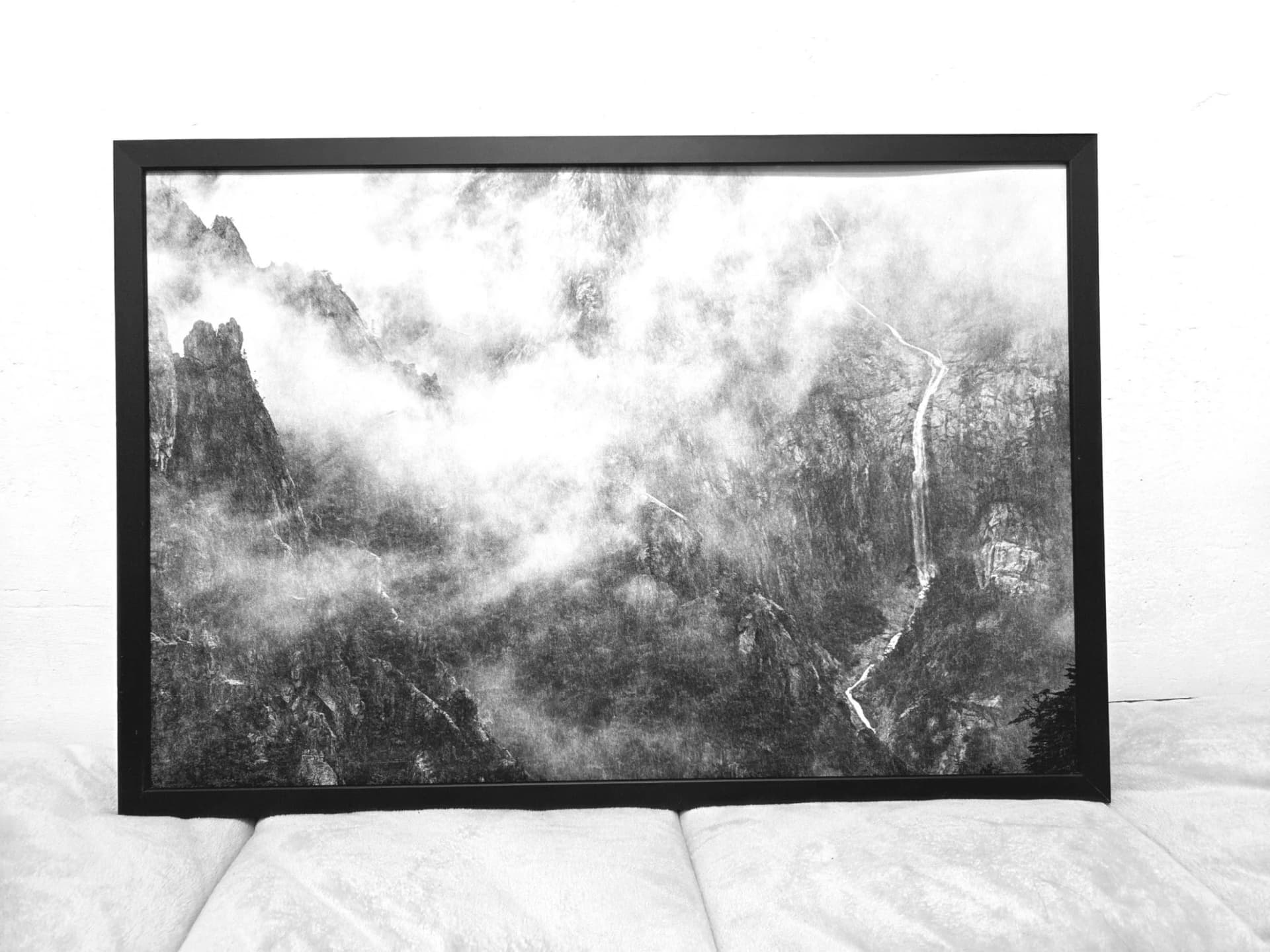
The cliché says digital photographs fade within 30 years. The exception: pigment inks plus archival paper produce 200-year longevity. Reading contemporary photographic media through Kang Le-a's "#01_S1707SP."
Collector path
Works to view after this guide
Use the guide below to understand the work, then compare available artworks in the gallery.

Archival Pigment Print
"Digital photographs fade within thirty years."
This statement is only half true. Standard inkjet prints, instant photos, and images made for social media may fade — but the archival pigment print is another matter. A pairing of pigment ink and conservation-grade paper, with a verified longevity of 100 to 200 years. It is the standard medium contemporary photographers and digital artists use for museum exhibitions, gallery shows, and collector sales.
This article uses Kang Le-a's #01_S1707SP as a focal point to explain what an archival pigment print is, why it endures for two centuries, and how it differs from ordinary digital prints.
What Is an Archival Pigment Print?
Inkjet + Conservation Ink + Conservation Paper
"Archival" means 'suited for long-term preservation.' It isn't simply a picture made on an inkjet printer. It is a print that meets all three of the following conditions:
- Pigment ink — pigment, not dye-based ink.
- Acid-free conservation paper — hanji, cotton paper, or Lightjet paper at pH 7–8, free of acids.
- A UV-protected environment — kept and shown out of direct sunlight.
When all three conditions are met, the result is 5 to 10 times longer-lasting than a dye-ink photograph.
Pigment vs. Dye Ink — The Decisive Difference
There are two broad ink families:
| Property | Pigment Ink | Dye Ink |
|---|---|---|
| Particle form | Fine solid particles (mineral/synthetic) | Molecules dissolved in liquid |
| Bond with paper | Sits on the paper surface | Absorbed into paper fibers |
| Light degradation | Very slow (100–200 years) | Fast (30–50 years) |
| Water resistance | Strong | Weak |
| Color depth | Deep, rich, can be matte | Highly vivid, strong gloss |
| Price | KRW 50,000–100,000 per cartridge | KRW 10,000–20,000 |
The heart of an archival pigment print is the pigment ink. Two prints of the same image — one in pigment, one in dye — diverge sharply over time. The gap at 50 years is decisive.
Conservation Paper — Hanji, Cotton, Lightjet
Standard photographic RC paper used in digital output is acidic, so it yellows within 30 to 50 years. Archival prints use the following papers instead:
- Hanji — Korean traditional mulberry paper, pH-neutral, with a verified 1,000-year archival record (see Hanji Aesthetics in Contemporary Art(공개 예정)).
- Acid-free cotton paper — 100% cotton pulp, pH 7–8.
- Lightjet paper — photographic conservation-grade stock.
- Watercolor-textured papers — chosen for the artist's aesthetic intent.
The choice of paper determines the work's surface, grain, and sense of time. Pigment print on hanji is the choice most often made by Korean contemporary photographers.
Kang Le-a — The Grain of Pigment Print on Hanji
#01_S1707SP (2017)
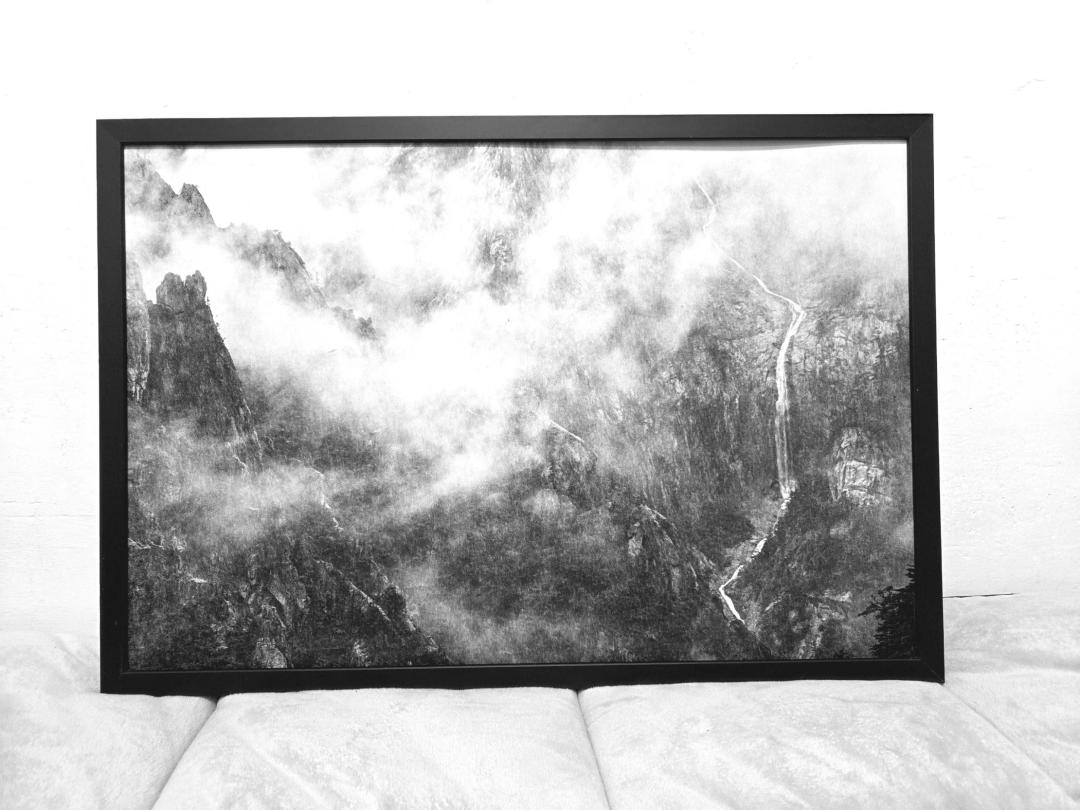
Kang Le-a's #01_S1707SP is a photographic work made as a pigment print on hanji. A landscape captured on a digital camera, then printed onto hanji with pigment inks.
What sets this work apart from other photographic media:
- The grain of hanji: Instead of the smooth surface of standard photographic paper, hanji's fine grain and warm off-white tone is added to the photograph.
- The depth of pigment ink: The cool precision of digital photography meets hanji's warm, micro-absorptive surface and produces a grain closer to painting than to photography.
- A collision of timescales: The newest medium (digital camera) meets the oldest (hanji). It is a temporal pairing similar to the experiment in Jung Chae-hee's lacquer painting(공개 예정).
Where Kang Le-a's Work Sits
Kang Le-a is one of a handful of Korean contemporary photographers carrying an East Asian sensibility. Her work is unlike Western photography's objective, documentary tone — she carries the meditative spirit of Korean landscape painting into digital photography. Her decision to print on hanji is the natural extension of that emotional grain.
How Archival Prints Differ from Other Photographic Media
| Medium | Longevity | Surface | Price Range |
|---|---|---|---|
| Instant photo (Polaroid) | 5–20 years | Glossy | Very cheap |
| Standard inkjet print | 5–20 years | Glossy to matte | Cheap |
| C-print (Chromogenic) | 50–100 years | Glossy | Mid-range |
| Silver gelatin (B&W) | 100–150 years | Glossy to matte | Expensive |
| Archival pigment print | 100–200 years | Matte to semi-gloss | Expensive |
| Daguerreotype | 200+ years (very fragile) | Mirror-like gloss | Very expensive |
The archival pigment print is realistically the most archival medium available to a contemporary photographer.
Four Effects an Archival Print Brings to a Work
Effect 1. Color Depth and Tonal Dynamic Range
Pigment ink rests on the paper's surface, so the ink's own color appears clearly on the image. Dye ink is absorbed and the color blends with the paper. This difference is what gives pigment-ink works their deep blacks and saturated, full-bodied color.
Effect 2. The Possibility of Matte
Standard photographic paper is so glossy that reflections often interfere with viewing. Archival prints can be made on glossy, semi-gloss, or matte stock, letting the artist control surface texture to match intent. Hanji and cotton papers are naturally matte.
Effect 3. Minimal Visible Change Over Time
Standard photographs show visible yellowing or fading after 10–30 years. Archival prints retain almost the same color a century later — a promise of time-resistance for the collector.
Effect 4. The Identity of Korean Contemporary Photography
Pigment print on hanji is part of the contemporary identity of Korean photography. Japanese and Chinese photographers also experiment with East Asian papers, but the texture and absorbency of hanji fits the Korean grain best of all. Korean artists like Kang Le-a, Park Hyung-geun, and Jung Yeon-doo have developed this grain.
Five Practical Tips for Collecting Archival Prints
1. Confirm the edition number and the artist's signature
Photographs are usually edition works. "1/10" means the first impression in a run of 10; smaller editions (5 or fewer) command higher value. Confirm that the artist's hand-signed signature and edition number appear on the back of the work or on the matting.
2. Confirm the print specifications
Reputable artists state their print specifications. The ink type (EPSON UltraChrome HD, Canon Lucia, etc.), paper type (hanji, baryta, Hahnemühle), and date of printing should be on the invoice. This information affects both longevity and resale.
3. Frame with UV-blocking glass
Archival prints are still somewhat affected by UV light. Use UV-blocking glass (99% block). It costs about 1.5x the price of standard glass, but extends the work's lifespan by 2–3x.
4. Avoid direct sunlight, always
Long-lasting doesn't mean immune to sunlight. Standard living-room and study environments (natural daylight + artificial light) are safe enough, but avoid direct south-facing window placement.
5. Inspect the framing once a year
Once a year, take the work out of its frame to check the matting and paper. The matboard can become acidic and start to yellow, and edges of the work can compress against the matting and leave marks.
Frequently Asked Questions
Q. When I buy a digital photographic work, do I receive the original? A. The concept of "original" is different in photography. The digital original file remains with the artist; what the collector receives is a single physical print issued as one item of an edition. This is not forgery — it is the nature of the medium. Photography is "a reproducible medium," and value is sustained only when the artist limits output to the stated edition size.
Q. How is the artist prevented from printing more later? A. Printing beyond the stated edition (say, 1–10) breaks the artist's credibility and effectively removes them from the market. Invoices, collection records, and gallery transactions are all traceable, making this practically impossible. The collector's safeguard is to verify the edition size and date of printing before buying.
Q. Are photographic works also exempt from Korea's art transfer tax? A. Photography is not a taxable category to begin with. What the tax law enumerates as taxable is paintings/calligraphy and antiques (Article 41 of the Enforcement Decree of the Income Tax Act), and photography is not on that list. Whatever the transfer price, no other-income tax arises under that provision. The same holds for sculpture and media works. See the Art Tax Guide for details.
Q. How can I tell an archival print from one made at a regular print shop? A. The differences show up in paper, ink, and surface gloss. Standard prints are glossy on smooth paper; archival prints are typically matte with natural texture. The decisive clue is whether the back of the work carries the artist's signature, edition number, and printing specifications.
Q. Are photographic works cheaper than paintings? A. Generally, photography prices about 30–50% lower than painting — a market perception of "reproducible medium." That said, photographs by reputable artists (Andreas Gursky, Cindy Sherman, Park Hyung-geun) reach painting-level prices, and the photography market is gradually closing the gap with the painting market.
Q. What's the relationship between archival prints and digital purchases (NFTs)? A. They are different. An archival print is a purchase of a physical print; an NFT is a purchase of a digital right. The two markets are separate. Archival prints suit collectors who want to hold physical works while engaging with the grain of digital-era artists.
Q. Besides Kang Le-a, who else in Korea works in hanji + pigment print? A. Park Hyung-geun, Jung Yeon-doo, Atta Kim, and Noh Suntag are among those who regularly combine digital output with hanji or acid-free paper. That said, Kang Le-a's signature is uniquely her own — the grain of hanji combined with a meditative landscape sensibility.
Closing
The archival pigment print is one Korean contemporary artist's answer to the question of how digital-era photography can endure across time. The pairing of pigment ink and hanji — the newest medium meeting the oldest — produces a depth that ordinary photographic paper cannot match.
When a work like Kang Le-a's #01_S1707SP catches the light on a living-room wall, its image is a digital photograph and at the same time carries the meditative spirit of Korean landscape painting. To collect a photograph, then, is not to buy "a reproducible image" but to buy how that image was rendered, on what medium. That truth is what archival prints make visible.
Related reading
If this piece helped, you may also enjoy these related articles:
Browse Korean contemporary photography and digital-grain works at SAF →
Frequently asked questions
Q. What is an archival pigment print? A. An archival pigment print (also called archival inkjet or fine-art inkjet) uses pigment-based inks — particles suspended in liquid — rather than dye. The pigment bonds to the substrate surface, resulting in exceptional fade resistance lasting 100 or more years under controlled conditions.
Q. How long does an archival pigment print last? A. Under archival conditions — acid-free paper, UV-protective glazing, stable humidity — manufacturers rate pigment prints at 100 to 200 years. Standard dye-based inkjet prints typically last 20 to 30 years before noticeable fading.
Q. Do photographers issue editions for their pigment prints? A. Yes. Most contemporary photographers publish limited editions of 3, 5, or 10 copies per image, each hand-signed and numbered. Some artists destroy or seal the source file after the final copy is produced to guarantee the edition limit.
Q. How is a pigment print different from a C-print? A. A C-print (chromogenic print) uses photographic chemistry — light exposes silver halide layers in colour paper. An archival pigment print is purely digital: inkjet heads deposit pigment dots onto paper or alternative substrates like hanji. Pigment prints offer a wider colour gamut, greater durability, and broader substrate flexibility than C-prints.
Further Reading
Seed Art Festival
·