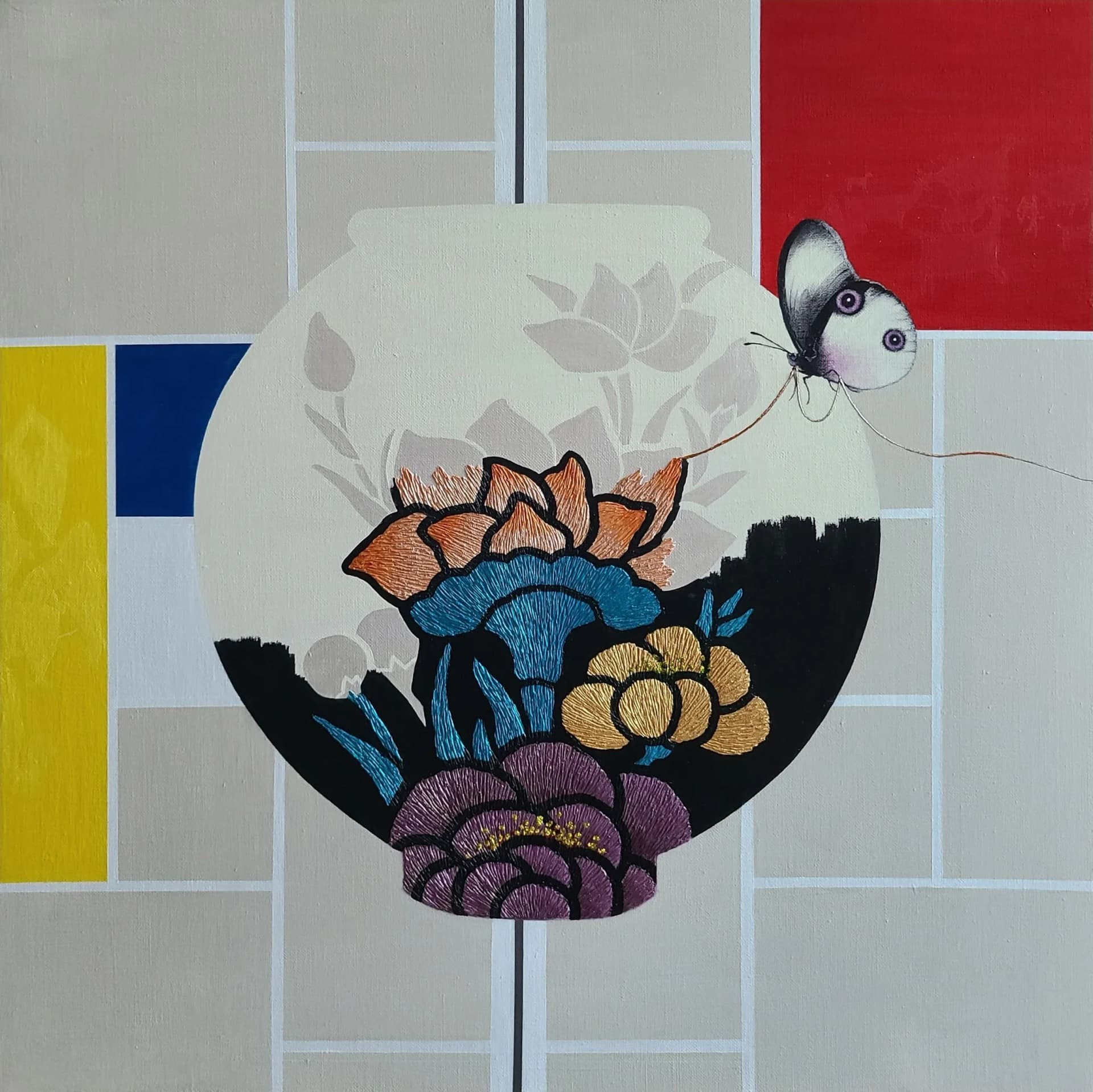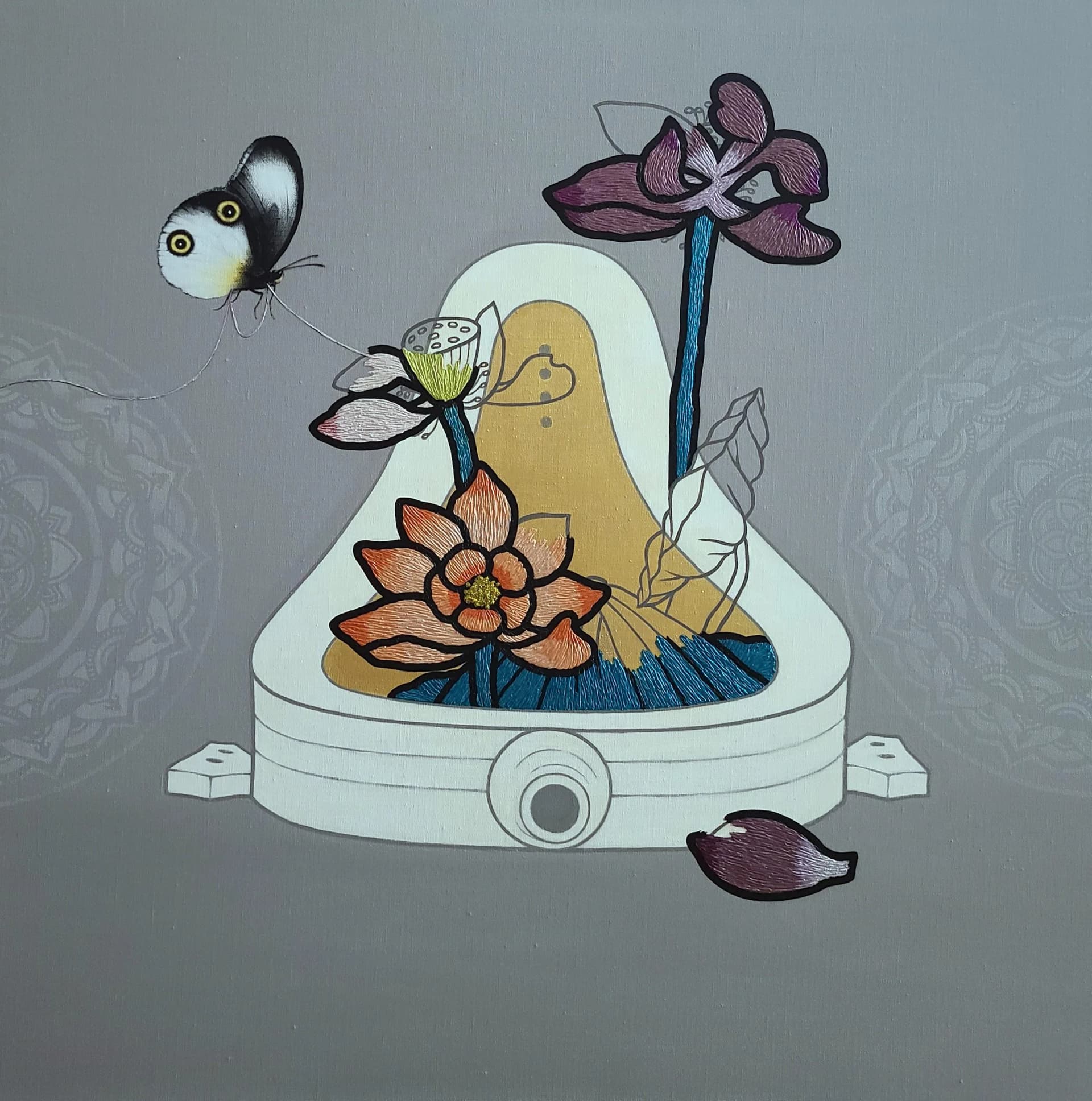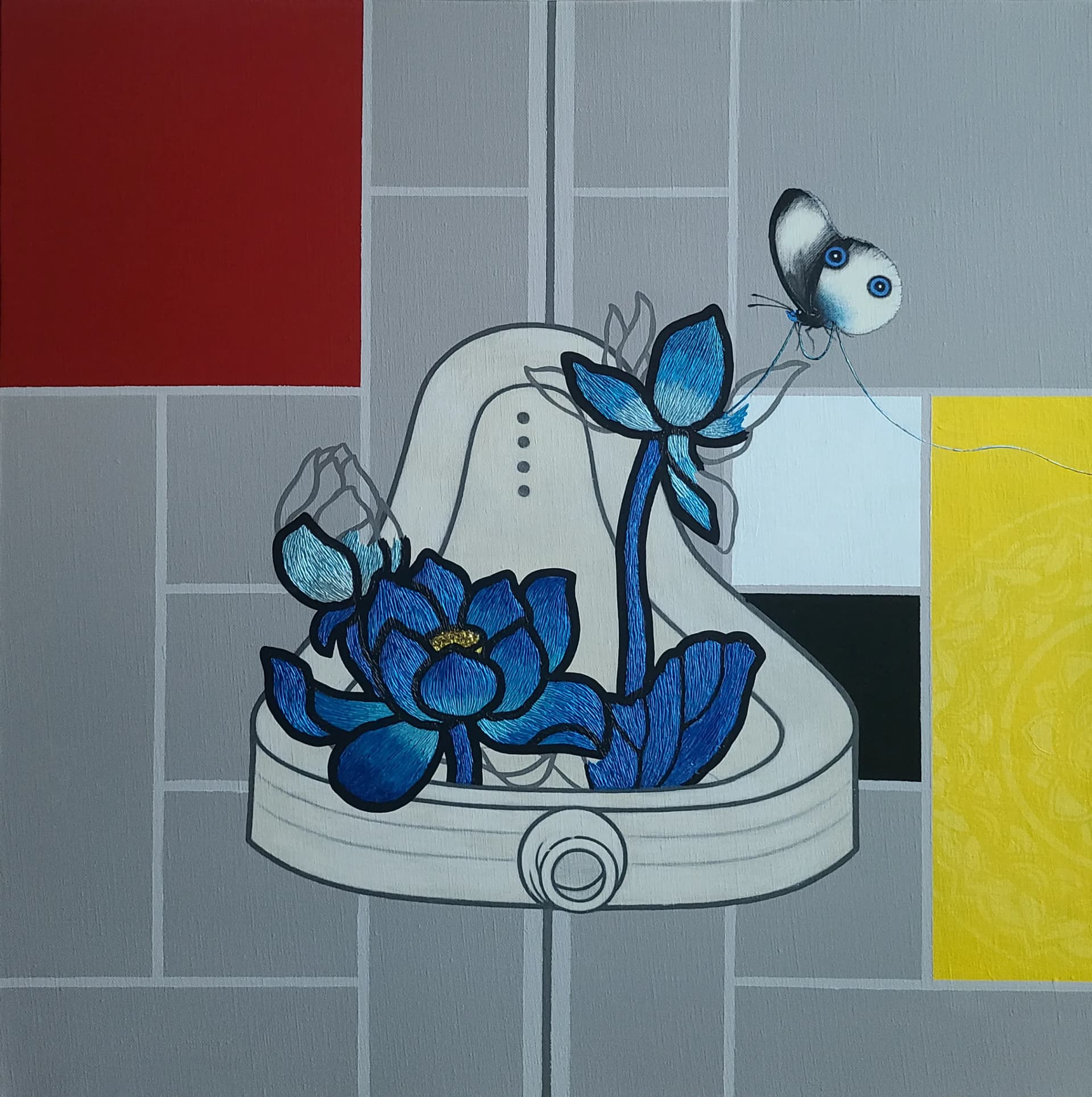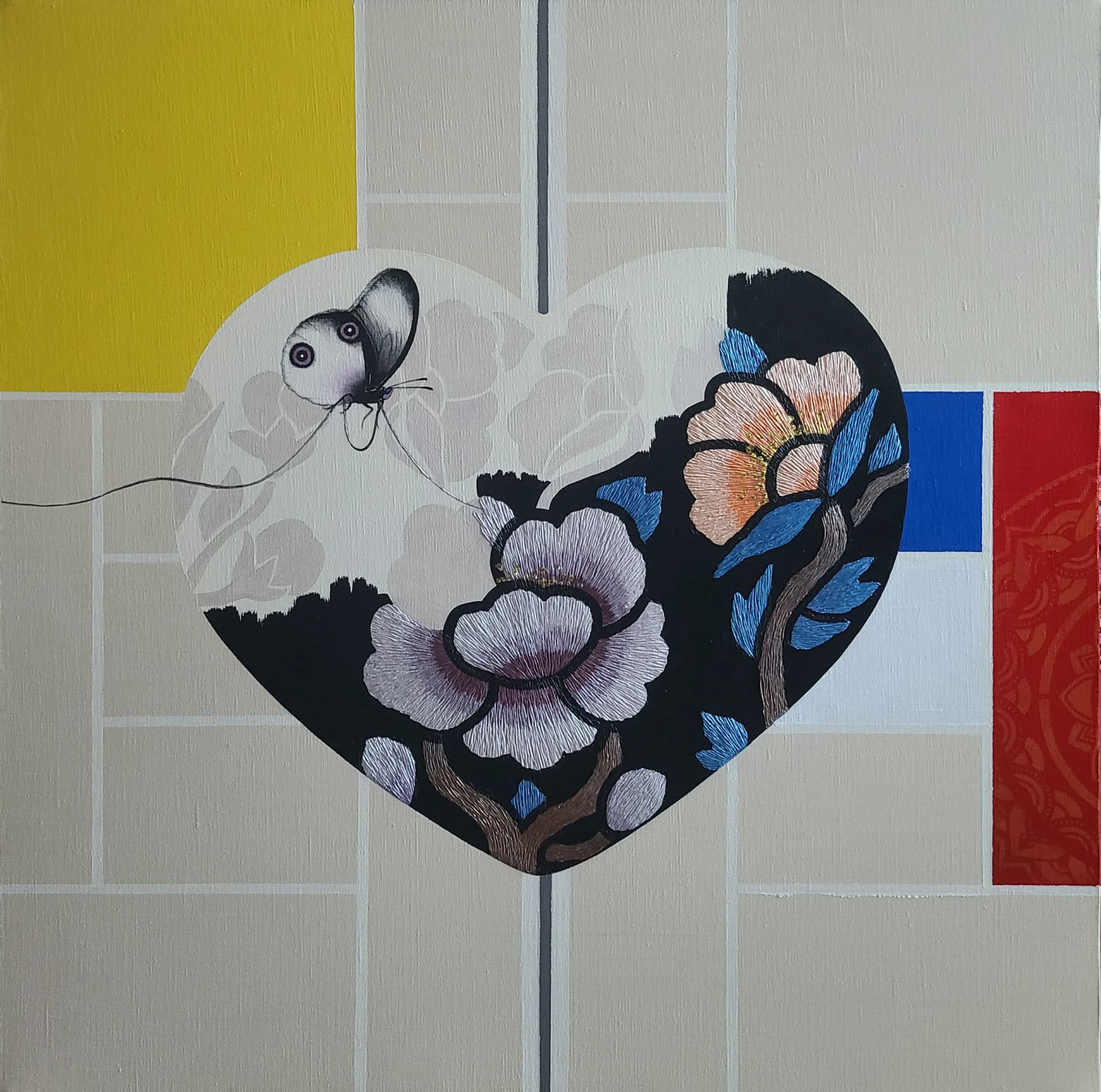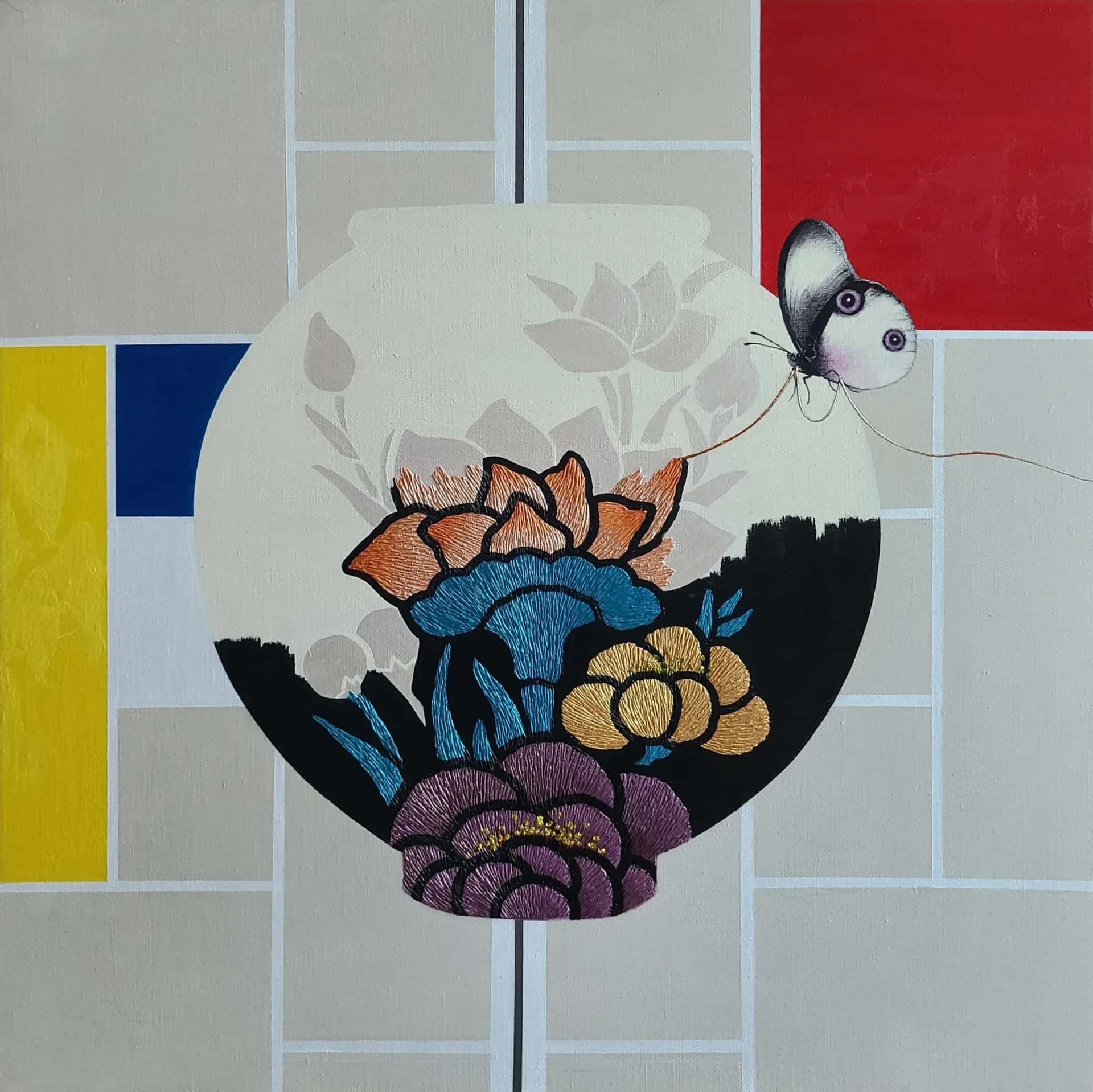
In Song Kwang-yeon's Butterfly's Dream, the butterfly trails a thread. The flowers are painted like embroidery. A close reading of four works at the Seed Art Festival.
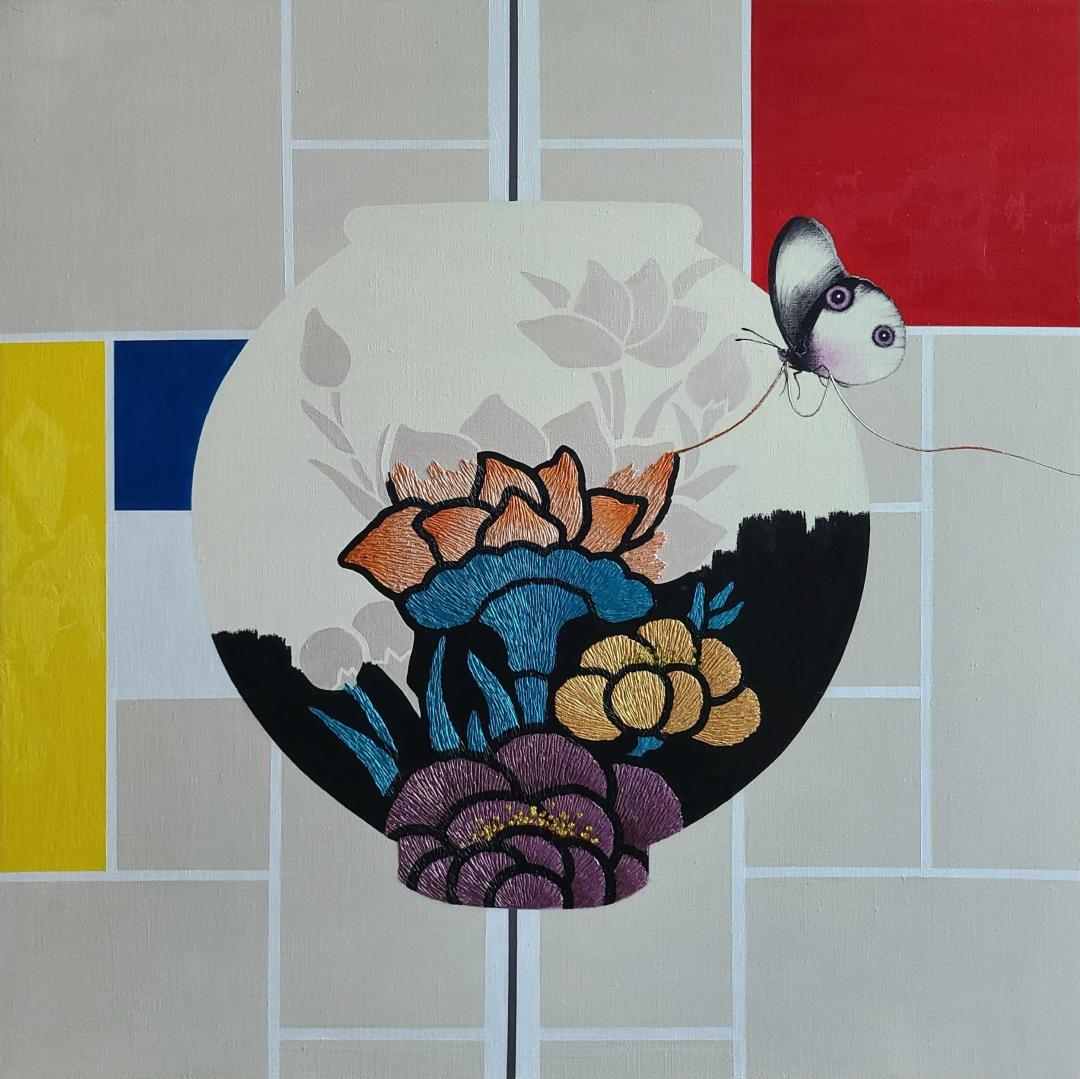
On Song Gwang-yeon's canvas, two times overlap.
One is the time of stitch-by-stitch embroidery. The other is the time Andy Warhol and Lichtenstein printed in one pass on silkscreen. The peony painting (牡丹圖) of Korean traditional folk art is recreated in acrylic, and a butterfly lands upon it. In the background sit the icons of pop-art masters. The faithful embroidery and the surface of mass reproduction collide within a single work.
The artist calls this K-Pop Art (Korean Pop Art).
Looks Like Embroidery, But Isn't
When you first face Song Gwang-yeon's work, the petals on the surface look like actual embroidered textile. But up close, the embroidery is not hand-stitched — it is rendered through textured painting. Layer by layer, acrylic paint is built up with a brush to "perform" the feel of textile on canvas.
There is a clear intent behind this choice. In contrast to pop art's "infinite reproduction," embroidery is drawn in as a symbol of time-consuming devotion and patience, a satire of the present age. To "paint" embroidery in fact takes longer than to stitch it. The needle passes in one stroke; the brush must build up layers of the place the needle would have gone.
What the Butterfly's Dream Is Saying
The overarching thesis is "Butterfly's Dream." The artist's statement begins:
"The Butterfly's Dream series began from the wish that in an era where humanity is drying up under excessive greed and material worship, we might return to the original human posture, and seek a valuable happiness filled with ceaseless effort, as nature flows."
The peony on the canvas is empty, and what fills it is a butterfly. The butterfly fills the petals stitch by stitch, like embroidery. This time of repetition is "an act of longing and blessing for happiness." In Korean folk painting, the peony traditionally represents wealth and the act of prayer (祈福性), voicing a pure human wish and Korean sentiment. Song Gwang-yeon translates that meaning into the worldview of her personal practice.
From Yeungnam Western Painting to Ulsan
Song Gwang-yeon holds an MFA in Western Painting from Yeungnam University. Solo exhibitions: 22. Beginning with the 2008 invited exhibition for the 32nd anniversary of Mekhyang Gallery (Daegu), she continued at Dongwon Gallery (2010), Gallery H (Hyundai Department Store, Ulsan, 2010), Gallery Cheongdam (Daegu, 2014), and the Healing Gallery at Chilgok Kyungpook National University Hospital (Daegu, 2015).
Based in Ulsan, she was selected four times — 2020, 2022, 2024, 2025 — for the Ulsan Cultural Foundation Ulsan Arts Grant. 2019 Uljugun Culture & Arts Center invited exhibition, 2024 BNK Kyongnam Bank Headquarters Art Gallery selected artist exhibition (Changwon), 2025 invited exhibitions at Gallery Sun (Seoul) and Gallery PAC (Jinju). Building outward from the Yeongnam region to the Seoul metropolitan area.
Saatchi Gallery London, Korean Cultural Center Washington
Two international moments are decisive in the artist's trajectory.
In 2016, the invited exhibition POP of KOLOR at the Korean Cultural Center, Embassy of the Republic of Korea in Washington, D.C. She presented her work as a K-pop-art artist in a venue of Korean cultural diplomacy.
In 2017, selection as solo-booth artist at StART Art Fair, Saatchi Gallery, London. It is rare for a Korean artist to meet a London audience through a solo booth at Saatchi Gallery. The same year she was also invited to Ongojishin, a Korea-China three-person exhibition at the Korean Cultural Center Shanghai.
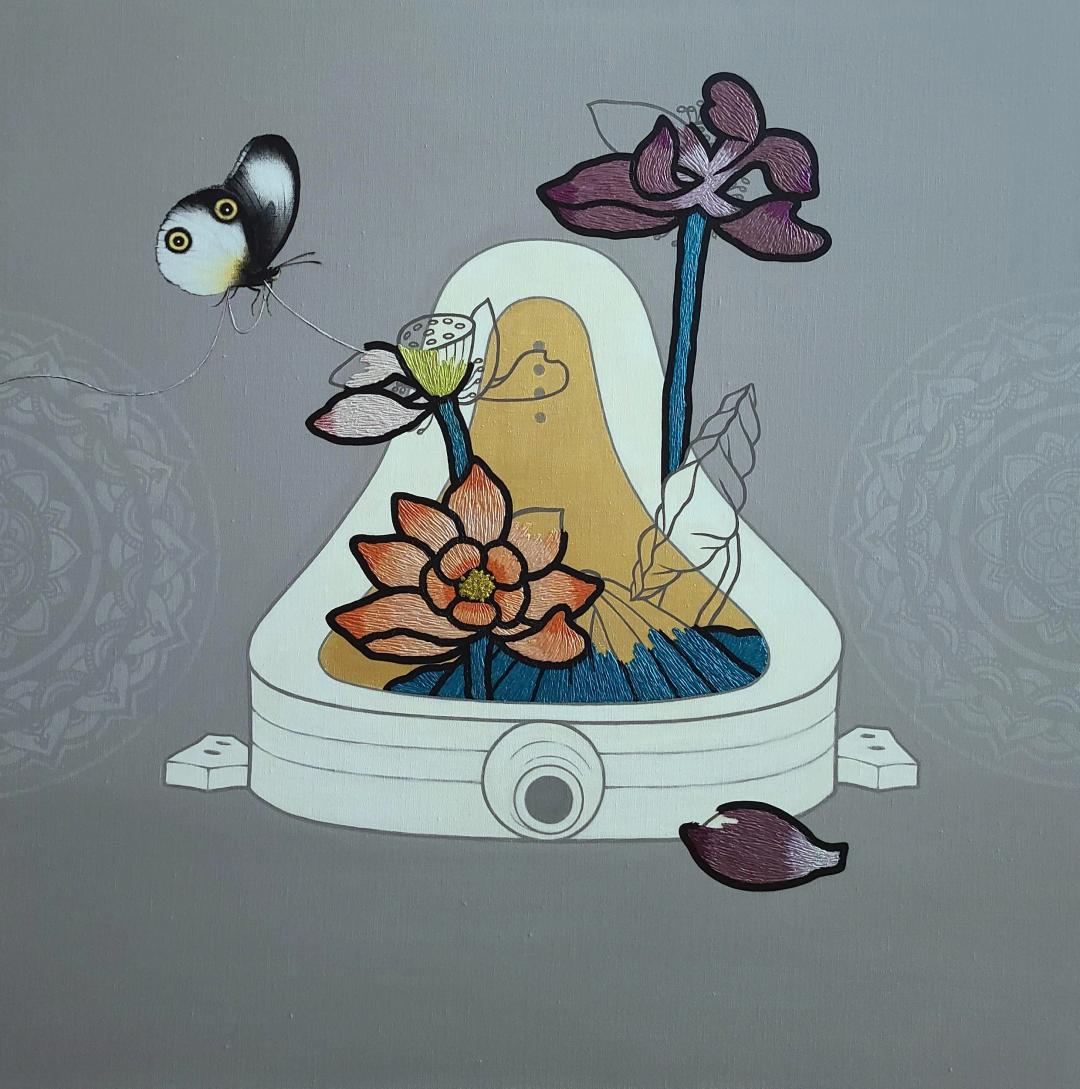
Peony × Andy Warhol — The Grammar of K-Pop Art
The core of her statement:
"As a painter holding a brush, I chose acrylic paint — the most familiar, basic, primal medium — and rendered an entirely different material, embroidered peony textile, as a three-dimensional, realistic object. I sublimated the moments of reproducing embroidery stitch by stitch into 'an act of longing and blessing for happiness.' Some works appropriate the works of pop-art icons Andy Warhol and Lichtenstein, pulling in their era's background and their questions about the loss of humanity and a diseased society. Using mass-produced prints by the masters as the background code, opposite in meaning to embroidery filled with diligence, effort, and earnestness, also implies a direct satirical intent."
Pop art tore down the boundary between the public and art, reflecting a present saturated with material worship. Onto this pop-art language, Song Gwang-yeon lays the peony of folk painting. Infinite reproduction and long devotion, materialism and prayer, Western contemporary and Korean tradition — all collide and converse in one frame. This conversation becomes the grammar of K-pop art.
A Map of Exhibitions and Art Fairs
Song Gwang-yeon's name recurs throughout the curatorial lineage of Korean pop art.
- Marilyn Monroe and Korean Pop Art — Shinsegae Centum City Grand Opening special exhibition and Shinsegae touring shows (Busan, Seoul, Gwangju)
- Korean Pop Art — Insa Art Festival, Insadong
- Wow~! Funny Pop — Gyeongnam Art Museum, Changwon
- Paintings That Bring Happiness — Sejong Center project, Buk-Seoul Dream Forest Arts Center
- A Certain Art Community: Boogie-Woogie Museum — Ulsan Museum of Art
- Mugunghwa Has Bloomed — 2024 Cheonan K-Culture Expo linked special exhibition, Cheonan Art Museum
- Colores de Corea — four-person exhibition at the Korean Cultural Center in Spain, Madrid
Art fairs span domestic and overseas. London StART Art Fair (Saatchi Gallery), Art Singapore, Art Beijing, Art Taipei, LA Art Show. Domestically, KIAF SEOUL, Art Busan, Busan International Art Fair, Galleries Art Fair, Daegu Art Fair, Seoul Art Show.
Public Collections
Her work is held in many public and private collections.
- Ulsan Museum of Art
- Korean Folk Village Museum
- Gallery We (Pyeongtaek), Leeahn Gallery, Insa Gallery, Gallery Art Park, Gallery Cheongdam (Daegu), Dongwon Gallery
- Numerous hospitals, corporations, and private collectors
The two institutional anchors — Ulsan Museum of Art and Korean Folk Village Museum — confirm that the artist bridges "contemporary pop art" and "Korean folk context" simultaneously.
Two Works at SAF
SAF 2026 submissions are two 2025 works. Same title Butterfly's Dream, same size 72.7×72.7cm square, acrylic on canvas. Hung side by side as a pair, they create a mutual surface that expands the "Butterfly's Dream."
The Solidarity of Blessing
84.9% of Korean artists are excluded from institutional finance. Sales of works by SAF-exhibiting artists build a mutual-aid fund that returns as low-interest loans to fellow artists facing financial discrimination.
The peony painting is an image of prayer for wealth and flourishing. Just as the traditional icon of praying for one's blessings expands, on Song Gwang-yeon's canvas, into "the shared dream of people today," SAF's fund structure is also a way of carrying one person's blessing into shared blessing. One collector's purchase becomes an artist's studio rent; another Butterfly's Dream born from that studio reaches the wall of the next collector. A cycle of blessing.
How Should We Live
Song Gwang-yeon's message — contemplating the present through the harmony of pop art and folk painting, seeking to fill an inner happiness — invites us to think once more about how we ought to live.
The brush that paints embroidery cannot be replaced by a computer. It is time the brush follows, stitch by stitch. In an age of mass reproduction, choosing a slow repetition is a humble declaration the artist places on every canvas. What that slow repetition fills is exactly "the act of longing for the original human dream and happiness" — the title of the artist's statement itself.
Works by Song Gwangyeon
Related reading
If this piece helped, you may also enjoy these related articles:
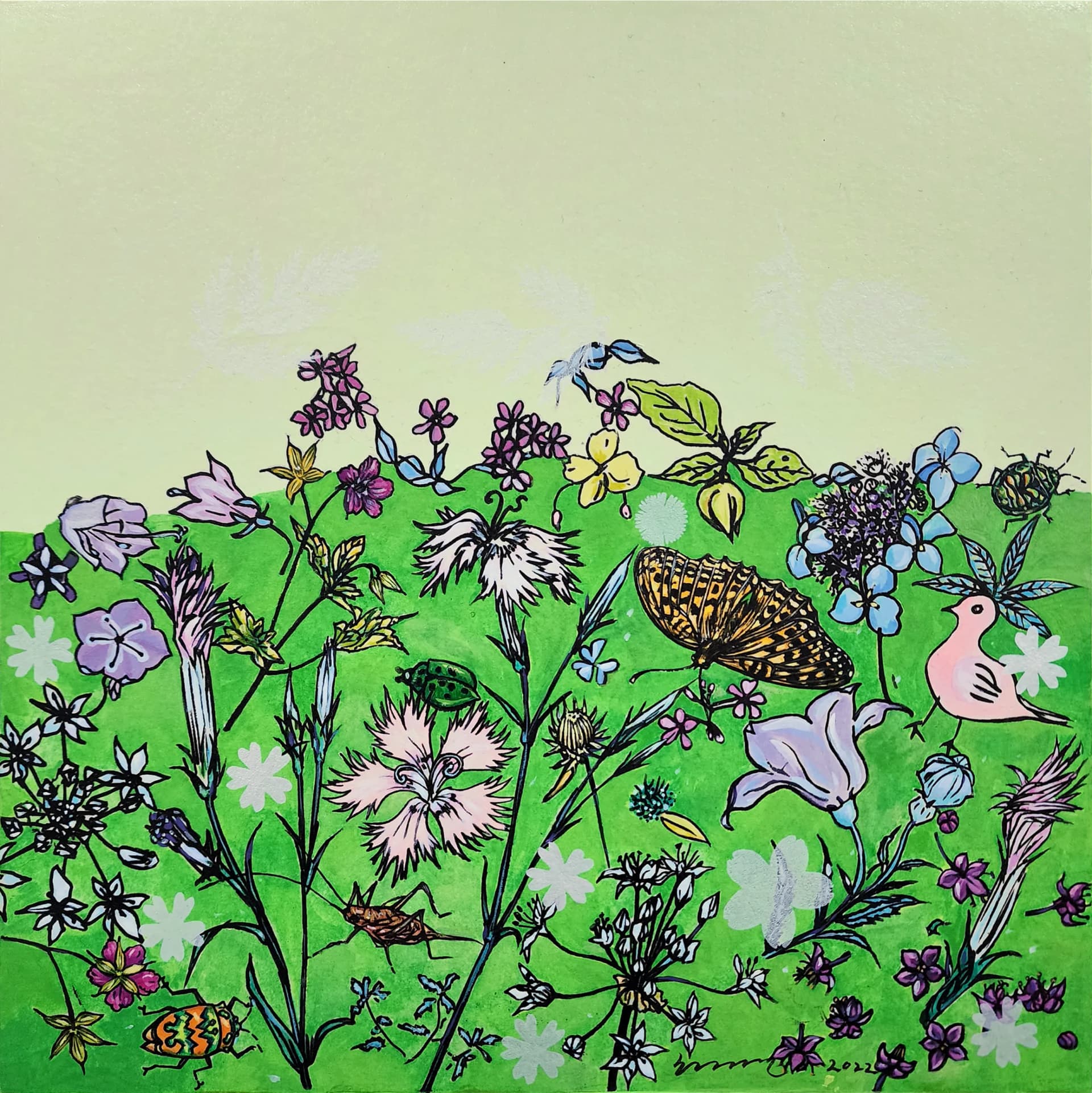
View all works by Song Gwangyeon →
Related Reads
Artists on the Same Path
Collecting Guides
Seed Art Festival
·