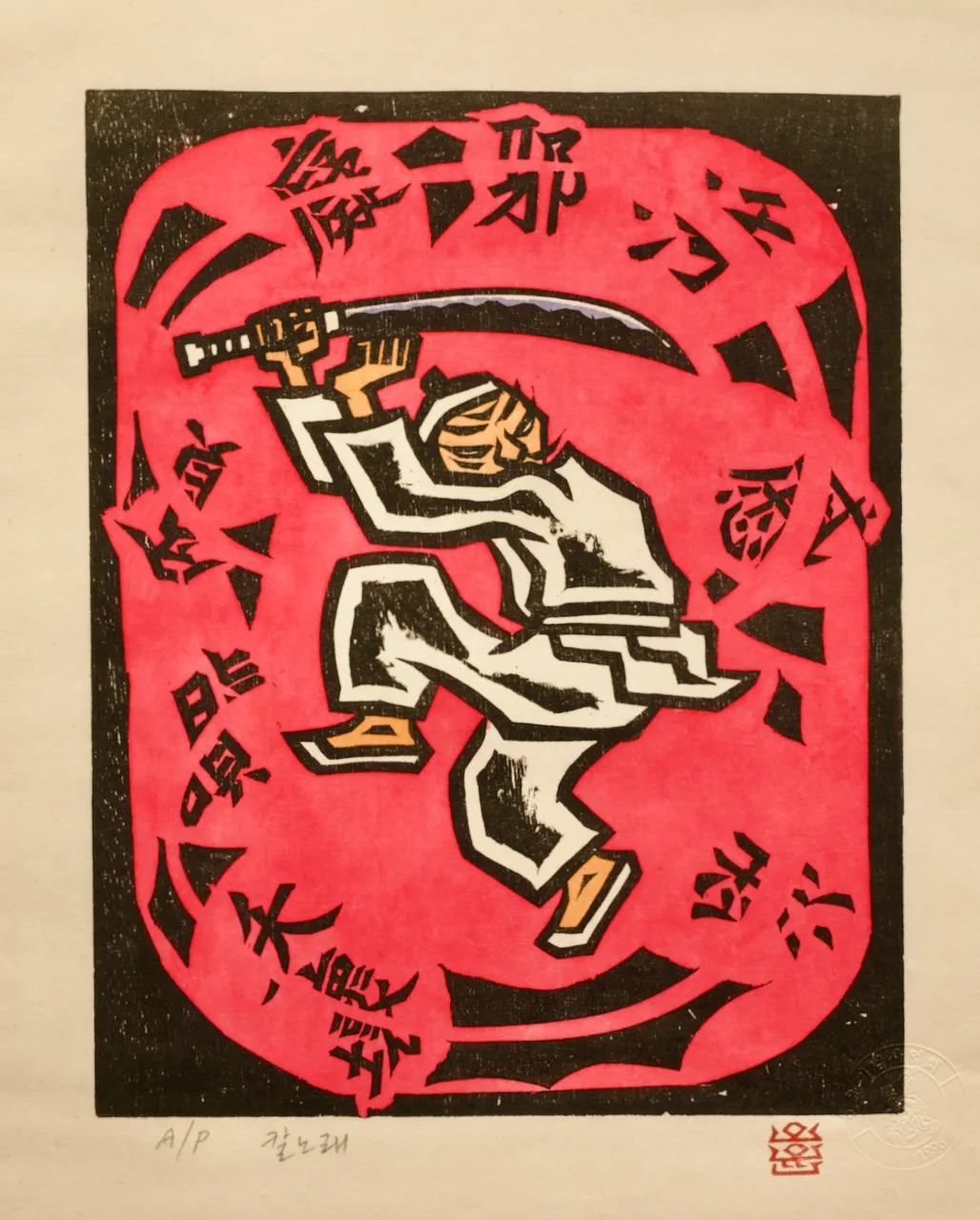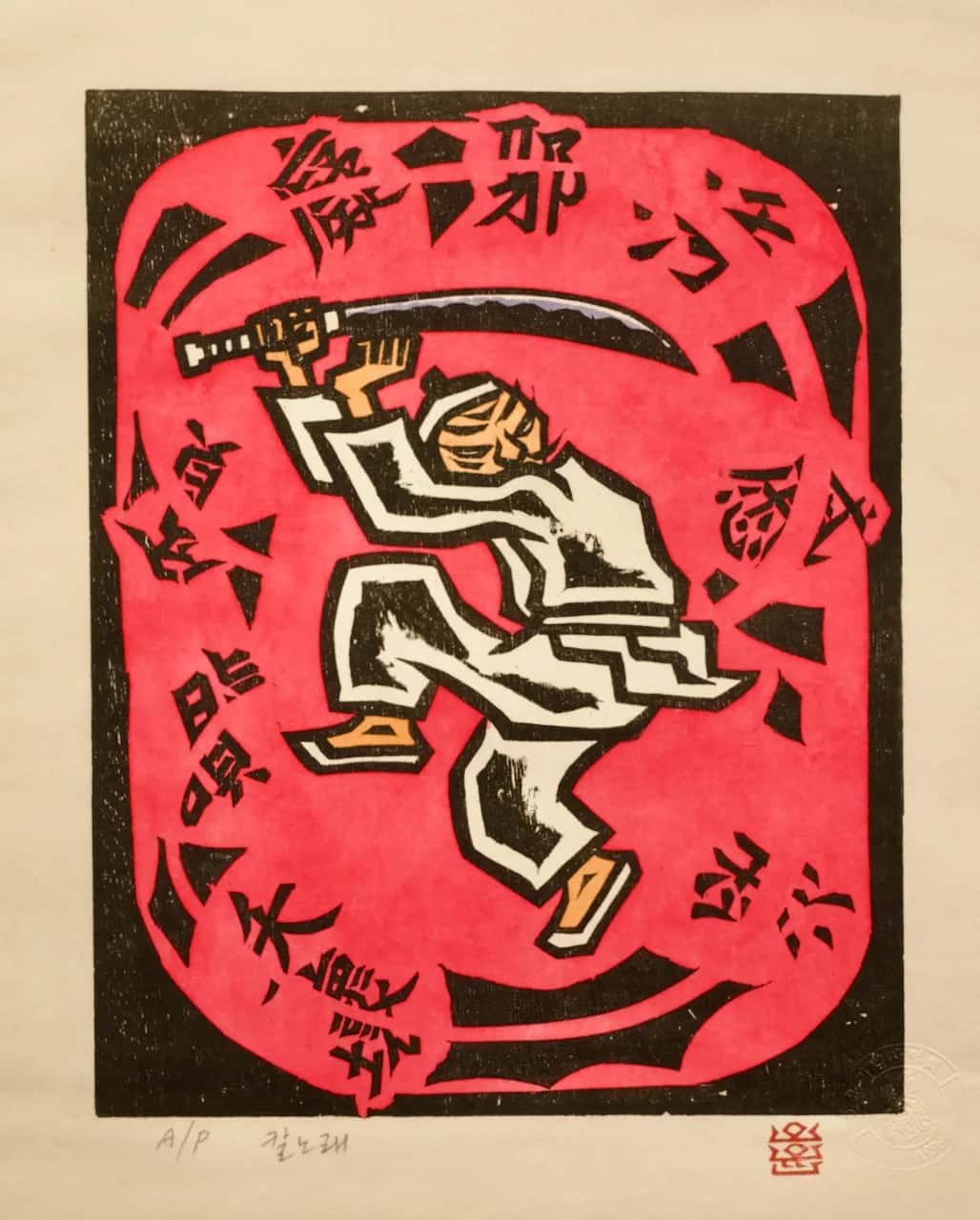
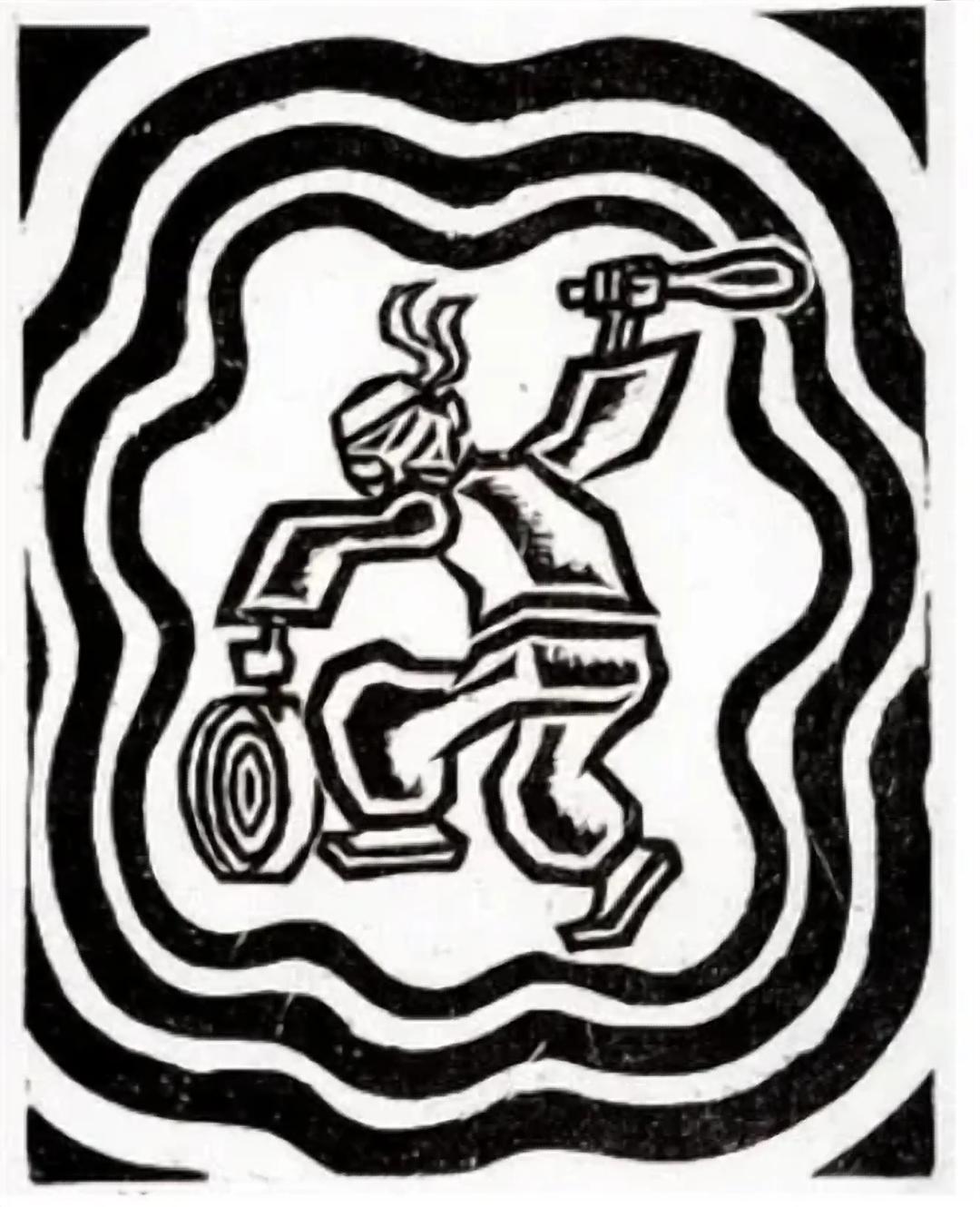
32.2x25.5cm. A single woodblock cut one year before his death. What was Oh Yoon's *Song of the Blade* (1985) singing? A 30-minute deep read of a single work — from the Donghak sword dance to the posthumous print market.
Oh Yoon, Song of the Blade — A Single-Work Reading: 1985, How a Blade Became a Song
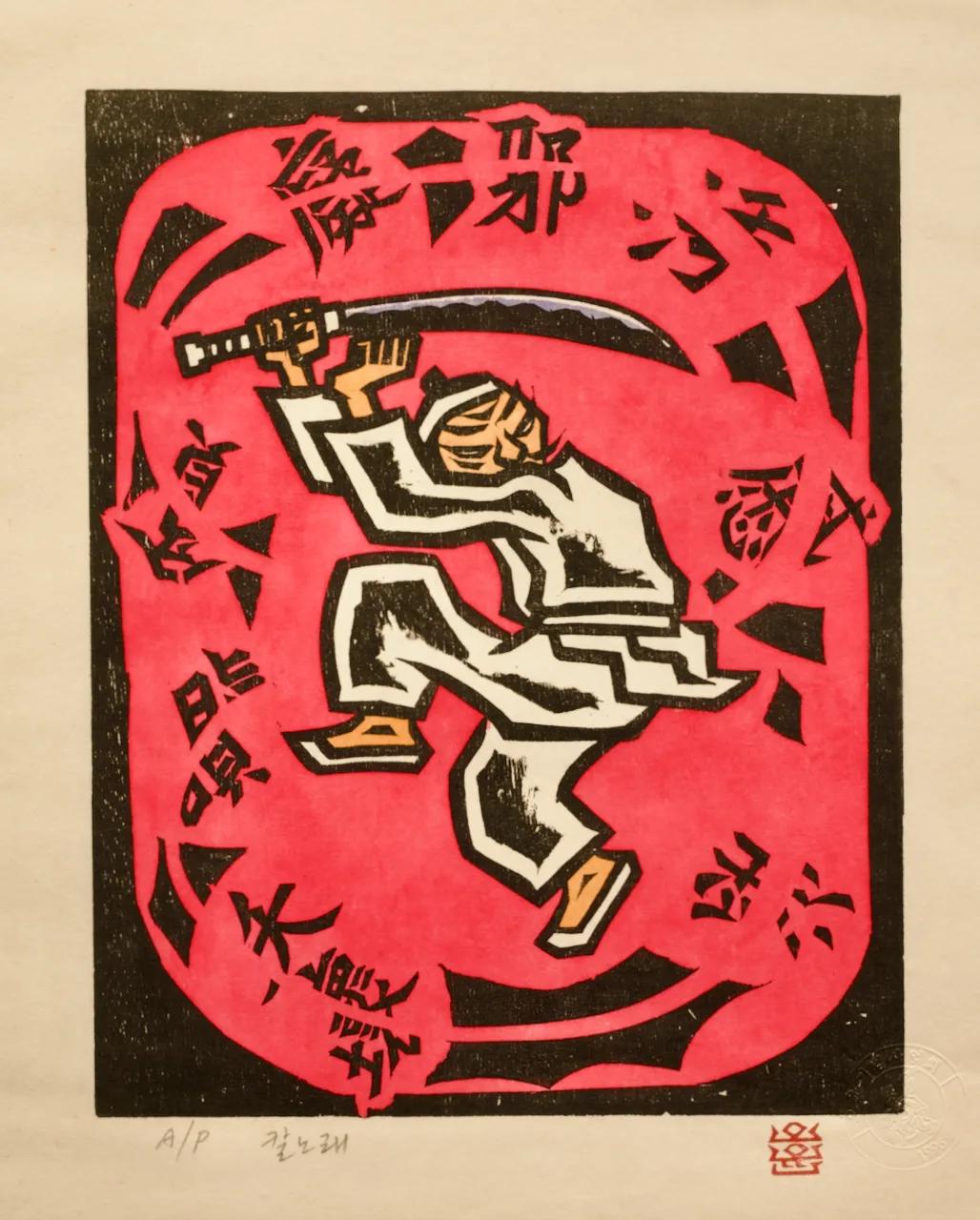
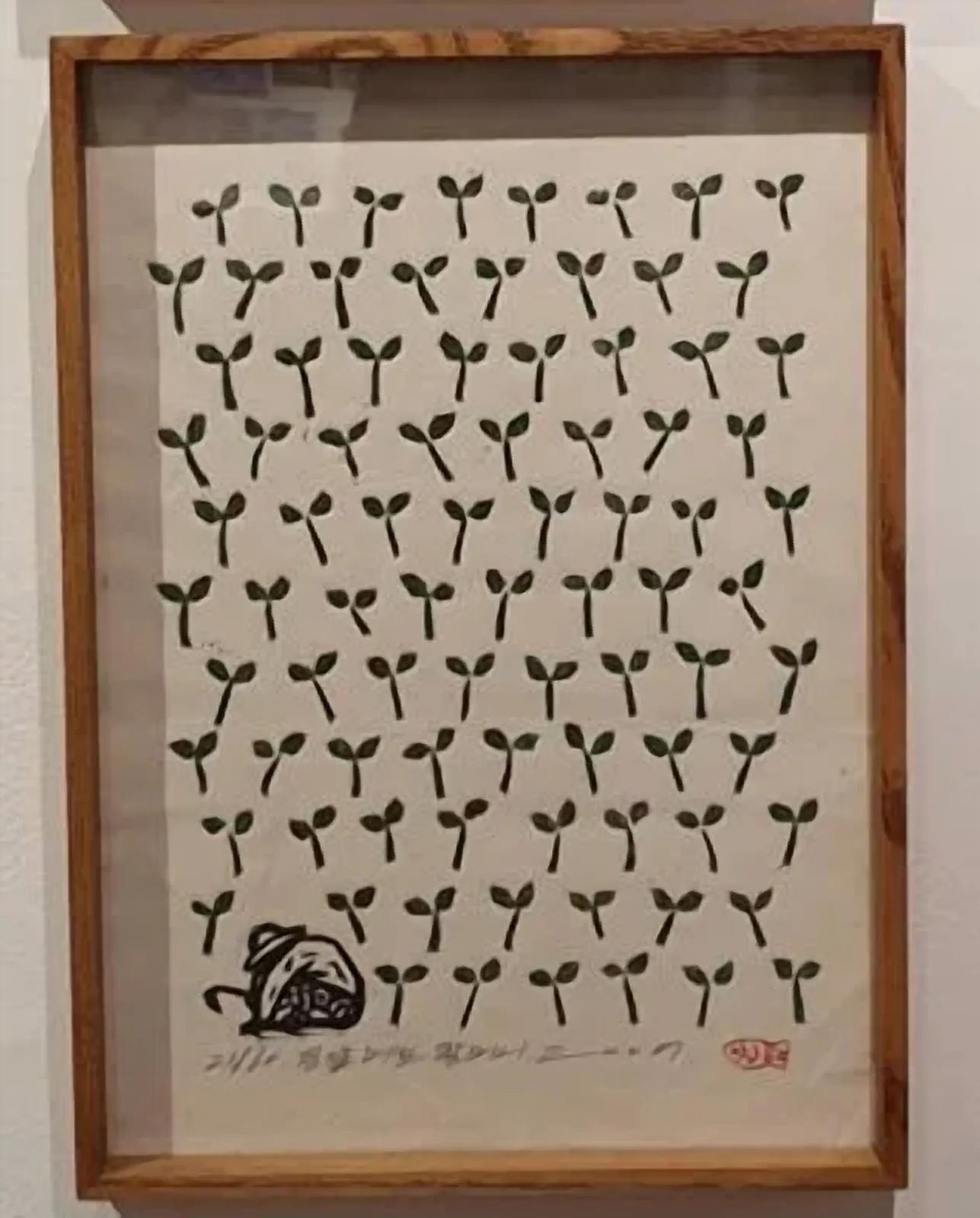
32.2 by 25.5 centimeters. Almost the size of an open hand. And yet this small woodblock is the place a man named Oh Yoon (1946–1986) reached, with the tip of his own knife, one year before his death.
This essay follows only Song of the Blade (1985). The artist's biography is gathered separately in Carved with the Tip of a Blade — A Special Exhibition for Oh Yoon's 40th Anniversary. Here we ask how this one work came to be, why its forms were carved that way, and what it means to live with it now.
The Image — What Was Carved
In the center of the picture stands a single figure. One leg raised, both arms spread, blade in hand. The pose of a Korean geommu — the sword dance. Not the dancer of a stage, but a shaman of the gut, or a Donghak peasant with a bamboo spear, the posture insists on those associations.
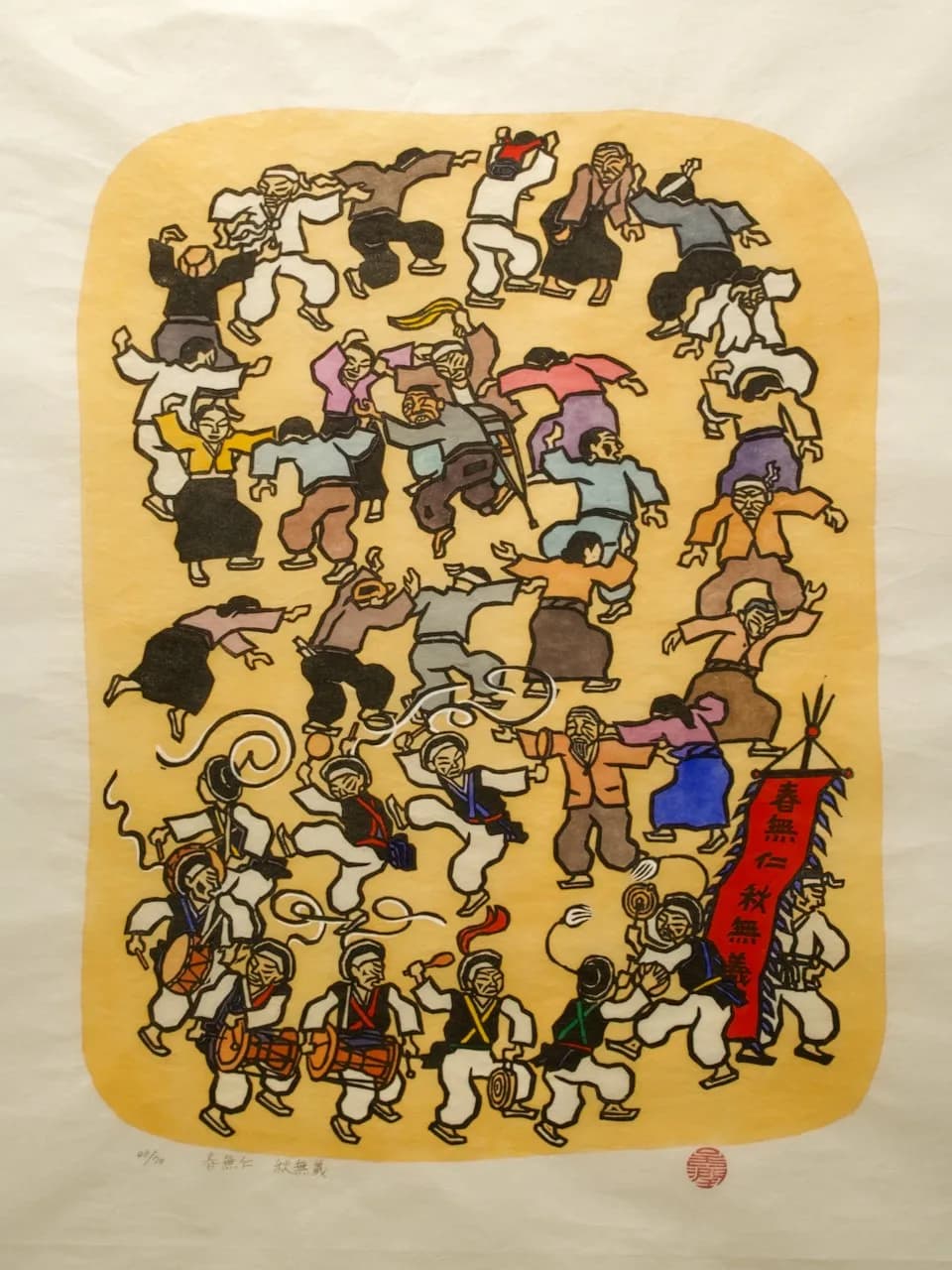
Oh Yoon carved this in the yangak technique — leaving the parts that will print on paper and cutting away the rest. The lines are bold; the black masses are dense. Compared with Spring Without People, Autumn Without Will (1985, 65.5x48cm) or Eight-Petal One-Flower (1985, 50x50cm) from the same year, Song of the Blade is much smaller and simpler. But it is precisely that simplicity that gives weight to each gesture.
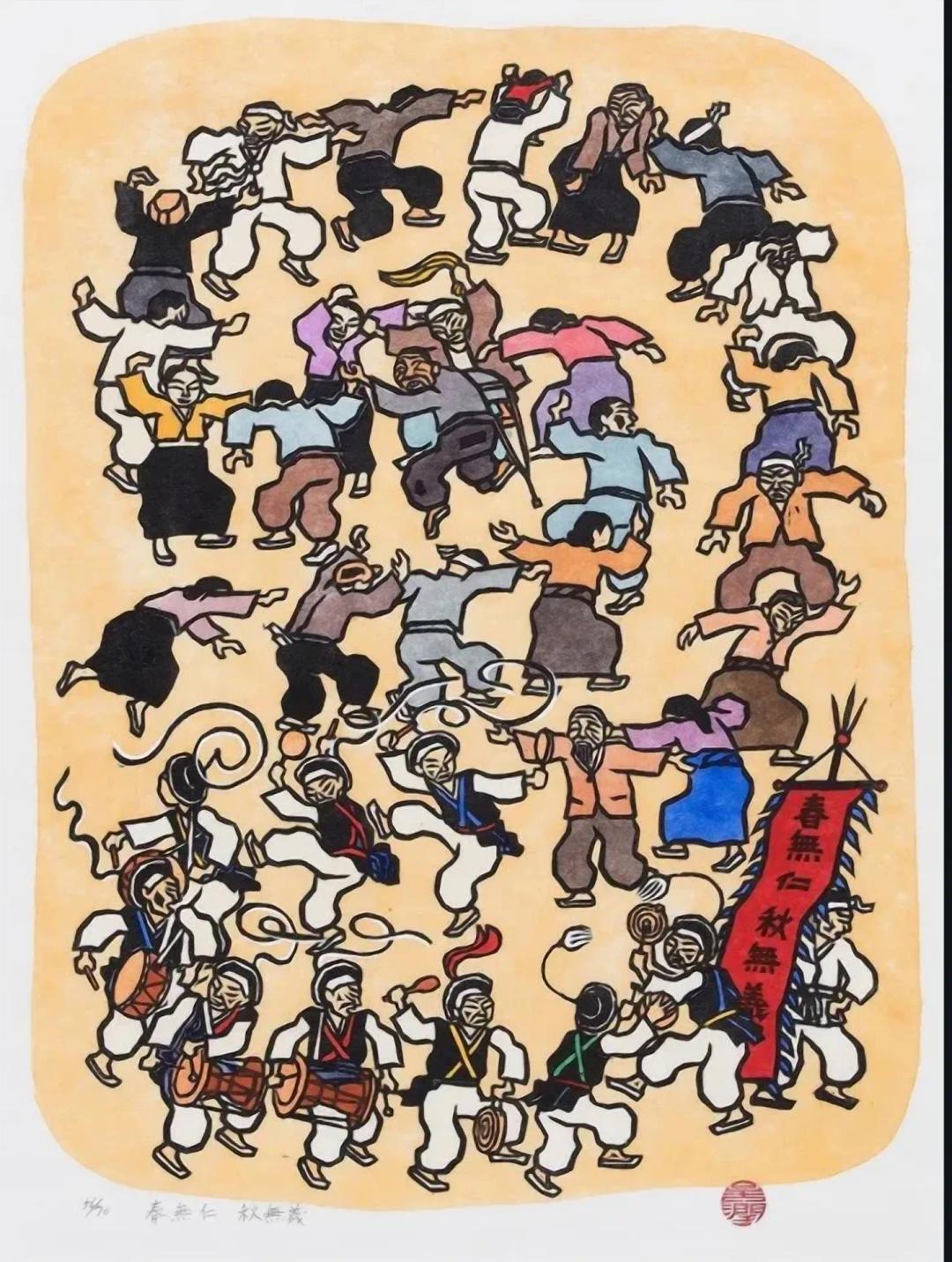
The same year, the same blade tip. Spring Without People, Autumn Without Will — its classical-Chinese title carrying the era's emptiness — is a large image; Song of the Blade compresses that emptiness into a single sword on a small one. The same artist in the same year, but the breath of each work is a different length.
The Title — The Word "Song"
Let us turn the title over: Song of the Blade. A song sung holding a blade, or a song the blade itself sings. In Korean shamanic practice, the sword dance is itself a kind of song. The shaman's muga, sung as the blade sweeps the air, is a rite that releases the grief of the dead and steadies the fear of the living.
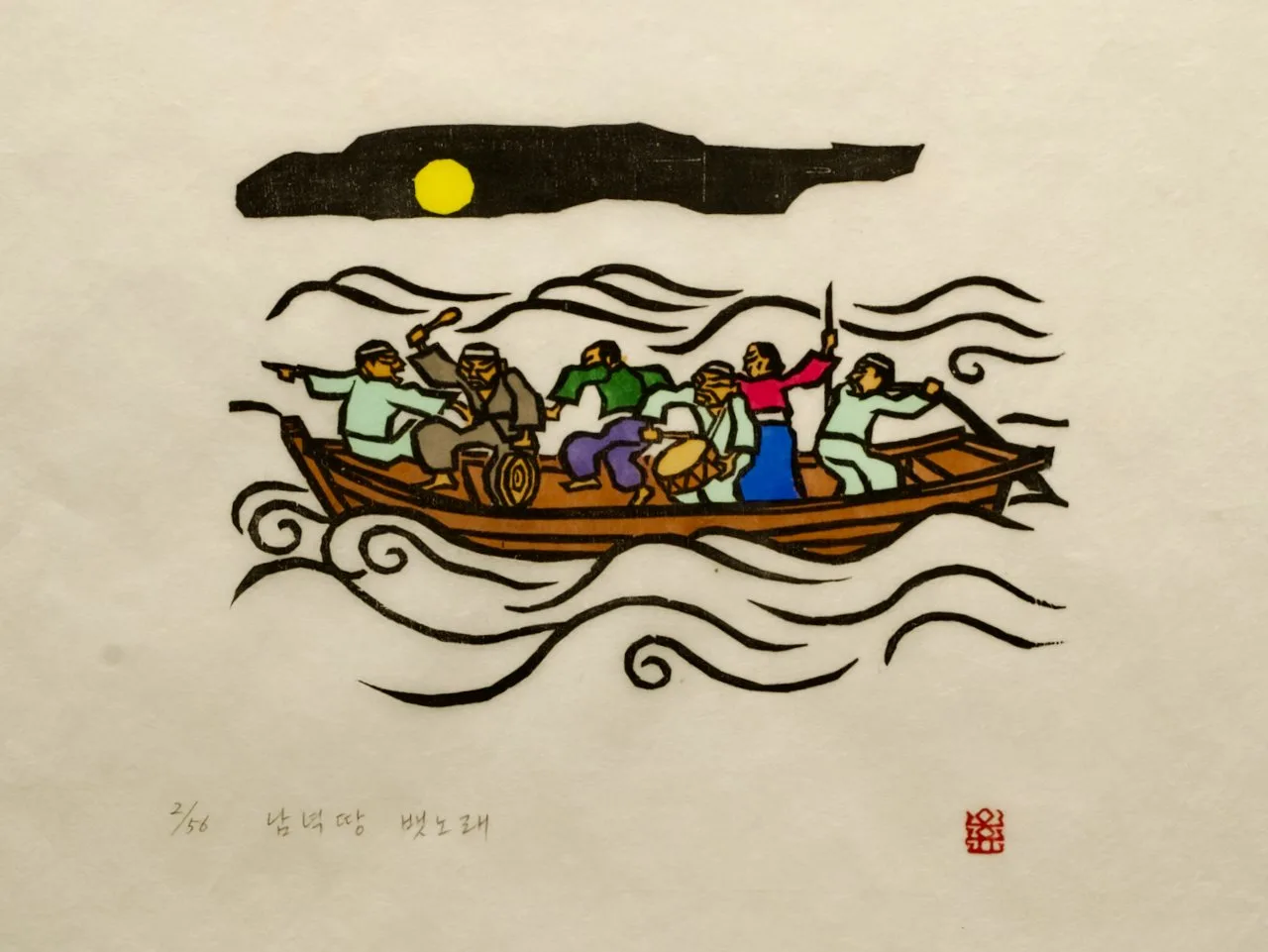
Oh Yoon also used the words song and sound in works like Boat Song of the Southern Land (1985), Sound of Spring 1 (1983), and Sound of Spring 2 (1984).
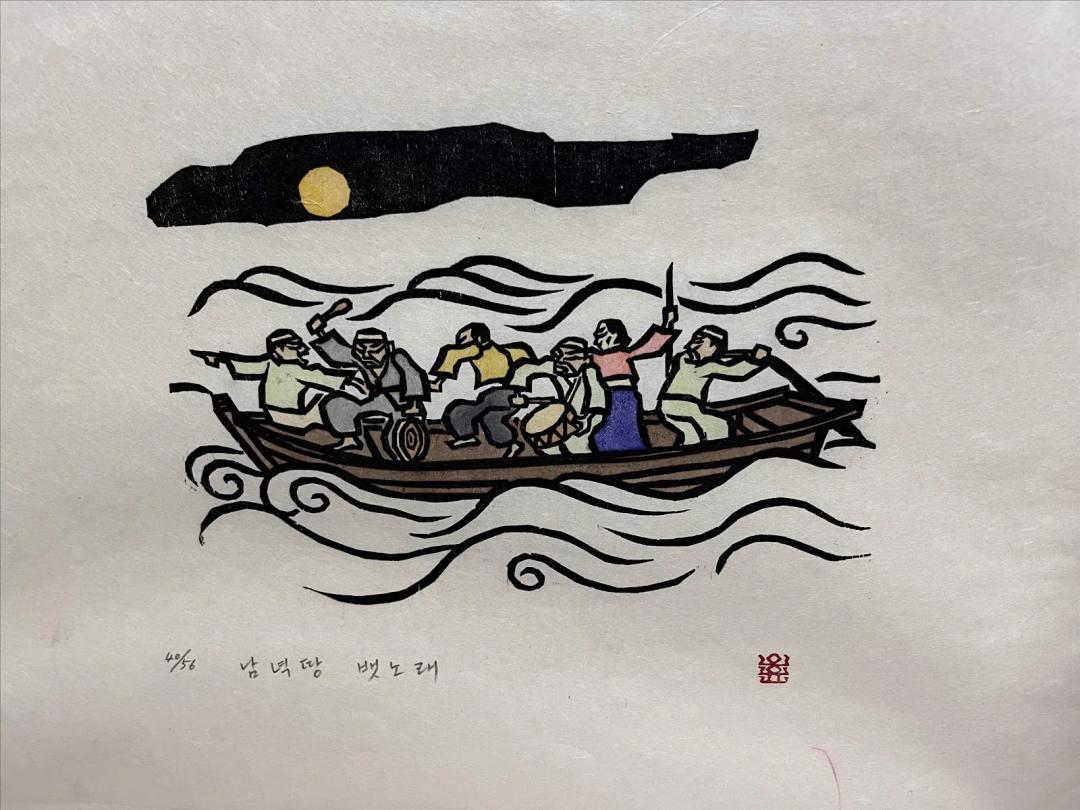
Boat song, sound of spring, song of the blade — they are all one family of words. For Oh Yoon, art was something to be heard before it was something to be seen. It was the work of receiving the sound of the era through a knife's tip and writing it down.
1985 — What the Blade Was Singing
What was Korea in 1985? Five years after the December 12 coup, two years before the June Uprising. The violence of the new military regime was daily life, and Gwangju was still being called by its distorted name, "the Gwangju Incident." The sword dance Oh Yoon carved in 1985 was not simple folk imagery.
Critics have called Oh Yoon's work in this period "shamanic resistance." When direct political art ran into censorship, Oh Yoon walked into the gut, the shaman's rite. Shamanic iconography was protected within tradition and harder to censor; at the same time, it was the deepest spiritual resource of the Korean people. Song of the Blade is a peak of that strategy.
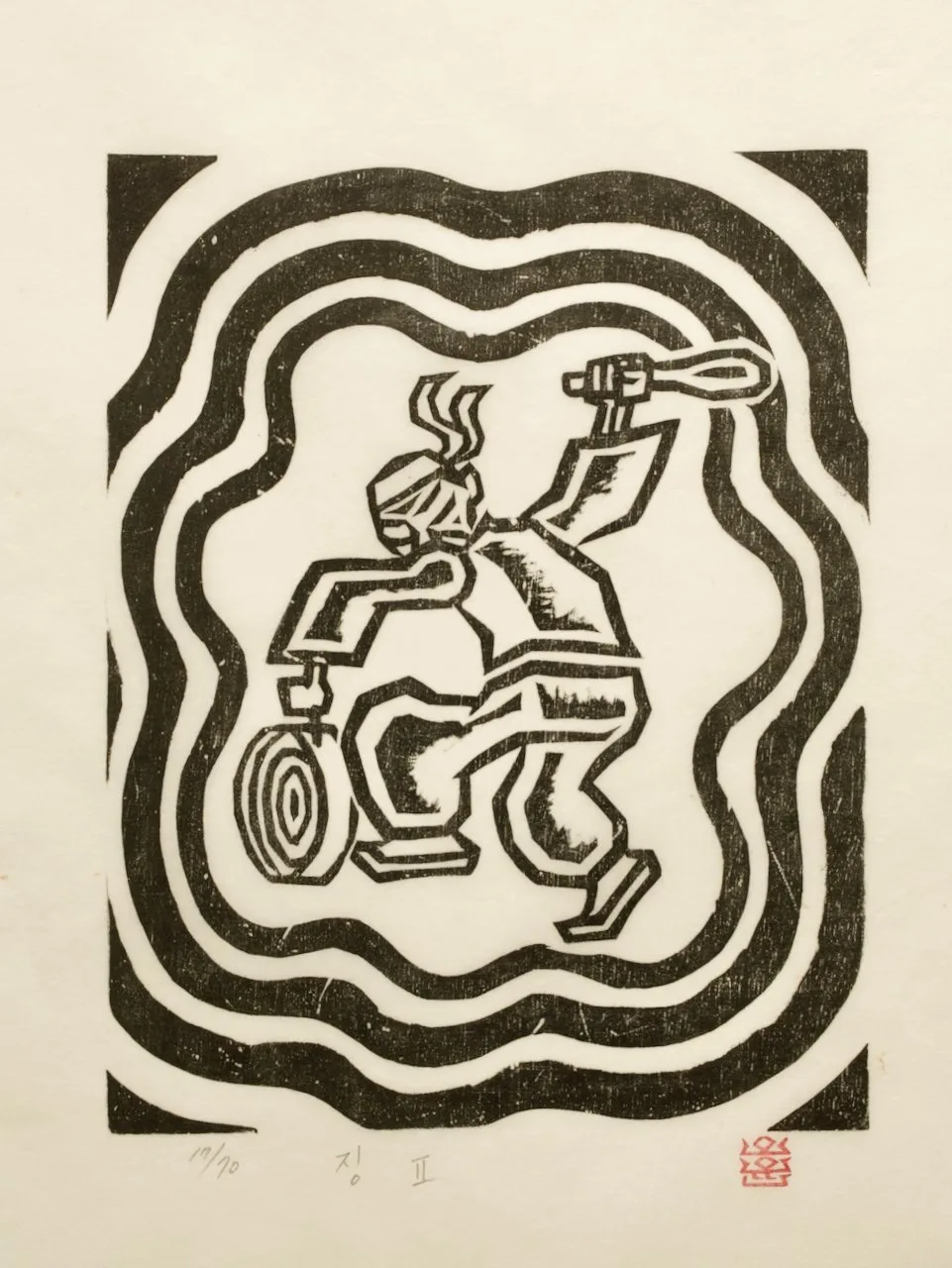
The same year, he carved Daytime Goblin, Tiger Painting, Eight-Petal One-Flower, Gong 2, and other shamanic images intensively. We have gathered this period in Korean Shamanism in Art — Oh Yoon's Goblins, Park Saeng-gwang's Gut, Ahn Eun-kyung's Recovery.
The gong is the first instrument the shaman strikes when the rite begins. Gong 2 and Song of the Blade can be read as two scenes from a single rite — the gong calling the spirit, the song of the blade releasing the grief. Oh Yoon's images of 1985 bind together as one shamanic ceremony.
Posthumous Prints — What Happened After 1986
Oh Yoon died in July 1986, at the age of forty-one. One year after he carved Song of the Blade.
After the artist was gone, his family and fellow artists organized the woodblocks he left behind. Some had not been printed in adequate numbers during his lifetime; some had been printed only in tiny editions. Beginning in the 1990s, with the family's authority, formally printed works entered the market under the name of posthumous prints.
The Song of the Blade in the SAF presentation belongs to that posthumous-print series. The label clearly reads "posthumous woodblock print." This notation is a guarantee — not a forgery, but an officially family-authorized printing.
Posthumous prints sit at a lower price band than lifetime prints. But they are not fakes. In the U.S. and European markets, posthumous prints by Picasso, Chagall, and Keith Haring are also traded as legitimate art. We unpack the structure of prints and editions in Original, Limited, Open Edition — Now Let's Buy Knowing What an Edition Is and The Map of Contemporary Korean Printmaking.
A Collector's Note — Before You Buy This One Work
The Song of the Blade listed on SAF carries this metadata.
| Item | Detail |
|---|---|
| Artist | Oh Yoon (1946–1986) |
| Year | 1985 |
| Medium | Posthumous woodblock print |
| Size | 32.2 x 25.5 cm |
| Price | ₩2,950,000 |
| Series | 1985 shamanic-iconography series |
| Work page | /artworks/c74a894a-19e4-c446-f910-8b7537e331f1 |
A few suggestions for living with it. The black masses of the relief carving are strong, so a white hanji mat with a dark, matte frame holds the image most cleanly. Avoid direct sunlight; keep humidity below 60% and the paper will last for generations.
The price band of ₩2,950,000 sits exactly at the entry point for Minjung-art collecting. The same amount could buy a large painting by an emerging contemporary artist, but the historical position of 1985 makes the comparison different. Oh Yoon's posthumous prints carry steady liquidity in the market, and over the long term their valuation tends to be stable.
FAQ
Q. What kind of blade is in Song of the Blade? A. A short two-handed blade used in the Korean geommu — distinct from the bamboo spears the Donghak peasant army carried, and used as a ritual implement. Oh Yoon did not transcribe a fixed sword-dance posture but carved something closer to the free movement of a shaman dancing in a gut.
Q. How big is the price gap between posthumous prints and lifetime prints? A. It varies by artist and image, but for Oh Yoon, lifetime prints of the same composition trade at 1.5 to 3 times the price of posthumous prints. Against the Song of the Blade posthumous price (about ₩2,950,000), lifetime prints are formed roughly between ₩5,000,000 and ₩9,000,000. That said, lifetime prints come to market very rarely.
Q. How can the authenticity of Song of the Blade be confirmed? A. The SAF listing is a family-printed and family-authenticated posthumous edition, with "posthumous woodblock print" notation and provenance information clearly stated. When buying Oh Yoon work on the open market, look for authentication from the Oh Yoon Memorial Foundation or a publisher recognized by the family.
Q. Which Oh Yoon work should I buy first? A. The right starting work is one that "shows the artist's breath in a single piece." Song of the Blade, Daytime Goblin, and Tiger Painting are the most-recommended entry-level lineup. For a larger image, Spring Without People, Autumn Without Will (65.5x48cm); for clean, contained form, Eight-Petal One-Flower (50x50cm).
Q. How do Oh Yoon's other series break down? A. By period — early 1980s works such as Black Bird and Sound of Spring are smaller, lyric, nature-based images; the middle period expands into landscapes such as Jirisan and The Earth; and in 1985 he reaches his peak with Song of the Blade, Daytime Goblin, and Eight-Petal One-Flower in shamanic imagery. Choose the period that fits your collecting direction.
Related reading
If this piece helped, you may also enjoy these related articles:
A small work is not a small thing. The 32.2 x 25.5cm Song of the Blade is the place where, in 1985 Korea, a man at the threshold of forty arrived with the tip of his own knife. That this place can now be moved to the wall of our living rooms — the form of the posthumous print makes that possible.
The proceeds from the sale of this work flow into the mutual aid fund for fellow artists. The spirit of "solidarity through prints" that Oh Yoon practiced in the 1980s is being carried forward in 2026 in another form.
Related Reads

Artists on the Same Path

Collecting Guides
What Is Under Way
The terracotta relief Oh Yun carved into the interior wall of a bank branch in Guui-dong in 1973 is facing demolition. It was made together with Oh Kyung-hwan and Yoon Kwang-ju, and it was not public art — it was a commission from the then Commercial Bank of Korea (now Woori Bank).
- Citizens' petition for the Guui-dong terracotta — addressed to the next mayor of Seoul and the Minister of Culture, Sports and Tourism
- Preservation fund — raising the cost of conservation through citizen donations
Seed Art Festival
·