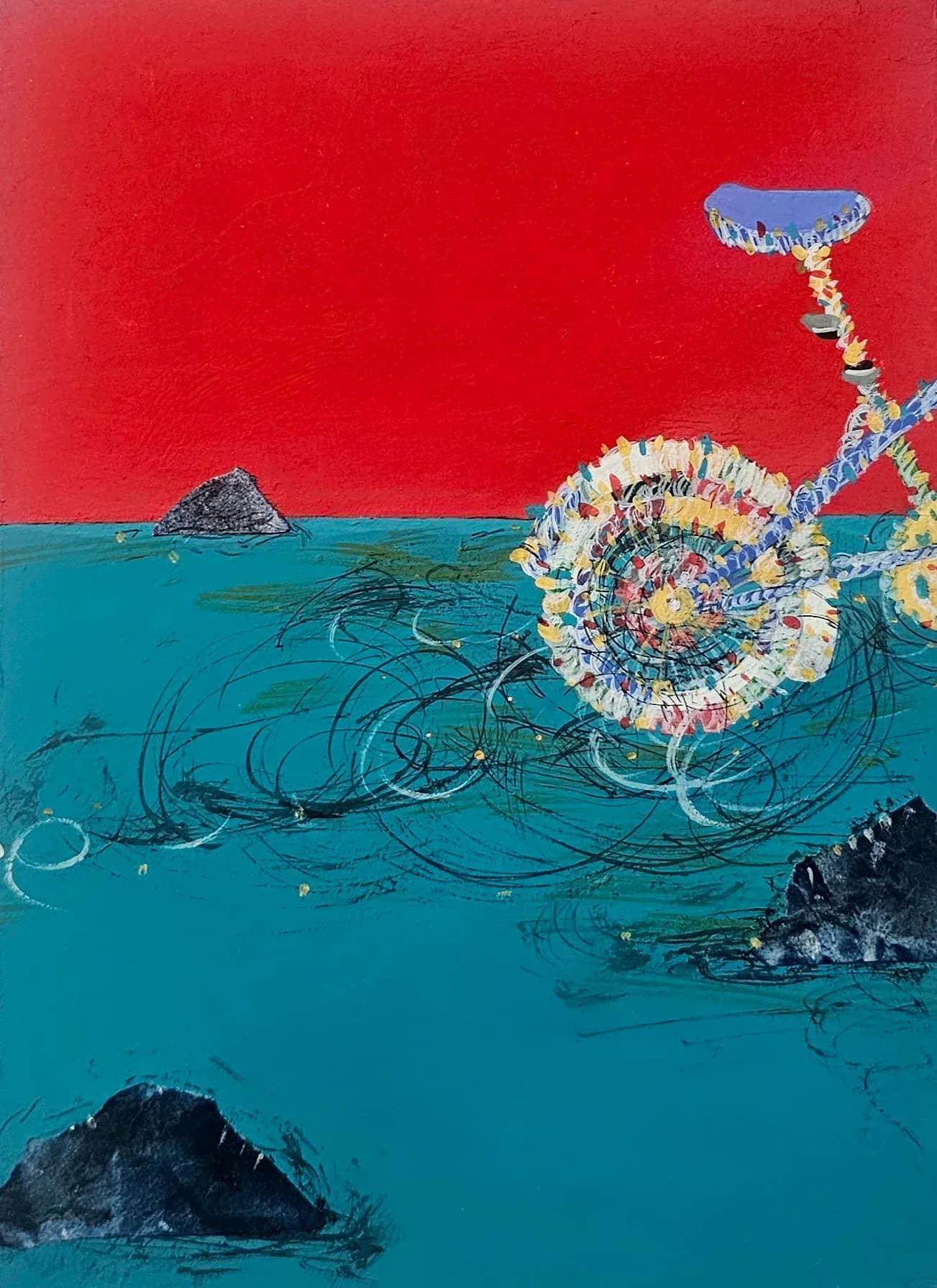
Artists are not born with a gender, but life places gender's weight differently. A roundtable with five women artists who endured the triangle of childcare, livelihood, and creation.
A Conversation Between Five Women Artists — The Triangle of Childcare, Livelihood, and Creation
In the Korean art world, the topic "the life of a woman artist" was, only a few years ago, difficult to speak of in public. It was treated as a private matter, or lumped in under the umbrella of feminism. And yet among colleagues, a long-shared concrete reality had always existed. The balance of childcare and creation, the gender bias of the market, career interruption during pregnancy and postpartum.
This essay is the record of a roundtable held by five women artists who took part in SAF. Five people of different practices, generations, and family configurations gathered on an afternoon in spring 2026 and spoke for five hours.
This roundtable is reconstructed from the transcript of an actual conversation. At the participants' request, all names are pseudonyms, and certain details have been altered for privacy.
The Participants
- Jiyoung (pseudonym, painting, 34, single) — First solo exhibition in 2020. Currently in a shared studio on the outskirts of Seoul.
- Misun (pseudonym, sculpture, 42, two children) — Mid-career artist. Three residency stints.
- Yeona (pseudonym, drawing & painting, 45, one child) — Twenty years of practice. Two years back from a postpartum return.
- Haejin (pseudonym, printmaking, 56, children grown) — A senior figure in Korean printmaking. Active for thirty years.
- Yumi (pseudonym, photography & video, 29, single) — Emerging artist. Recently nominated for Artist of the Year.
Session 1. "What It Means for a Woman to Become an Artist"
Misun: When I was in graduate school I heard this phrase constantly. "Women quit once they get married." Professors and seniors said it as a joke, but looking back now it was a prophecy. Of the women in my cohort, only three are still working today.
Haejin: My generation had it worse. Closing your studio after marriage was "the natural thing." I kept mine, and even that was enough to be treated like a strange person.
Yumi: These days no one says that out loud. But the structure remains. It's still common to see a curated group exhibition of five with only one woman. "We don't take gender into account" — but the result speaks for itself.
Jiyoung: I once debated whether to sign my work "Kim Jiyoung" in Korean or "Jiyoung Kim" in English. The Korean version, with a clearly female-coded name, felt as if it would narrow the context of the work. I ended up using Korean, but the deliberation itself shook me for a long time.
Yeona: I had a similar struggle. The conclusion I came to was — whether you make being a woman the subject of your work, or exclude it entirely, both are choices. What mattered was that I made that choice consciously.
Session 2. "The Gap of Pregnancy and Postpartum"
Yeona: I rested completely for two years after giving birth. I was afraid that gap would show up on my CV. Every time someone asked, "Why is there no activity in 2023–2024?" it felt strange to answer, "Because of childcare." Male artists don't have to say that.
Misun: When my second was born, I couldn't make work at all. A curatorial invitation came during that period and I had to decline. That curator hasn't been in touch since. A single decline becomes a rupture in long-term relationships.
Haejin: That's why I went back to my studio six months after delivery. I left the baby with my mother. The guilt of being a bad mother lasted ten years. But I held on, and that's why I'm here now.
Yumi: I'm seriously thinking right now about whether to have children at all. Beyond the financial issue, the fear of career interruption is enormous. For an artist, a two-year gap feels irrecoverable.
Jiyoung: Same. I'm in my mid-thirties and I can't see a path that combines marriage, childbirth, and an artist's practice. I came here today wanting to see how the older sisters a few steps ahead of me are doing it, so I could decide.
Yeona: From my experience — don't try to do it perfectly. I decided to do childcare, work, and housework at 60% each. That's how I survived.
Session 3. "The Market's Gender Bias"
Haejin: In printmaking, women masters can be counted on one hand. Even with thirty years of practice, male artists with shorter careers than mine have had retrospectives before me. That is not coincidence.
Misun: Sculpture is worse. I still hear that "sculpture is physically demanding, a hard medium for women." I weld. I handle large stones. And yet that gets treated as if it were something special.
Yumi: Look at the auction record and it's clear. In the same age range and the same genre, hammer prices for male and female artists differ. The valuation system itself carries bias.
Jiyoung: When I first showed work to a gallery, the gallerist said, "We're trying to balance our roster of women artists, but right now we're full." "Balancing the ratio" sounded like a quota. Rather than seeing the work for itself, it felt like I was being counted as one woman artist.
Yeona: But there has been visible change in recent years. Since 2016, as feminist discourse has spread, the share of women artists in museums and biennials has actually risen. Slowly, but it is moving.
Haejin: I'm a beneficiary of that change too. The opportunity finally came as I approach sixty. I sometimes wonder if it's too late, but better than nothing.
Session 4. "The Gap Between Creation and Livelihood"
Yumi: I make work and teach at an art academy at the same time. With both, my time for work is halved. But if I quit teaching I can't pay rent.
Jiyoung: I take freelance design jobs on the side. When a job comes in, I rest from my work for a month, and pick it up again when the job ends. The cycle being broken is the hardest part.
Misun: My husband has a salaried job, so I have financial stability. That's a double-edged sword. I hear from people around me, "Your husband earns, so of course you can do art." My work gets treated like a hobby.
Haejin: I ran a printmaking class for a long time. It was both my stable income and a channel for finding fellow women artists. Livelihood and solidarity in one structure.
Yeona: Looking at a mutual aid fund like SAF, I think a lot about my twenties. If something like this had existed back then, I wouldn't have spent those two postpartum years so cut off.
Session 5. "On the Word Solidarity"
Jiyoung: I was skeptical at first about gatherings like "women artists' networks." I had a feeling that I didn't want to be grouped by gender. One meeting changed me.
Jiyoung: The senior artists I met there shared concrete information. Which gallery offers unfavorable contracts to women artists, which residency has childcare facilities, which institution gives priority to artists returning from postpartum. None of this is on official channels.
Haejin: All my life I had many male colleagues. There was a time when I thought women banding together was "awkward." I regret it now. I never opened a path early enough for the women artists who came after me.
Misun: I'm slightly wary of how recent feminist art discourse drifts toward personal stories alone. Personal narrative matters, of course, but on its own the structure won't change. Demands aimed at institution, market, and policy must come along with it.
Yumi: For my generation, feminism isn't a choice — it's the air. We end up making work inside it whether we like it or not. Even if it's not the subject, the influence is there.
Yeona: What a campaign like SAF gives us is the possibility that "this too can be a feminist practice." Not a grand declaration, but the act of protecting a colleague's rent — that itself is the practice of solidarity.
Session 6. "What I'd Like to Say to Younger Artists"
Haejin (56): Practice is a marathon. Sprinting in your twenties doesn't win it. Run steadily into your sixties. So don't push yourself so hard in your twenties and thirties. It's okay to rest. You can come back.
Yeona (45): Whether to have a child is each person's choice. But don't postpone the decision out of fear for your career. The gap can be filled. There are seniors who know how to fill it. Ask for help.
Misun (42): "I'm not a woman artist, I'm an artist" — that sentence is finally possible now. I'm grateful to every previous generation that made it possible to define oneself that way, and I hope we carry that current to the next generation.
Yumi (29): If others my age are reading this with the same struggles, let's talk together. Don't decide alone. A network like SAF makes me feel less alone too.
Jiyoung (34): I almost cried for five hours at this table today. I think I wanted to confirm that someone like me wasn't alone. After this conversation ends, I think I'll keep painting.
Closing the Roundtable
"Woman artist" does not carry a single meaning. The reality differs by generation, region, family form, medium, and economic situation. Yet there was one thing five people made unmistakably clear in five hours.
We have walked different paths, but we have endured inside the same structure.
That recognition is what makes solidarity possible. SAF's mutual aid fund supports artists across all genders, but the reason women artists so often become both beneficiaries and contributors of this fund is that they understand this shared structure.
When one artist's studio rent is protected, that artist can produce the next work. That work, in turn, becomes the fund that protects another artist's rent. This circulation runs across gender, generation, and medium.
Frequently Asked Questions
Q. Did this roundtable actually take place? A. This essay is a fictionalized roundtable form reconstructed from real testimony and interview material from women artists participating in SAF. All names are pseudonyms and some details have been altered. An actual roundtable is being planned, and a follow-up based on a real transcript will be published in due course.
Q. Why a roundtable for women artists only? A. It is not that a roundtable for male artists is unnecessary. Women artists share specific structural experiences — pregnancy, childbirth, gender bias, care work — that have not been adequately addressed in public discourse, and so they need a separate space. Roundtables for male and non-binary artists are also planned.
Q. Doesn't continuing to use the category "women artist" reinforce that boundary? A. A fair concern. Even in this roundtable, the voice that said "I want to be called an artist, not a woman artist" was present. We see two pursuits — acknowledging identity and moving beyond identity into the universal — as simultaneously possible. At this moment, recording the unique experiences of women artists and building discourse that goes beyond those experiences are both needed together.
Q. Can I see the work of the artists in this roundtable on SAF? A. Some of the five participants are SAF artists. You can find them through the women-artist filter in the artwork gallery, and view their CVs and works on each artist's profile page.
Q. When is the next roundtable? A. Announcements will come through SAF's official channels. Future roundtables will run on themes such as young artists, artists outside the capital, artists in the parenting years, and artists nearing retirement.
Related reading
If this piece helped, you may also enjoy these related articles:

A single conversation can change one artist's practice. May this afternoon of five women artists carry into someone's studio tomorrow morning. Browse women artists' work in the SAF artist gallery →
Collecting Guides
Seed Art Festival
·