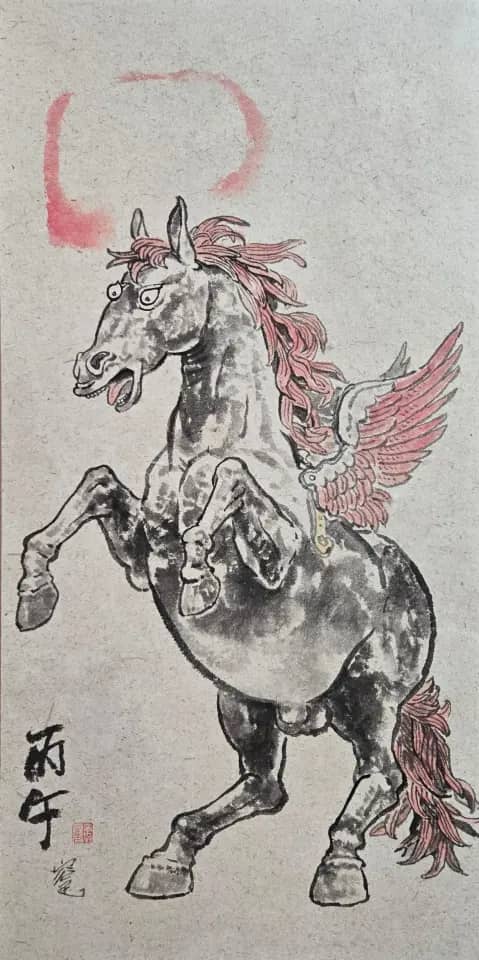
Jiri and Dureun,
drawn in ink
Sumuk expanded into a contemporary sensibility.The deep, flowing ink of the southern mountains on large hanji.
Ink, expanded —
sumuk in a contemporary key
U Yongmin is a mid-career Korean painter who has expanded the possibilities of sumuk — Korean ink painting — with a contemporary sensibility. His subjects gather around the landscapes of the Namdo region: the ranges of Jirisan and Dureunsan, the temple grounds of Daeheungsa, birch forests, and the Four Gentlemen of classical painting.
He has held solo exhibitions at a steady pace — 〈Tangjin Sumuk〉 at Inyoung Gallery, Seoul (2019); 〈Dureun〉 at Haengchon Art Museum, Haenam (2020); 〈Permano〉 at Duin Art Museum, Seoul (2023); and 〈Sumuk — Four Gentlemen〉 at Haengchon Art Museum (2025), among others. Alongside the solo work he has taken part in the Jeonnam International Sumuk Biennale, the Pungnyu Namdo Art Project, and the Kim Whanki Art Festival.
What distinguishes the work is its scale. The painting 〈Dureun〉 (2020), held in the collection of Haengchon Art Museum, measures 198×545cm in ink on hanji — a single sheet of mulberry paper that carries an entire mountain range. To work at this size in ink is to commit to a single, unrepeatable gesture across an expanse of paper, where every stroke must hold.
His works are held by Haengchon Art Museum, the Jeonnam Museum of Art, and Gallery Northbruga in Austria, among others. He has published two art books with Hexagon — 《Dureun》 (2020) and 《Jiri》 (2025) — gathering the southern landscapes that have anchored his practice.
Major themes
- 1
Jiri and Dureun
The ranges of Jirisan and Dureunsan, drawn again and again — the landscapes of the Namdo region as the steady ground of the work.
- 2
The scale of large hanji
Ink on hanji at 198×545cm and beyond — a single sheet of paper carrying an entire mountain range, where each stroke is unrepeatable.
- 3
Tangjin Sumuk
A long-running engagement with sumuk — birch forests and the Four Gentlemen carried into a contemporary sensibility.
Selected solo exhibitions
- 2025〈Sumuk — Four Gentlemen〉, Haengchon Art Museum, Haenam.
- 2024〈Birch — Given by the Sky, Tended by Inje〉, Miracle Library, Inje.
- 2023〈Permano〉, Duin Art Museum, Seoul.
- 2022〈Hwaeom Jiri〉, Hwaeomsa Museum; 〈The Tiger Comes Down, Fortune Comes Down〉, Sinan.
- 2021〈The Moon and Stars of the Kim Whanki House〉, Kim Whanki House.
- 2020〈Dureun〉, Haengchon Art Museum, Haenam.
- 2019〈Tangjin Sumuk〉, Inyoung Gallery, Seoul.
- 2017Artists Center, Seoul.
- 2005Lee Hyoung Gallery.
Selected group shows, collections & books
- Group shows: Jeonnam International Sumuk Biennale (2017, 2018, 2021 Haenam, 2023); Pungnyu Namdo Art Project; the 1st Kim Whanki Art Festival (2021); and exhibitions abroad in Thailand (Chiang Mai, Bangkok) and Austria (Northbruga Gallery, Innsbruck).
- Haengchon Art Museum collection: 〈Dureun〉 (2020), ink on hanji, 198×545cm.
- Jeonnam Museum of Art collection: 〈Snow Blossom〉 (2022) and 〈Jirisan Banyabong〉 (2022), ink on hanji.
- Gallery Northbruga (Austria) collection: 〈Snow-Pine Tiger〉 (2022) and 〈Peacock〉 (2025), ink on hanji.
- Art books: 《Dureun》 (Hexagon, 2020) and 《Jiri》 (Hexagon, 2025).
- Awards: Special Selection, Mudeung Art Exhibition (2005); selected, Seoul Art Grand Exhibition (2004); selected, National Art Exhibition (1989); selected, Mogwoo Association (1988).
Three essays —
on ink, scale, and the mountain
1Sumuk, in a contemporary key
Sumuk — painting in ink and water on paper — is among the oldest continuous traditions in East Asian art. Its difficulty is also its discipline: ink does not forgive. A stroke laid on hanji cannot be lifted, corrected, or painted over. What the brush does, the paper keeps.
U Yongmin's practice has been a long engagement with that discipline, and an effort to carry it into a contemporary sensibility. He does not treat sumuk as a museum language to be preserved unchanged; he treats it as a living medium, open to the scale, the subjects, and the feeling of the present. Birch forests, mountain ranges seen up close, the Four Gentlemen rendered with a modern hand — these are the materials through which he tests how far ink can travel.
The recurring title Tangjin Sumuk— roughly, “ink spent to exhaustion” — names the attitude. It is not ink used sparingly but ink given fully, an aesthetic of commitment rather than restraint.
2The scale of 〈Dureun〉 — a single sheet carrying a mountain
〈Dureun〉 (2020), held by Haengchon Art Museum, measures 198×545cm in ink on hanji. The number is not a detail but a decision. At that width, the paper is no longer a surface the hand can reach across in a single gesture — it must be navigated, the brush carried over an expanse that exceeds the body.
Scale in ink painting is unlike scale in oil. A large oil canvas can be built up over weeks, layer over layer. A large sumuk work compresses time: the ground tone, the mountain ridge, the weight of a shadow — much of it has to be committed while the ink is still wet, in passages that cannot be undone. To make a five-metre painting in ink is to accept that the whole thing rests on gestures that allow no second chance.
This is why the recurring subject — Dureunsan, Jirisan, the southern ranges seen near and whole — matters. A mountain is large; a painting that wants to carry its weight must be large too. The scale is not display but fidelity: an attempt to give the mountain a surface equal to it.
3Namdo — the coordinates of a landscape
The work is rooted in a place. Haenam, at the southwestern edge of the peninsula, with Dureunsan and Daeheungsa nearby; the broad reach of Jirisan; the islands and shores of Sinan and the Namdo coast. Many of the exhibitions name these coordinates directly — Hwaeom Jiri, The Moon and Stars of the Kim Whanki House, the Pungnyu Namdo Art Project.
To paint the same region across years is not repetition but deepening. The landscape becomes less a subject to be captured than a place to be known — in different seasons, at different scales, under different states of ink. The Jeonnam International Sumuk Biennale, in which he has taken part across several editions, is itself an expression of this regional commitment: an argument that the Namdo tradition of ink painting is a living, contemporary practice, not a heritage display.
His art books gather these coordinates into form — 《Dureun》 (2020) and 《Jiri》 (2025), two volumes that take the names of the mountains and make them the names of a body of work.
From the solo shows of the 2000s to the large hanji works of the 2020s, U Yongmin's practice has pursued a single discipline: to give the southern mountains a surface equal to their weight, in a medium that allows no second stroke. He joins this campaign not as a subject of its cause but as a fellow artist in solidarity — so that those who come after might work without the financial weight that should never have been theirs.
Selected Works
2 works are featured here.
U Yongmin joined this campaign in solidarity with fellow artists. Every work sold flows directly into the artists' mutual-aid loan fund— a purchase becomes the next month's lifeline for an artist navigating financial exclusion today.