The landscape of this land,
the faces of its people
A painter who has spent his career looking at regional life in Gwangju and South Jeolla.Bold brushwork. Vivid colour. The emotion and memory of ordinary people.
Painting the region —
the everyday and its communal memory
Park Seongwan built the foundation of his practice at Chonnam National University, where he completed a BFA in Fine Arts and then an MFA concentrating in Western Painting. That training gave him a rigorous grounding in the discipline of painting — in how to handle colour, how to load and drive a brush, how to make a surface carry weight.
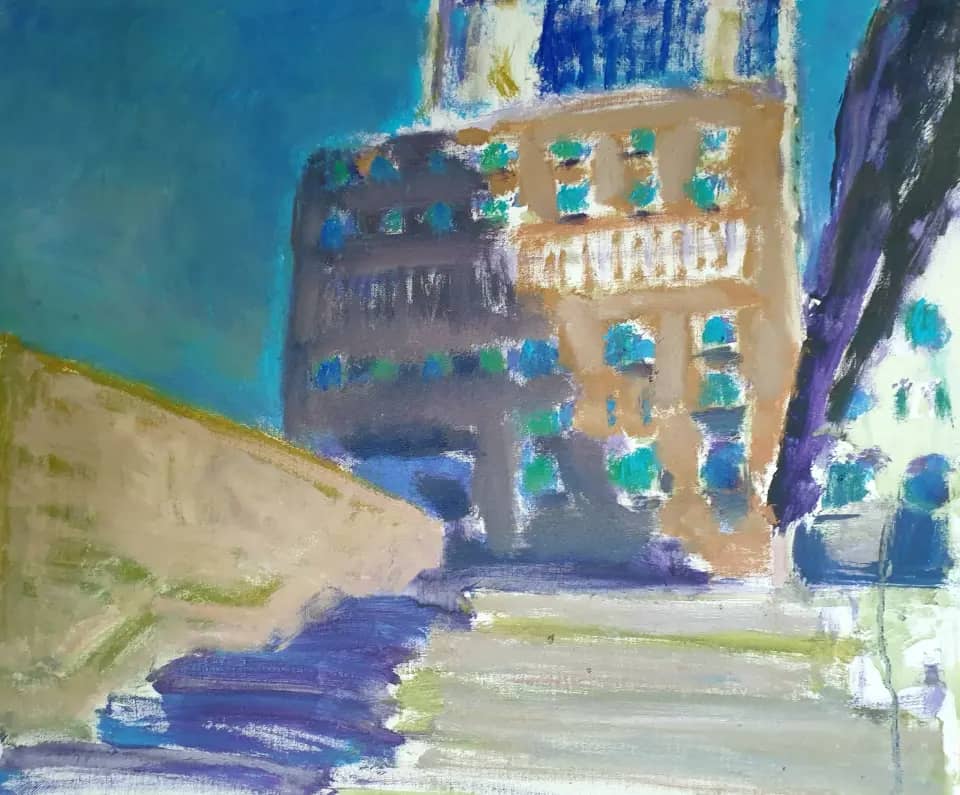
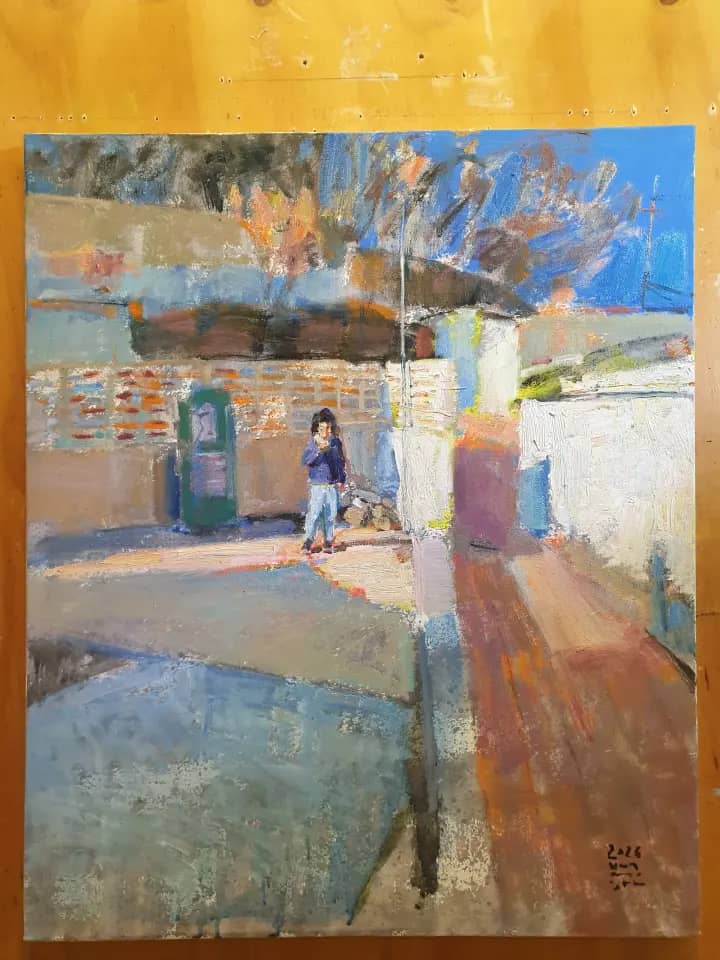
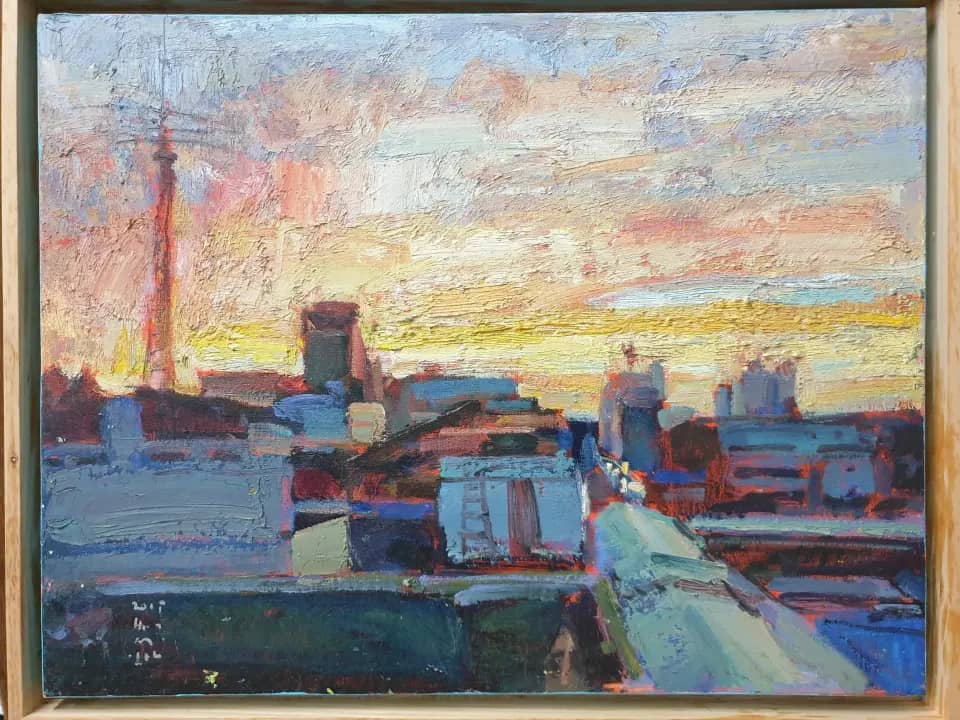
He has remained in the region ever since. Based in Gwangju and South Jeolla Province, he has spent his career looking at the places and people around him — the ordinary landscapes, the faces of neighbours and contemporaries, the spaces that are being built, changed, or lost. His paintings are characterised by bold, forceful brushwork and vivid colour: marks that carry energy and directness, surfaces that are immediate and alive.
But the work is not only about looking. In the everyday scenes Park Seongwan paints — the construction sites, the streets, the faces met in squares and markets — he draws out what lies beneath: the sensibility and memory of the community, the historical consciousness of people living through their own time. His practice has been described in connection with the Gwangju Biennale's regional programme as focusing on revealing “our stories” — the shared life that belongs to a particular place and its people.
Across more than two decades of solo and group exhibitions — in Gwangju, Damyang, Seoul, Daegu, and further afield in Malaysia, Thailand, and the Philippines — Park Seongwan has steadily deepened a painterly language that is rooted in place, attentive to time, and generous to the people it depicts. His residency at Mali Home in Penang (2012) and subsequent international group shows extended his practice beyond the region without severing its roots.
Most recently, his 2026 solo exhibition Spring Gwangju, Autumn Daegu (Mon Gallery, Daegu) and his 2024 exhibition People Met at Candlelight Square (Gallery Saenggaksangja, Gwangju) demonstrate a practice in which the personal, the political, and the communal are never fully separated — and in which painting remains the medium best suited to holding them together.
Major themes
- 1
Regional landscape and everyday life
Gwangju and South Jeolla provide the visual and emotional terrain of his practice — ordinary places and moments re-encountered through forceful, immediate painting.
- 2
Communal memory and the people's sensibility
Beneath the visible surface of landscape and scene, Park Seongwan reaches for shared history and the emotional consciousness of his contemporaries.
- 3
Bold brushwork and vivid colour
His handling of paint is immediate and energetic — marks that carry the weight of the moment, surfaces that are direct and alive rather than smoothed or distanced.
The artist's timeline
- Edu.BFA, Dept. of Fine Arts, Chonnam National University; MFA in Western Painting, Graduate School, Chonnam National University.
- 2012〈Construction Site Picture Diary〉, Asia Culture Maru, Gwangju. Mali Home Residency, Penang, Malaysia. Eodeung Art Festival Grand Prize.
- 2015〈Under Construction〉, Space K, Gwangju; 〈Construction Site Diary〉, Kumho Gallery, Gwangju.
- 2016–17〈RIVERS〉 Asian Contemporary Art Network, Gwangju Museum of Art. 〈Unexpected Everyday〉, Lotte Gallery, Gwangju. 〈From Berlin to Georgetown〉, China House, Penang. Korea-Thailand Contemporary Art Exhibition.
- 2020–21〈Light and the Heart’s Hometown〉, Haedong Culture & Art Village, Damyang. 〈5·18 40th Anniversary May Art Festival〉. Honglim Creative Studio residency.
- 2024〈People Met at Candlelight Square〉, Gallery Saenggaksangja, Gwangju. 〈Interwoven Stories〉, Sakima Art Museum.
- 2026〈Spring Gwangju, Autumn Daegu〉, Mon Gallery, Daegu. 〈Acrylic Smashing〉, Gallery B, Seoul.
Selected awards & residencies
- 2012 Eodeung Art Festival — Grand Prize
- 2020 Honglim Creative Studio Residency, Gwangju
- 2012 Mali Home Residency, Penang, Malaysia
- International group exhibitions in Malaysia, Thailand, and the Philippines; featured in the 8th Gwangju Biennale 〈Man In Bo〉 (2010)
Three essays —
on the work and its roots
1Gwangju and South Jeolla — the landscape as subject
Park Seongwan has painted the landscape of the region he inhabits for more than two decades. This is not a choice to stay provincial; it is a choice to look carefully. The streets of Gwangju, the villages of South Jeolla, the construction sites and galleries and squares where people gather — all of these become, under his brush, material as rich and demanding as any.
His series of construction-site paintings — shown across multiple exhibitions from 2012 through 2015 — took a subject that is usually invisible in fine art and made it central. The temporary, the unfinished, the zone between one state of a place and another: these were precisely what his bold, energetic brushwork was built to render. The paintings hold the site in its moment of transformation, before the scaffolding comes down and the ordinary resumes.
In later work — Landscape Beyond the Wind, Light and the Heart’s Hometown — the landscape becomes more lyrical, more interior. Place is still the subject, but what the painting reaches for is the emotion and memory that settle into a landscape over time: what it feels like to have grown up near these hills, to have passed through these streets, to carry a place inside you.
2The emotion and memory of contemporary people
Park Seongwan's paintings are full of people. Or rather: they carry the presence of people even when figures are absent — in the lit window, the worn pavement, the half-finished wall. His practice has consistently returned to what he has described as “our stories”: the collective life that a particular community lives in a particular time.
This becomes explicit in exhibitions like People Met at Candlelight Square (2024), which centres on figures encountered in the spaces of civic gathering — the squares and streets where public life is made visible. The title refers to the candlelight protests that have been a recurring feature of Korean civic life; the paintings hold the faces and presences of people who showed up to make history in small, ordinary ways.
This attention to historical consciousness runs through his group show participations as well — from the 5·18 40th Anniversary May Art Festivalto exhibitions on climate justice, on the memory of specific political moments, on the shared life of communities across South Jeolla. In all of these, Park Seongwan's painting is less a record than an act of witness: a way of saying that this happened, these people were here, and painting can hold that.
3Locality, publicness, and the medium of painting
To paint a place for more than two decades is to make an argument: that the particular matters, that what happens in Gwangju and South Jeolla is not a provincial footnote but a centre of its own. Park Seongwan's sustained practice in the region is itself a kind of claim — that painting rooted in place can carry as much weight, can say as much, as painting rooted anywhere else.
That claim extends to the social dimension of his work. His participation in group exhibitions on civic memory, climate justice, and historical commemoration — and his residencies at community-oriented spaces — reflect an understanding of painting as a public medium: not a luxury object made for collectors, but a way of attending to what a community experiences and needs to remember.
This is why Park Seongwan participates in this campaign as a fellow in solidarity with artists facing financial exclusion. His practice has always held that art is not separate from the conditions under which people live — and that those conditions, including financial ones, shape what can and cannot be made. The work sold here flows into the mutual-aid fund so that the next generation can keep painting.
From the construction sites of Gwangju to the candlelight squares of our times, Park Seongwan has built a sustained practice of painting rooted in place and attentive to the people who inhabit it. He joins this campaign in solidarity with fellow artists — so that the next generation might keep painting this land and its people.
Selected Works
4 works are featured here.
Park Seongwan joined this campaign in solidarity with fellow artists. Every work sold flows directly into the artists' mutual-aid loan fund— a purchase becomes the next month's lifeline for an artist navigating financial exclusion today.