Tradition, carried forward
into the present
Forty years on a single path of folk painting.The old symbols of blessing, rendered in luminous color.
Folk painting, renewed —
tradition in a contemporary hand
Minhwa — Korean folk painting — was never the art of the court or the literati. It was the picture of ordinary people: tigers to ward off misfortune, peonies for wealth, lotus and pomegranate for abundant children, books and brushes for learning. Pinned to a wall at New Year or a wedding, it carried wishes more than it carried signatures, and for that reason most of it came down to us anonymous.
Seo Gongim has spent more than forty years on this single path. She learned traditional folk painting in the old way, by copying the established types — the flower-and-bird picture (hwajodo), the scholar's bookshelf (chaekgado), the character paintings (munjado), the ten symbols of longevity (sipjangsaeng). Out of that long apprenticeship she built something her own.
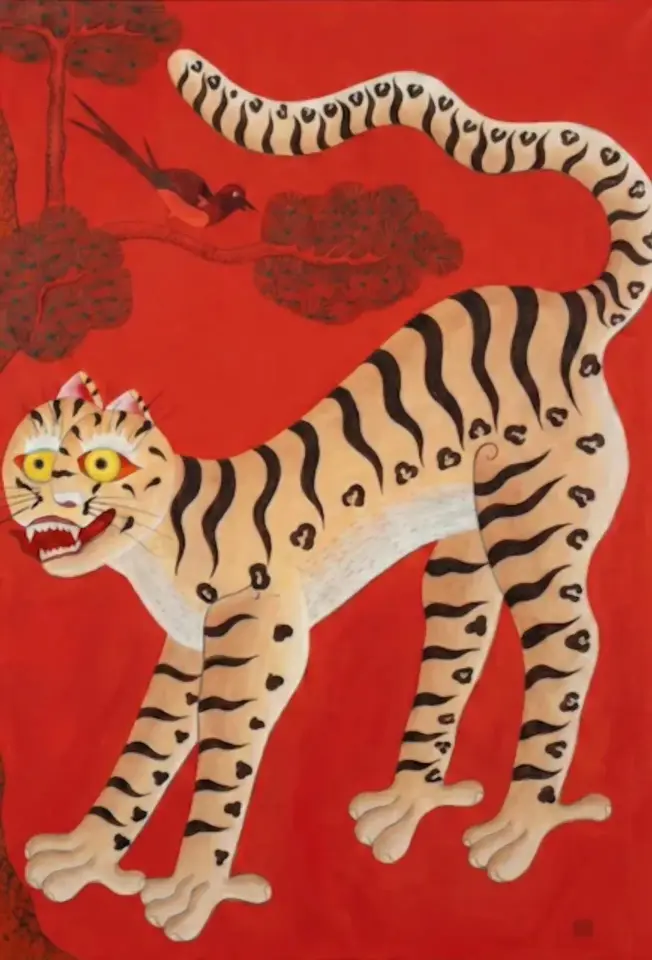
What sets her work apart is a contemporary reinterpretation of tradition. She keeps the symbolic grammar of minhwa intact, yet renders it in clear, luminous color rarely seen in the genre, with a simplified and confident composition that speaks to a modern eye. The tiger she has returned to again and again — the guardian beast of the folk imagination — becomes, in her hand, both an old talisman and a new picture.
She has also worked, persistently, to bring minhwa out of the specialist's circle and into everyday life — through teaching, exhibitions such as Spellbound by Minhwa, and books including the Minhwa Coloring Wish Book, in which she selected and drew the source images so that anyone might pick up a brush. Hers is the work of a master who treats popularization not as a dilution of tradition but as its survival: a living art only stays alive in many hands.
Major themes
- 1
Tradition reinterpreted
The symbolic grammar of minhwa kept intact, yet rendered in clear, luminous color and a confident contemporary composition.
- 2
Symbols of blessing & protection
Tigers that ward off misfortune, peonies for fortune, lotus and pomegranate for abundance — the folk wishes carried by hwajodo, chaekgado and munjado.
- 3
Bringing minhwa to everyone
Teaching, exhibitions and books such as the 〈Minhwa Coloring Wish Book〉 carry folk painting out of the specialist circle and into many hands.
Genres of folk painting
- Hwajodo (화조도) — flowers and birds, for love and prosperity
- Chaekgado (책가도) — the scholar’s bookshelf, for learning and aspiration
- Munjado (문자도) — character pictures of the Confucian virtues
- Tiger & magpie, sipjangsaeng (십장생) — guardian beasts and the symbols of long life
Three essays —
on folk painting and its keeper
1The people’s picture — what minhwa was
For most of the Joseon period, painting that hung in palaces and scholars' studies was the work of trained court painters and literati. Minhwa was the other tradition: pictures made by and for ordinary people, often by unnamed itinerant painters, to be hung at New Year, at a wedding, at a sixtieth birthday. They were not collected as masterpieces; they were used.
Their grammar was a grammar of wishes. A tiger drove away the misfortunes of the coming year; a pair of magpies brought good news; peonies promised wealth and honor; lotus and pomegranate, many children; the ten symbols of longevity, a long life. Munjado spelled out the Confucian virtues in the very strokes of their characters. To read a minhwa is to read what a household hoped for.
Precisely because it served life rather than the art market, minhwa was long dismissed by official art history. Its rediscovery in the twentieth century — as one of the most distinctive and inventive bodies of Korean visual culture — owes much to the painters who kept practicing it when it was unfashionable to do so.
2Forty years on one path — copy, then make new
Folk painting is learned by copying. The apprentice repeats the established types — the same tiger, the same peony, the same bookshelf — until the form is in the hand and not only in the eye. It is slow, unglamorous training, and it is the foundation on which any personal voice in this genre has to be built.
Seo Gongim has kept to this path for more than forty years. What grew out of that discipline is a body of work that is unmistakably hers: the traditional motifs are all present, but the color is clearer and more transparent than the genre usually allows, and the composition is pared down to a modern clarity. She has returned to the tiger again and again, a motif that has become almost a signature.
Her contemporary minhwa keeps the symbolism of the old pictures while letting the feeling and the life of the present enter them. It is reinterpretation, not replacement — the tradition carried forward rather than left behind, in the hands of a master who has made the genre her life's work.
3Popularization as preservation — the brush in many hands
A folk art lives differently from a museum art. It does not survive by being guarded behind glass; it survives by being made — copied, hung, given, made again. Seo Gongim has understood this and built a second strand of her practice around it: bringing minhwa back into ordinary hands.
Through teaching, through exhibitions such as Spellbound by Minhwa, and through books including the Minhwa Coloring Wish Book— for which she selected and drew the source images so that beginners could follow them — she has turned the genre into something anyone can pick up. To put a brush in a stranger's hand is, for a folk painter, the surest form of conservation.
That outreach has carried minhwa outward as well — toward audiences beyond Korea, as a living face of Korean visual culture rather than a museum relic. Popularization and internationalization, in her work, are not a softening of tradition but its continuation by other means.
Over four decades, Seo Gongim has done two things at once: kept a quiet, exacting faith with the oldest of Korean folk traditions, and opened it wide enough that anyone might enter. She joins this campaign not as a subject of its cause but as a fellow artist in solidarity — so that the painters who come after might keep their brushes moving without the weight of financial exclusion.
Selected Works
2 works are featured here.
Seo Gongim joined this campaign in solidarity with fellow artists. Every work sold flows directly into the artists' mutual-aid loan fund— a purchase becomes the next month's lifeline for an artist navigating financial exclusion today.