A city, cropped
and restacked into landscape
He crops a fragment of the city and reassembles it.Retro and dystopia — the architecture of an age of self-replication.
The cropped city —
architecture as a reconstructed gaze
Sin Geonwu (b. 1986) is a mid-career artist who reconstructs the scenery of city and architecture into visual art. He studied at Induk University, receiving a bachelor's degree in Media Art & Design in 2016. From the grammar of media and design he carries a structural eye for surface, frame, and reproduction — the building blocks of the contemporary city.
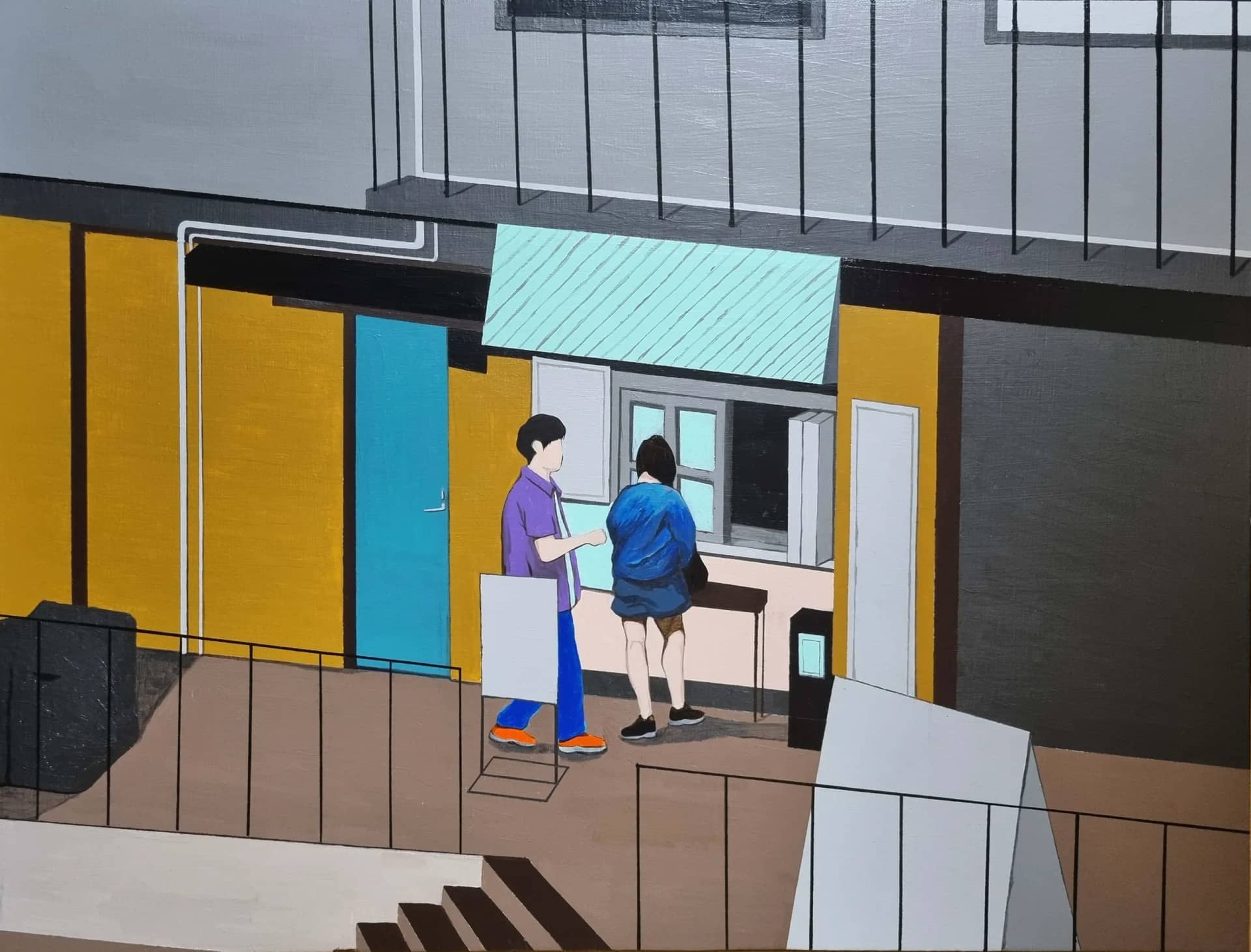
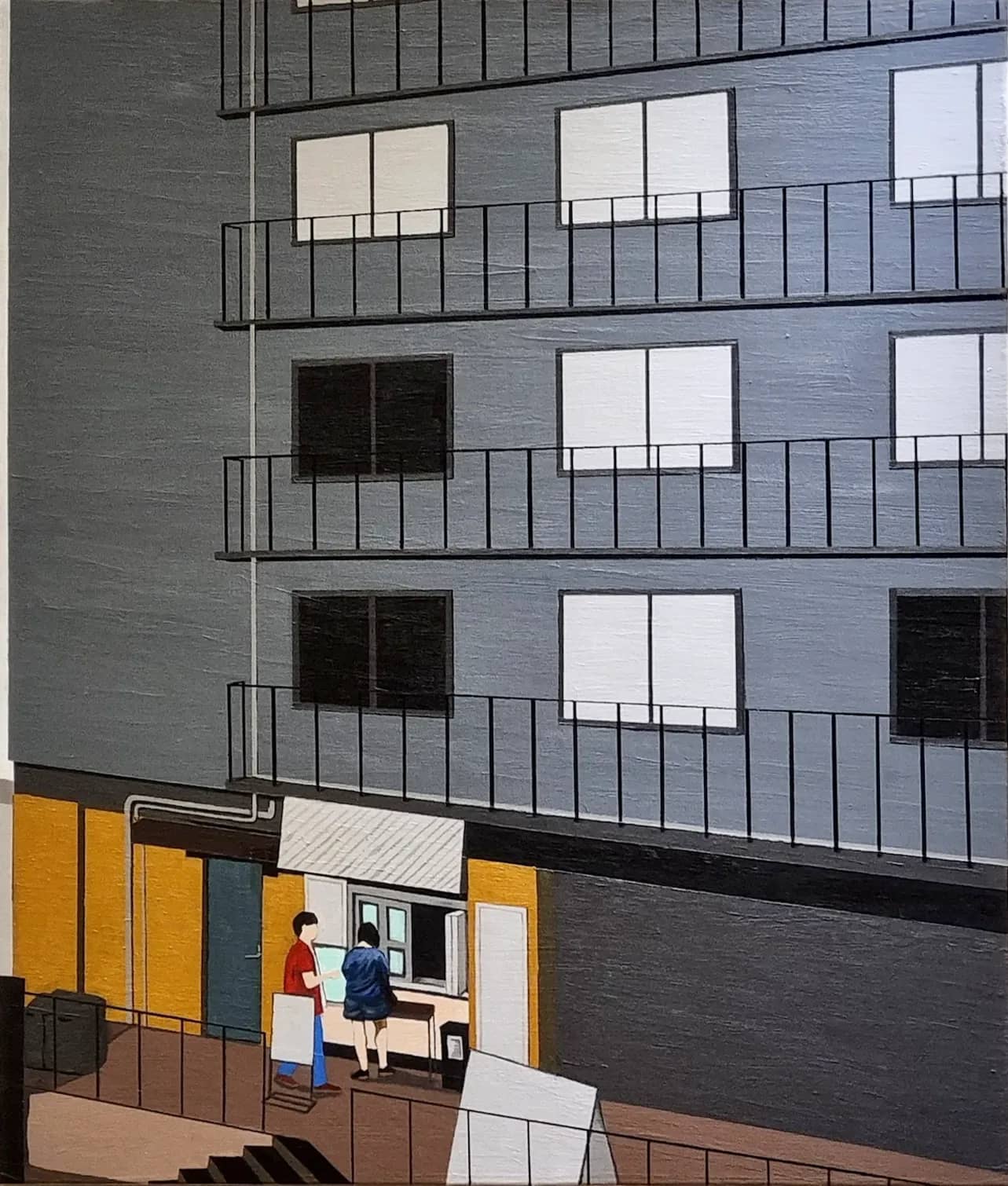
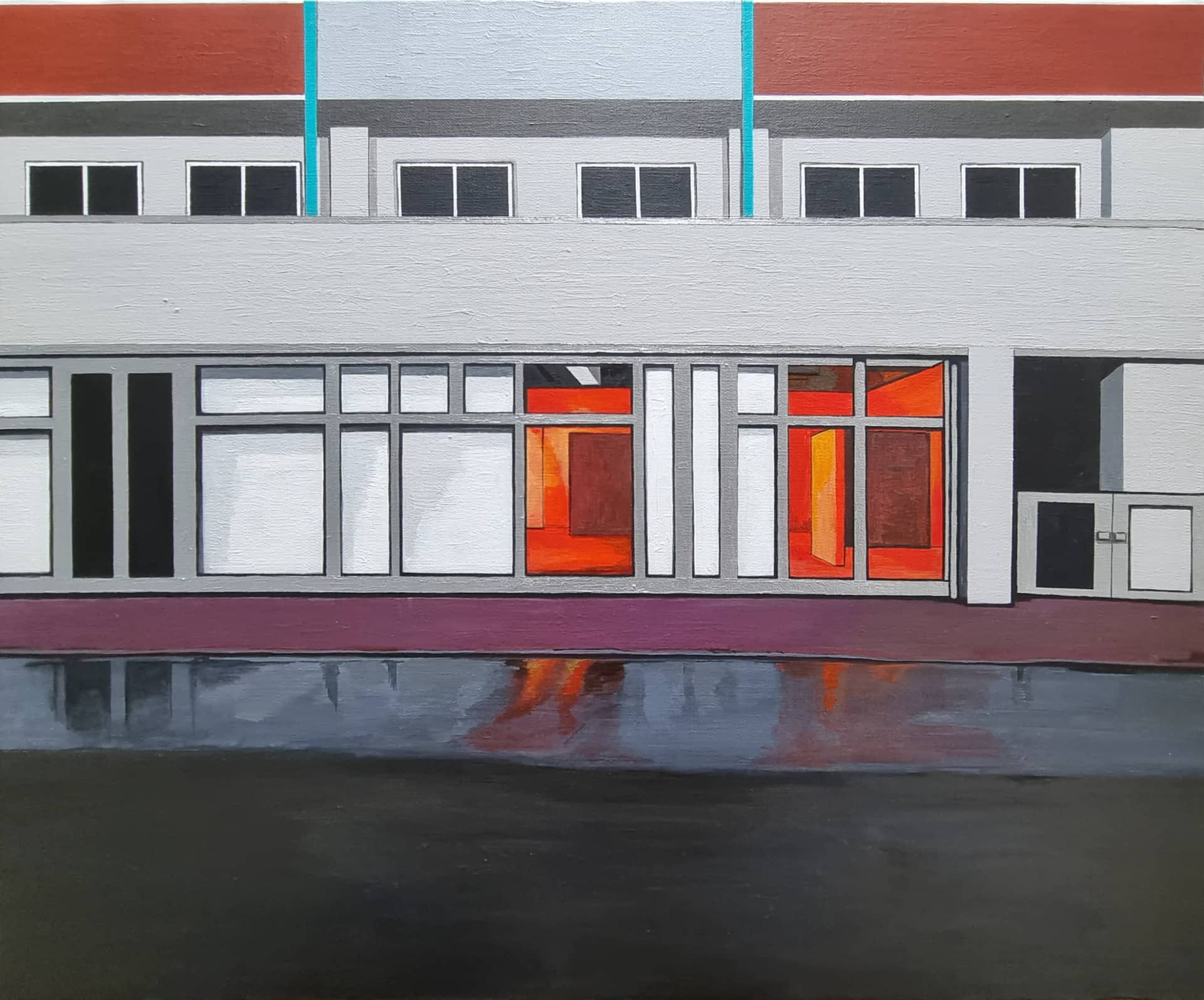
His practice crops a fragment of the urban scene and restacks it. In the 〈Cropped City〉 series — shown at Gallery Onui, Seoul, in 2022 — the city is not described but cut apart and reassembled, its architectural blocks rearranged into a landscape that is at once familiar and estranged. The frame of the canvas behaves like a camera crop: what is left out matters as much as what remains.
Across solo exhibitions he has returned to the registers of retro and dystopia. In 2021 PRESENT (Gallery Chosun) and Architectural Landscape (YOONION ART SPACE, Seoul) framed the built environment as a structural subject; in 2019 RETRO (Coutances Art Center, France) and in 2018 Destroy the Distopia(Monthly) pressed the city's nostalgic and apocalyptic registers against each other.
The question of reproduction runs through the work. His 2022 exhibition DUAL: The Artwork in the Age of Self-Replication(BGM Gallery, Lotte World Tower) takes the title's wager seriously — what does an original mean when the city itself is built from repetition, copy, and template? From the 2016 Self-Funeral (MAKSA) onward, his exhibitions have treated the city as a body that endlessly duplicates and discards itself.
He has built his practice through residencies as much as galleries — Daegu Art Factory (15th, 2025), Dalcheon Art Creation Space (4th, 2024), Science Walden at UNIST (2021), Suchang Youth Mansion (2nd, 2020), and Coutances Art Center in France (1st, 2019). His work is held in the collections of the Gangwon Cultural Foundation, Hori Art Space, the Coutances Art Center, the Coutances municipal museum, Galerie Pont des Arts, and Gallery Yiang.
Major themes
- 1
Cropped City
A fragment of the urban scene is cut out and restacked — the frame works like a camera crop, where what is left out matters as much as what remains.
- 2
Retro and dystopia
The built environment held between nostalgia and apocalypse — the city read as both a memory and a warning.
- 3
The age of self-replication
A structural question about the original when the city is built from repetition, copy, and template.
The artist's timeline
- 1986Born.
- 2016B.A. in Media Art & Design, Induk University; solo exhibition 〈Self-Funeral〉 (MAKSA).
- 2018Solo exhibitions 〈Walking Narratives〉 (Space55) and 〈Destroy the Distopia〉 (Monthly).
- 2019Solo exhibition 〈RETRO〉, Coutances Art Center, France; residency, Coutances Art Center (1st).
- 2020Residency, Suchang Youth Mansion (2nd); participating artist in MMCA Seoul education programs 〈Just Modern〉 / 〈Gathering〉.
- 2021Solo exhibitions 〈PRESENT〉 (Gallery Chosun) and 〈Architectural Landscape〉 (YOONION ART SPACE, Seoul); residency, Science Walden (UNIST).
- 2022Solo exhibitions 〈Cropped City〉 (Gallery Onui, Seoul), 〈Sin Geonwu’s Strolling Mind〉 (Mir Gallery, Daegu), and 〈DUAL: The Artwork in the Age of Self-Replication〉 (BGM Gallery, Lotte World Tower).
- 2024Solo exhibition 〈The Banal Is the New〉 (Dalcheon Art Creation Space, Daegu); residency, Dalcheon Art Creation Space (4th).
- 2025Residency, Daegu Art Factory (15th); group exhibitions at the Dalseong Daegu Contemporary Art Festival and 〈Time That Became Art〉 (Hyundai Department Store, Apgujeong).
Selected exhibitions & collections
- Solo: 〈Cropped City〉, Gallery Onui, Seoul (2022); 〈DUAL: The Artwork in the Age of Self-Replication〉, BGM Gallery, Lotte World Tower (2022)
- Solo: 〈PRESENT〉, Gallery Chosun (2021); 〈RETRO〉, Coutances Art Center, France (2019); 〈The Banal Is the New〉, Dalcheon Art Creation Space, Daegu (2024)
- Group: Dalseong Daegu Contemporary Art Festival (2025); 〈Time That Became Art〉, Hyundai Department Store, Apgujeong (2025)
- Collections: Gangwon Cultural Foundation, Hori Art Space, Coutances Art Center, Coutances municipal museum, Galerie Pont des Arts, Gallery Yiang
Three essays —
on the city he cuts and rebuilds
1From media and design to the urban landscape
Sin Geonwu came to painting through media and design. His 2016 bachelor's degree in Media Art & Design at Induk University gave him a grammar of surface, screen, and frame rather than the inherited vocabulary of landscape painting. That origin shows in how he treats the city: not as a view to be rendered, but as material to be edited.
From his earliest solo exhibitions — 〈Self-Funeral〉 (MAKSA, 2016), 〈Walking Narratives〉 (Space55, 2018) — the work moves like a designer's layout: cropping, framing, repeating. The architectural scene is composed in blocks, each one selected and placed, so that the finished image reads as a constructed proposition about the city rather than a transcription of it.
By 〈Architectural Landscape〉 (YOONION ART SPACE, 2021), the building had become his explicit subject. The structures are not backdrops for human narrative; they are the narrative — stacked, mirrored, and cut to expose the logic of how a contemporary city is assembled.
2〈Cropped City〉 — the form of a severed city
The 2022 exhibition 〈Cropped City〉 (Gallery Onui, Seoul) names the method. To crop is to choose an edge — to decide where the world stops. Sin Geonwu's canvases take that editorial cut as their first gesture: a fragment of the city is severed from its context and set on its own terms.
What follows the cut is reassembly. The cropped blocks are restacked, sometimes mirrored, sometimes repeated, into a landscape that holds together by composition rather than by geography. The result is a city you recognize without being able to locate — a place built from the grammar of urban form rather than from any single street.
The frame thus carries the argument. By making the crop visible — by letting the cut be felt as a cut — the series asks how much of what we call “the city” is already a matter of framing: of what the camera, the developer, the map chooses to include and discard.
3The artwork in the age of self-replication
His 2022 exhibition 〈DUAL: The Artwork in the Age of Self-Replication〉 (BGM Gallery, Lotte World Tower) turns the question of reproduction onto the work itself. If the contemporary city is built from repetition — the same tower, the same template, the same façade copied block by block — then what does an original painting of that city mean?
The retro and dystopian registers he had already explored in 〈RETRO〉 (Coutances Art Center, 2019) and 〈Destroy the Distopia〉 (Monthly, 2018) return here as the affective tone of self-replication: nostalgia for an origin that may never have existed, and dread of a future that is only more of the same. The city duplicates and discards itself, and the painting records both the duplication and the discard.
With the 2024 exhibition 〈The Banal Is the New〉 (Dalcheon Art Creation Space), the wager sharpens: in an age where everything is reproduced, the banal — the repeated, the templated, the ordinary block of the city — is precisely where the new must be found. It is a structural, unsentimental position, and it is the through-line of his practice.
From 〈Self-Funeral〉 to 〈Cropped City〉, Sin Geonwu's work has pursued a single question: how is a city assembled, and what does it mean to cut a piece of it free and call it a landscape? The answer, built across galleries and residencies in Korea and France, is an architectural vocabulary of cropping and restacking. He joins this campaign not as a subject of its cause but as a fellow artist in solidarity — so that those who come after might have the room to build.
Selected Works
4 works are featured here.
Sin Geonwu joined this campaign in solidarity with fellow artists. Every work sold flows directly into the artists' mutual-aid loan fund— a purchase becomes the next month's lifeline for an artist navigating financial exclusion today.