Light carved into ox horn
between hwagak and minhwa
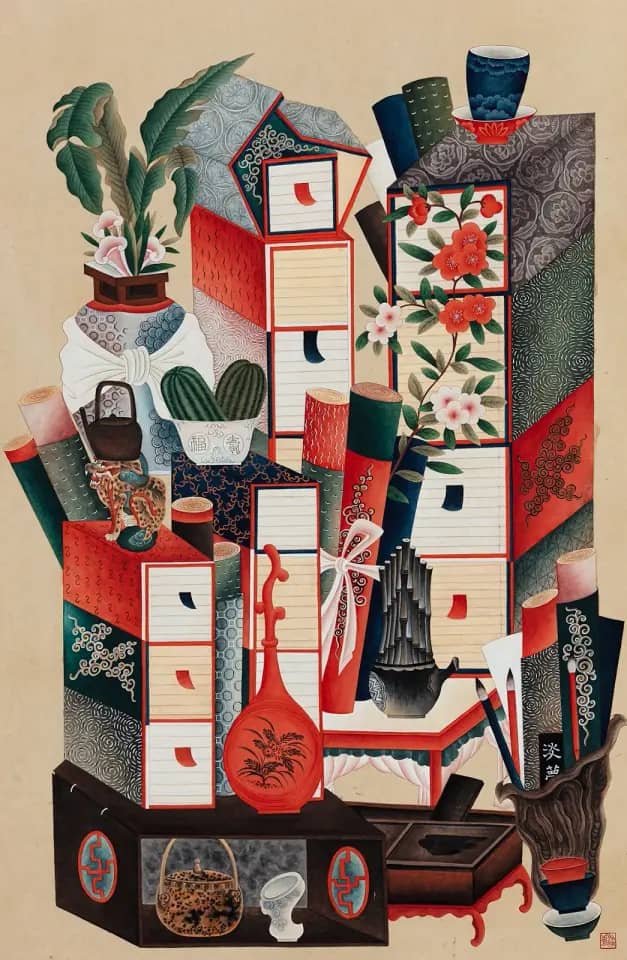
The brilliant colour of a vanishing royal craft, carried into painting.The precision of painted ox horn meets the free hand of folk imagery.
From horn to canvas —
the grain of a royal craft
Sin Yeri (pen name Dammong, 淡夢 — ‘a faint dream’) is a mid-career Korean artist who carries the grain of two traditions — hwagak (華角) painted ox-horn craft and minhwa folk painting — into a contemporary painterly language. She graduated from the Department of Textile Art at Gyeongwon University (now Gachon University) in 2003.
For ten years she served as lead designer at the Han Chun-seop hwagak studio run by a Gyeonggi Intangible Cultural Heritage hwagak master — a rare, sustained immersion in one of Korea's most exacting royal crafts. Hwagak is a uniquely Korean technique: the horn of an ox is ground until it is thin and translucent as paper, its reverse painted in brilliant dancheong mineral pigment, then glued onto a wooden body so the colour glows through the horn from beneath.
That decade taught her the discipline of the craft from the inside — the patience of the horn-grinder, the precise registration of motif and ground, the five cardinal colours of dancheong. From this foundation she now directs her own practice as head of Dammong, a minhwa craft studio, translating the iconography of folk painting — auspicious birds and flowers, the ten symbols of longevity — onto the painted surface.
Her work sits deliberately between craft and painting: the jewel-like saturation and meticulous outline of horn-craft, loosened by the free, generous hand of folk imagery. She has been invited as a featured artist to the Korea National Fine Art Special Invitational Exhibition, shown at the SNAF Seongnam Art Fair artist exhibition, and participated in Mokwonhoe group shows.
Major themes
- 1
The craft of painted ox horn
Ten years inside a royal craft — horn ground translucent, dancheong painted on its reverse, colour glowing through from beneath.
- 2
The free hand of minhwa
Auspicious birds and flowers, the ten symbols of longevity — folk iconography loosened from the rigour of the craft into painting.
- 3
Dammong — a faint dream
Her pen name names a sensibility: brilliant tradition rendered tender, the saturated colour of the craft drawn toward a quieter, dreamlike register.
The artist's path
- 2003Graduates from the Dept. of Textile Art, Gyeongwon University (now Gachon University).
- 10년Lead designer for a decade at the Han Chun-seop hwagak studio under a Gyeonggi Intangible Cultural Heritage hwagak master.
- 현재Directs Dammong, her own minhwa craft studio.
- 초대Featured artist, Korea National Fine Art Special Invitational Exhibition.
- 전시SNAF Seongnam Art Fair artist exhibition; Mokwonhoe group exhibitions, among others.
On the craft of hwagak
- Hwagak (華角) is a uniquely Korean lacquer craft — ox horn ground translucent, painted on its reverse, and inlaid onto wood. It was designated National Intangible Cultural Heritage (Hwagakjang) in 1996.
- Nacre and hwagak stand as twin peaks of Korean royal craft. Where neighbouring cultures inlaid tortoiseshell, only Korea developed the painted ox-horn technique.
- Its dancheong palette rests on five cardinal colours — red, blue, yellow, white, black — high in value and brilliance. Its motifs draw on folk iconography: the ten symbols of longevity, birds and flowers, dragons and fish.
- Because horn was scarce and the process exacting, hwagak pieces were rare luxuries of the royal court and yangban elite — a precision Sin Yeri carries from object into painting.
Three essays —
on horn, colour, and the dream
1Hwagak — the craft of light through horn
Hwagak — literally ‘brilliant horn’ — is among the most exacting of Korea's royal crafts. The horn of an ox, ideally a grain-fed three-year-old chosen for its clarity, is heated, pressed, and ground until it becomes a sheet thin and translucent as paper. On its reverse the artisan paints in dancheong mineral pigment; the painted sheet is then glued onto a wooden body, and the surrounding ground is finished in lacquer. The colour is thus seen through the horn — protected by it, lit from beneath it.
It is a craft of inversion and patience. The image must be painted in reverse, in mirror, so that it reads correctly through the translucent sheet. The five cardinal colours of dancheong — red, blue, yellow, white, black — sit high in value, giving hwagak its characteristic brilliance, a saturated radiance no other Korean craft quite matches.
Nacre lacquerware and hwagak are often named the twin peaks of Korean court craft. Yet hwagak is the rarer and more uniquely Korean of the two: where neighbouring cultures inlaid tortoiseshell, only the Korean tradition developed the painted ox-horn technique to this degree. Scarce material and difficult process kept hwagak pieces to the royal court and yangban elite — a craft that, by the twentieth century, came close to disappearing.
2Minhwa — the iconography of good fortune
The motifs that travel across hwagak surfaces are the same that fill Korean minhwa, folk painting: the ten symbols of longevity (sun, mountain, water, rock, pine, crane, deer, tortoise, cloud, and the herb of eternal life); birds and flowers; dragons and fish. These are not merely decorative. They are an iconography of good fortune — wishes for long life, fertility, and protection, painted into the daily objects of a household.
Minhwa was the painting of the people: practical, generous, often anonymous, made to decorate a living space rather than to be hung in a scholar's study. Its hand is freer than that of court painting — its proportions loosened, its colour exuberant, its rules bent toward warmth. Where hwagak demands exactitude, minhwa offers release.
Sin Yeri works in the seam between the two. She knows the discipline of the craft from a decade inside the workshop; she carries its precise outline and jewel-like colour. But onto the painted surface she lets the free hand of folk imagery breathe — the auspicious bird, the blossoming branch, the tortoise of long years — so that rigour and generosity meet in a single frame.
3Dammong — the dream that softens the brilliance
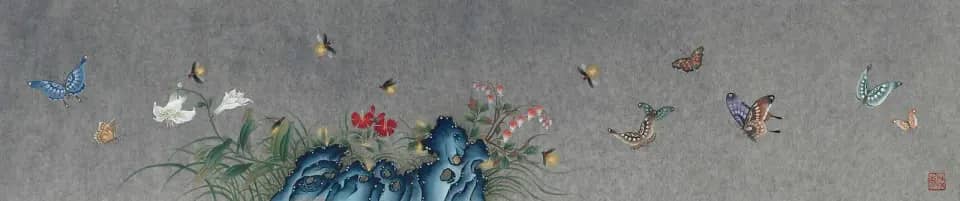
Her pen name, Dammong (淡夢), reads as ‘a faint dream’ — 淡 for the pale, the diluted, the quiet; 夢 for dream. It names a sensibility rather than a subject. The brilliance of the craft is real, but it is drawn here toward a softer register, as if remembered rather than displayed.
This is the distinctive turn of her practice: a tradition known for its saturated, almost dazzling colour, carried into a tenderer key. The five-colour radiance of dancheong remains, but it is held at the temperature of a dream — present, luminous, and gentle at once. The precision survives; the hardness softens.
From the textile studio to the hwagak workshop to her own studio Dammong, Sin Yeri has followed a single thread: how to keep a vanishing royal craft alive by giving it a contemporary voice — neither museum reproduction nor pure invention, but a living continuation. She joins this campaign not as a subject of its cause but as a fellow artist in solidarity, so that the craft she carries, and the artists who carry crafts like it, might have a future.
Between the exacting horn of a royal craft and the free hand of folk painting, Sin Yeri has built a practice that is neither preservation nor pastiche, but a living continuation — the brilliant colour of an old tradition carried, softly, into the present.
Selected Works
3 works are featured here.
Sin Yeri joined this campaign in solidarity with fellow artists. Every work sold flows directly into the artists' mutual-aid loan fund— a purchase becomes the next month's lifeline for an artist navigating financial exclusion today.