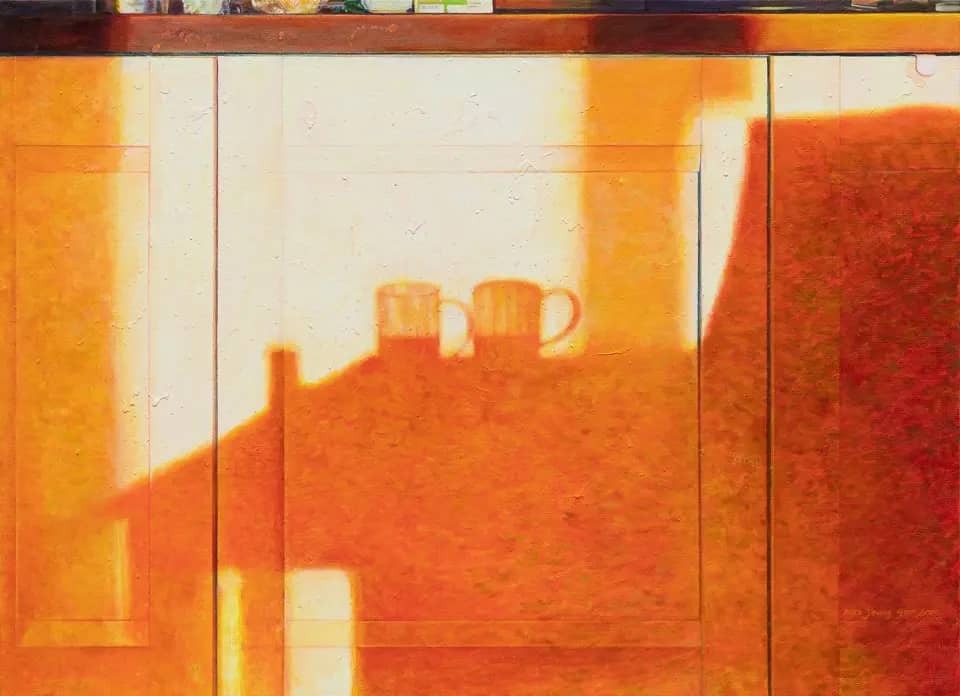
Where the light
has passed
Not the object itself, but the way of seeing it.Existence, surfacing through shadow and the underside.
The way of seeing —
painting the gaze, not the thing
Jeong Yeonsu is a painter who translates into painting the time and the gaze that reside in everyday objects. Her concern is not the object as a thing to be depicted, but the act of looking that falls upon it — what she names the way of seeing. A cup, a chair, a small implement on a table: in her work these are not subjects to be reproduced but occasions through which a gaze can be made visible.
This intention gives her central body of work its title. The 〈reflection (where the light has passed)〉 series sets out to paint not the object itself but the way one sees it, and turns toward shadow and the underside — the parts of a thing that are usually overlooked — as the place where its presence is most fully disclosed. What the front of an object withholds, its shadow returns.
To paint the reverse and the shadow rather than the lit face is a quiet argument about how existence becomes known. A thing is not only the surface that meets the eye; it is also the trace it casts, the dark it displaces, the light that has already moved across it and gone. By attending to the underside, her paintings explore a possibility within painting itself — that existence is revealed less by illumination than by the marks the light leaves as it passes.
Her practice begins from a thought about the present. In a digitised, de-materialised age, the everyday objects around us grow steadily thinner — replaced by screens, dissolved into data, forgotten. Against that fading, Jeong Yeonsu holds to a single conviction: that each small everyday object carries a time and a history of its own. To look closely at such an object, and to paint not the thing but the looking itself, is to insist that what is overlooked is not therefore without weight.
Across her canvases the work stays close to this narrow seam — the gap between the object and the gaze, between the lit face and the shadow it leaves. To stand before her paintings is to be returned, gently, to the things one passes without seeing, and to the time those things have quietly kept.
Major themes
- 1
The way of seeing
She paints not the object as a thing but the act of looking that falls upon it — making a gaze, rather than a surface, visible.
- 2
Shadow and the underside
In the 〈reflection (where the light has passed)〉 series, existence is disclosed through the overlooked reverse of a thing — what the front withholds, the shadow returns.
- 3
The time of everyday objects
In a digitised, de-materialised age, she holds that each fading everyday object carries a time and a history of its own.
The artistic premise
- Medium: painting. The subject is not the object but the gaze that meets it.
- Central body of work: the 〈reflection (where the light has passed)〉 series.
- Method of disclosure: existence revealed through shadow and the underside, rather than the lit face.
- Point of departure: the conviction that, in a de-materialised age, each everyday object holds a time and history of its own.
Three essays —
on the gaze, the shadow, and the thing
1Not the object, but the way of seeing it
Most still life begins with a question of resemblance: how faithfully can the thing on the table be returned to the surface of the canvas? Jeong Yeonsu's work begins one step earlier — with the looking that precedes the likeness. Her stated aim is to paint not the object itself but the way of seeing it. The object is the occasion; the gaze is the subject.
This is a difficult thing to paint, because a gaze has no surface of its own. It can only be shown indirectly — in what a viewer is led to notice, in where the attention is made to rest, in the parts of a thing the painting chooses to weigh. By organising her canvases around the act of looking rather than the thing looked at, she asks the viewer to become aware of their own seeing: to notice not just the cup, but the noticing of the cup.
In this sense her painting is quietly reflexive. It returns the eye to itself. The everyday object is the mirror in which a way of seeing is caught and held — which is why, in her hands, even the most ordinary thing becomes worth the long attention of a painting.
2〈reflection〉 — where the light has passed
The 〈reflection (where the light has passed)〉 series carries the artist's thinking in its very title. Reflection is both the optical thing — a cast image, a glint, a shadow — and the inward act of pondering. The Korean subtitle, where the light has passed, names a place rather than a source: not the lamp, but the trace it leaves behind once it has moved on.
This is why the work turns toward shadow and the underside. A lit face declares itself; it gives the eye an easy answer. The reverse of a thing, the dark it casts, asks to be read more slowly. By choosing the overlooked side, Jeong Yeonsu lets existence be disclosed in the register of the indirect — an object known not by the light upon it but by the mark the light has left in passing.
There is a tenderness in this. To paint where the light has passed is to attend to absence as carefully as to presence, to grant the shadow the same seriousness usually reserved for the illuminated. In her canvases the thing and its shadow are not figure and background but two halves of a single disclosure — the front showing, the underside telling.
3Objects in a de-materialised age — time, kept
Jeong Yeonsu's attention to the everyday object is not nostalgia for its own sake. It is a response to the present. In a digitised, de-materialised age, the physical things around us are quietly being emptied of weight — functions migrate to screens, possessions dissolve into accounts and data, and the small implements that once held the texture of a life grow thin and forgettable.
Against that thinning, her work holds to a conviction: that each such object carries a time and a history of its own. The chair has held bodies; the cup has met lips; the worn handle remembers a hand. These histories do not announce themselves. They have to be looked for — and looking for them is precisely what her painting practises.
So the two halves of her work meet here. To paint the way of seeing, and to paint where the light has passed, is finally to keep the time that objects hold — to refuse, with the slow means of painting, the forgetting that the age makes easy. Her canvases are a quiet argument that the overlooked thing is not weightless, and that attention is itself a form of keeping.
In painting not the object but the way of seeing it, and in turning toward shadow and the underside to find where existence is disclosed, Jeong Yeonsu pursues a single, patient question: how does a thing make its time known? She joins this campaign not as a subject of its cause but as a fellow artist in solidarity — so that the proceeds of her work might become a low-interest lifeline for artists facing financial exclusion today.
Selected Works
2 works are featured here.
Jeong Yeonsu joined this campaign in solidarity with fellow artists. Every work sold flows directly into the artists' mutual-aid loan fund— a purchase becomes the next month's lifeline for an artist navigating financial exclusion today.