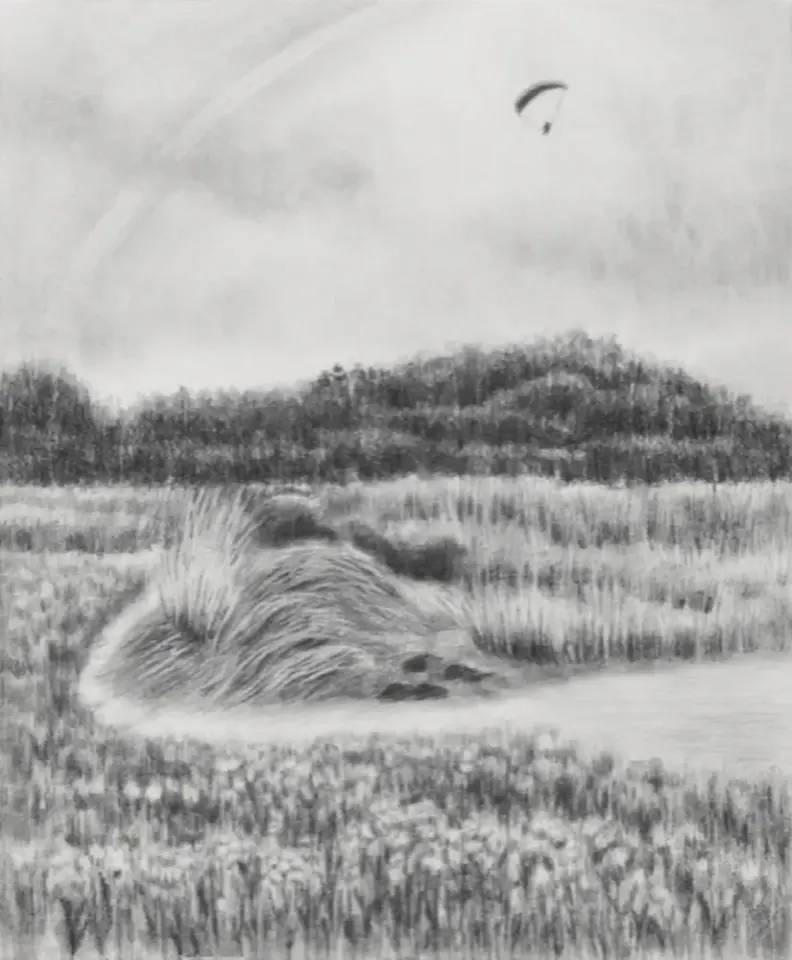
The beauty of
vanishing things
She layers thin ink washes until time itself surfaces.The grain of memory, recorded in the language of ink.
Layered ink —
the grain of time made visible
Kim Yeong-seo is an emerging Korean ink painter who completed her master's degree in the Department of Oriental Painting at the Hongik University Graduate School. Her practice begins from a single, patient premise: that what is disappearing carries a beauty all its own, and that the task of painting is to record the grain of time embedded in it.
She works on jangji — traditional Korean mulberry paper — and on linen, layering thin washes of ink over and over in the manner known as jeongmuk (積墨), the accumulation of ink. Each wash is allowed to dry before the next is drawn over it, so that the surface deepens not by force but by repetition. Pencil and conté enter quietly into the work, and a drawn line becomes the act of giving memory a shape.
In her solo exhibition The Beauty of Vanishing Things(Cyart Space, Seoul, 2022), she set out this artistic premise in full. The subject of her work is not a single scene but the atmosphere and scent peculiar to each person's recollection — the way a childhood sensibility, glimpsed only for an instant, returns to console those enduring the present.
Her restraint is deliberate. By withholding colour and building tone from layer upon layer of pale ink, she lets the form recede so that the depth of the trace can come forward. What is left on the paper is not a record of an object but a record of attention: the fine grain of the everyday, held long enough to be seen.
Across her group exhibitions — from The Depth of Traces at Dongjak Art Gallery (2024) to A Tender Record at the Cultural Experiment Space Hosu (2024) — the same quiet question recurs: how does one keep what is passing without stopping it? Her answer is not to seize the vanishing thing but to sit with it, wash after wash, until its time becomes legible on the surface of the paper.
Major themes
- 1
Accumulated ink (jeongmuk)
Thin washes of ink layered on jangji, each dried before the next — depth built by patience rather than force.
- 2
Memory and nostalgia
Not a single scene but the atmosphere and scent peculiar to each recollection — a childhood sensibility returning to console the present.
- 3
The depth of the trace
Colour withheld, form receding — what remains is a record of attention to the fine grain of the everyday.
The artist's timeline
- M.F.A.Master of Fine Arts, Dept. of Oriental Painting, Hongik University Graduate School.
- 2022Solo exhibition 〈The Beauty of Vanishing Things〉, Cyart Space, Seoul.
- 2023Group shows: 〈A Shop of Artist H〉, Dongtan Art Square; 〈Dongjak: Expansion〉, Dongjak Art Gallery.
- 2024Group shows: 〈The Depth of Traces〉, Dongjak Art Gallery; 〈A Tender Record〉, Cultural Experiment Space Hosu; 〈Art Alliance〉, N2 Art Space.
- 2025Group shows: 〈Manryugwijong〉, Idea Hoegwan; 〈Sai, or _ Sai〉, Gallery Ilho (Hankyoreh Curating School 3rd selected artist); 〈NO MATTER〉, N2 Art Space.
Selected exhibitions
- Solo exhibition: The Beauty of Vanishing Things, Cyart Space, Seoul (2022)
- Group exhibition: The Depth of Traces, Dongjak Art Gallery (2024) — Dongjak Art Gallery curatorial open call
- Group exhibition: A Tender Record, Cultural Experiment Space Hosu (2024) — emerging-artist open call
- Group exhibition: Sai, or _ Sai, Gallery Ilho (2025) — Hankyoreh Curating School 3rd-cohort selected artist
- Group exhibitions: 〈Manryugwijong〉, Idea Hoegwan (2025); 〈Sai Sai Swim〉, Cultural Experiment Space Hosu (2025); 〈NO MATTER〉, N2 Art Space (2025)
Three essays —
on ink, memory, and what remains
1Jeongmuk — depth built by repetition
The technical heart of Kim Yeong-seo's work is jeongmuk (積墨), the accumulation of ink. Rather than seeking depth through a single dark stroke, she lays down a thin, pale wash, waits for it to dry, and draws another over it — and another, and another. Tone is not applied; it is grown.
This is a slow method, and the slowness is the meaning. Each layer holds the time it took to dry, so the finished surface is not a picture of a moment but a sediment of many moments. On jangji paper — absorbent, unforgiving — there is no undoing a wash once it is laid. The painter must commit to patience as a form, accepting that the image will arrive only after the hand has repeated itself enough times for the paper to remember.
Pencil and conté enter at the edges of this process, and the drawn line takes on a particular role: it gives memory a shape. Where the ink builds atmosphere, the line traces the contour of a thing half-remembered — present enough to recognise, faint enough to keep dissolving.
2Vanishing things — beauty in what is leaving
In her 2022 solo exhibition The Beauty of Vanishing Thingsat Cyart Space, Kim Yeong-seo named the premise that has organised her practice since. Her subject is not loss as grief but loss as texture — the particular atmosphere and scent that each person's recollection carries, distorted and softened by the time it has spent inside memory.
A childhood sensibility, glimpsed only for an instant, returns in her work not to be possessed but to console. The paintings are addressed, in a sense, to everyone enduring the present: they offer the small comfort of recognising that what is gone has not simply disappeared but settled into us, changing colour as it goes.
This is why she withholds bright colour. A vanishing thing is not vivid; it is muted, half-erased, surfacing in tones of pale ink. To paint it loudly would be to falsify it. By keeping the palette quiet, she lets the work hold the true register of memory — the way the past speaks softly, and only to those who stop to listen.
3A tender record — attention as a form of keeping
Titles recur across Kim Yeong-seo's exhibitions like a private vocabulary: The Depth of Traces, A Tender Record. Together they describe a single working ethic — that to record carefully is itself a way of keeping what is passing, without pretending to stop it.
Her work does not seize the vanishing thing. It sits with it. The depth that accumulates on the paper is the depth of attention paid over time — wash after wash, a record not of the object but of how long the painter looked. In this sense her paintings are documents of patience as much as of memory.
From The Depth of Traces at Dongjak Art Gallery to A Tender Recordat Hosu, the same quiet question returns: how does one hold what is leaving without arresting it? Kim Yeong-seo's answer is offered in ink — keep company with the thing as it fades, layer by layer, until its time becomes legible on the surface of the page.
From her first solo exhibition to her recent group shows, Kim Yeong-seo's work has pursued a single, patient question: how does one record the grain of time embedded in vanishing things? The answer, built wash by wash, is an ink practice attentive to the fine texture of the everyday. She joins this campaign not as a subject of its cause but as a fellow artist in solidarity — so that those who come after might work with a little less of the weight that financial exclusion places on Korean artists.
Selected Works
2 works are featured here.
Kim Yeong-seo joined this campaign in solidarity with fellow artists. Every work sold flows directly into the artists' mutual-aid loan fund— a purchase becomes the next month's lifeline for an artist navigating financial exclusion today.