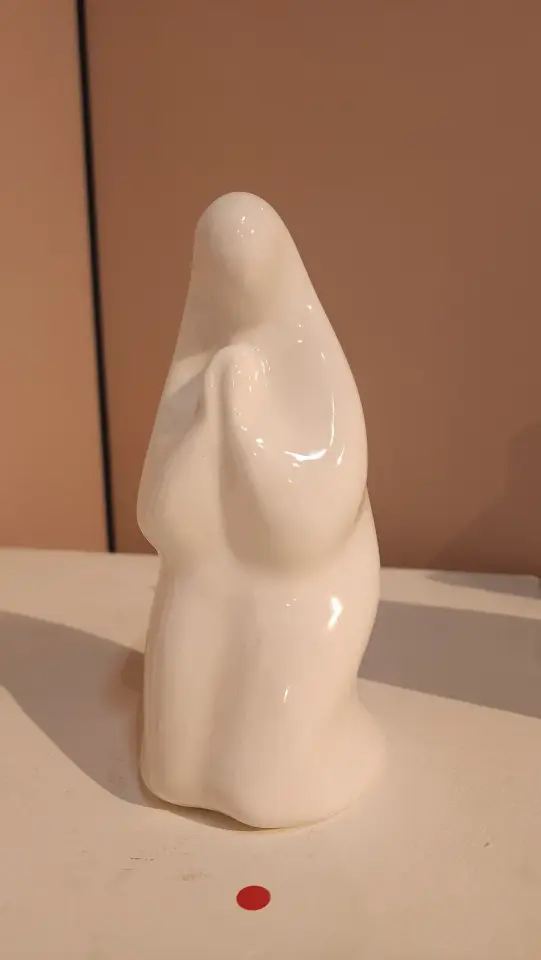
The heart within
an ordinary gesture
She translates the postures of everyday figures into painting.A folded pair of hands, holding the quiet grain of feeling.
A posture held —
the emotion of the everyday
Kim Jeongwon is a painter who translates the postures and quiet emotions of everyday figures onto the canvas. Her subject is not the dramatic event but the small, habitual movement — the way a body holds itself when no one is watching, the gestures so ordinary that we have stopped seeing them.
Among these gestures, one recurs as a kind of anchor: 〈A Person with Folded Hands〉. Folded hands are among the most common of human postures — a sign of waiting, of prayer, of patience, of quietly gathering oneself. In Kim Jeongwon's hands the gesture becomes a vessel: an ordinary movement made to hold the grain of a feeling that has no other words.
Her interest, in other words, is less in the face than in the body — in how posture itself carries emotion. A turned shoulder, a lowered head, a pair of hands brought together: these are the places where the inner life surfaces without being announced. She watches them long enough to paint them, and in that watching the everyday becomes something worth looking at.
What results is a painting that asks for slowness. It does not raise its voice or stage a scene. It sets down a single posture and trusts that a viewer, meeting it, will recognise the grain of feeling it holds — the way a familiar gesture can return us, suddenly, to our own quiet hours.
Major themes
- 1
Posture as emotion
Less the face than the body — how a turned shoulder or a lowered head carries an inner life that is never announced.
- 2
〈A Person with Folded Hands〉
Folded hands — a gesture of waiting, of patience, of quietly gathering oneself — made into a vessel for feeling that has no other words.
- 3
The grain of the everyday
Painting that asks for slowness — a single ordinary movement, watched long enough to become worth looking at.
The painter's gaze
- Medium: painting. The figure and its posture are her constant subject.
- She watches the small, habitual movements of everyday figures — the gestures we have stopped seeing.
- 〈A Person with Folded Hands〉 anchors her practice: an ordinary posture made to hold the grain of feeling.
- The work asks for slowness, trusting the viewer to recognise the quiet emotion it holds.
Three essays —
on gesture, posture, and the everyday
1Gesture as a language — the body before the word
Long before we speak, we hold ourselves in postures. A body waiting, a body bracing, a body at rest — each carries a meaning the face has not yet composed. Kim Jeongwon's painting begins from this premise: that the body is its own language, and that a gesture can say what words would only flatten.
Her figures are drawn from the everyday, and their movements are the kind we perform without noticing — the small adjustments of posture by which a person endures an ordinary hour. By painting them, she returns our attention to what habit has erased. The gesture, lifted out of the rush of the day and held still on the canvas, becomes legible again.
This is a quiet ambition, and a precise one. It asks the painter to read the body closely — to know which tilt of a shoulder reads as fatigue and which as patience, where a posture tips from rest into waiting. The emotion is never captioned; it is built into the pose, and trusted to the viewer's own recognition.
2〈A Person with Folded Hands〉 — a vessel for feeling
Of all the postures she returns to, the folded hands recur most insistently. It is among the most common of human gestures, and that commonness is the point: folded hands belong to no single occasion. They are the shape of waiting, of prayer, of patience, of a person quietly gathering themselves before whatever comes next.
Because the gesture is so open, it can hold almost any feeling poured into it. In Kim Jeongwon's 〈A Person with Folded Hands〉, the hands become a vessel — an ordinary movement made to carry the grain of an emotion that has no other words. The painting does not tell us what the figure feels; it gives us the posture and lets the feeling settle wherever the viewer's own life directs it.
There is a generosity in this. By choosing a gesture everyone has made, the painter leaves room for everyone to recognise themselves in it. The folded hands on the canvas are hers, and the figure's, and — for a moment — the viewer's own.
3To gaze at the everyday — slowness as a form of care
The everyday is, by definition, what we overlook. We move through our ordinary hours too quickly to see them, and the gestures that fill those hours pass unregarded. To paint the everyday, then, is first to slow down enough to look — and that slowness is itself a kind of care.
Kim Jeongwon's practice is built on this attention. She does not dramatise her figures or lend them borrowed significance; she watches a posture long enough to find what it already holds. The result is painting that asks the same slowness of its viewer — that resists the quick glance and rewards the lingering one.
In a culture that prizes the loud and the immediate, this is a quietly radical proposition: that the grain of feeling within an ordinary gesture is worth a painting, and worth our time. To look closely at the everyday is to insist that it matters — that the small movements of a single body are a subject equal to any.
From a pair of folded hands to the quiet postures of everyday figures, Kim Jeongwon's painting has pursued a single question: how does an ordinary gesture hold the grain of a feeling? Her answer is offered in paint — watch closely, slow down, and let the everyday become worth looking at. She joins this campaign not as a subject of its cause but as a fellow artist in solidarity — so that the proceeds of her work might become a low-interest lifeline for artists facing financial exclusion today.
Selected Works
2 works are featured here.
Kim Jeongwon joined this campaign in solidarity with fellow artists. Every work sold flows directly into the artists' mutual-aid loan fund— a purchase becomes the next month's lifeline for an artist navigating financial exclusion today.