Ink in the wood,
mountains at the blade's edge
He carves Korea's mountains in ink — water, blade, and wood as one breath.Forty years of woodblock printmaking rooted in the Korean landscape and solidarity.
Wood remembers water —
the printmaker who carved Korea into ink
Kim Jungwon was born in 1956 in Yeongam, South Jeolla Province, and graduated from Hongik University's Department of Art Education in 1982. He became an art teacher, and through teaching came to the art education movement of the 1980s — a period of intense social and political ferment in Korea. His involvement with the Korean Teachers and Educational Workers Union (전교조) led to his forced dismissal from teaching in 1989.
That turning point became the beginning of his life as a full-time printmaker. Moving through the Minjung art movement's organizational circles — 민미협 and 민예총 — he found the blade as his permanent instrument. Where teaching had been one form of public commitment, printmaking became another: linoleum and wood cuts that spoke to the Korean people directly, in images that could be reproduced, distributed, and held.
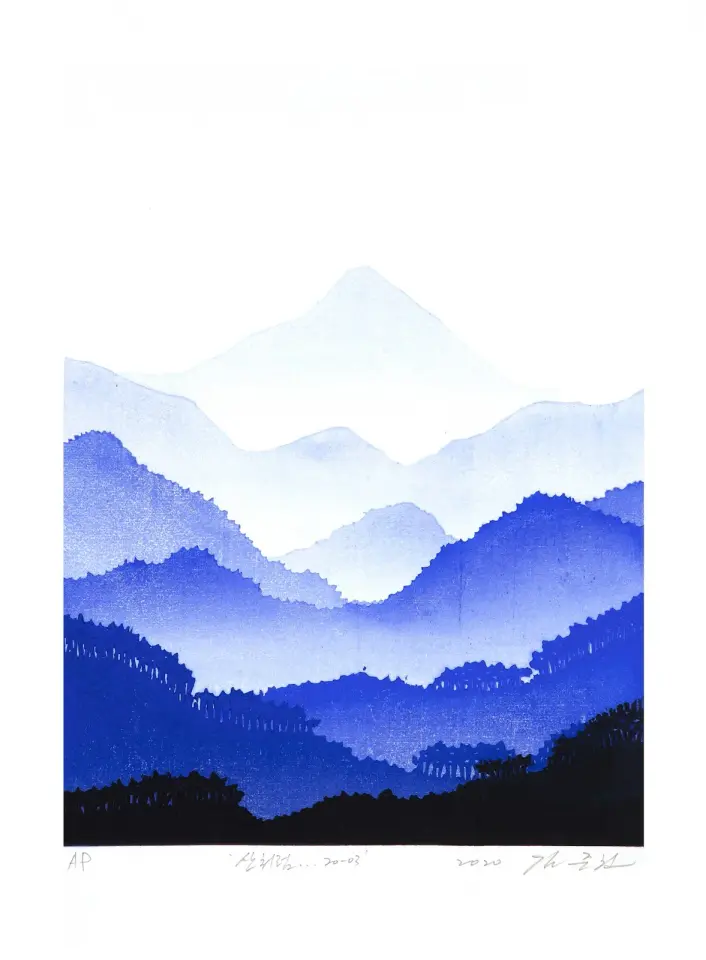
From 1994 to 1997, Kim Jungwon studied at the Lu Xun Academy of Fine Arts in China, one of the foremost institutions of printmaking in East Asia. There he deepened his command of water-based multi-color woodblock technique — the process of building tone through successive layers of ink and water pressed onto wood. This encounter with the East Asian ink-wash tradition reshaped his aesthetic: where much Korean woodblock printing had been defined by strong black line and flat colour, Kim was developing a practice of gradation — mountain mist rendered as layers of water-ink, the kind of atmospheric depth associated with traditional 수묵화 (ink-wash painting) but translated into the medium of the carved block.
In 1997, he established the Korean Woodblock Culture Research Institute (한국목판문화연구소) in Baekgok-myeon, Jincheon, North Chungcheong Province — a base from which he has worked ever since. It became more than a studio: a site of research, teaching, and advocacy for woodblock as a living tradition. Since 2017, he has served as Director of the Korea Woodblock Culture Center (한국목판문화원) and leads the Community Woodblock University, a programme dedicated to passing the craft on.
His work gained extraordinary public visibility on 27 April 2018, when his large-scale woodblock print Sanuun (山韻)-0901— a depiction of the Baekdudaegan mountain spine rendered in layered ink tones, completed in 2009 using 48 woodblocks — hung on the wall of the Peace House at Panmunjom as North Korean Chairman Kim Jong-un signed the visitor's book during the inter-Korean summit. The image of the two Koreas meeting against a backdrop of their shared mountain range, rendered in ink-wash woodblock, was seen by a global audience. His works are held in the collections of the National Museum of Modern and Contemporary Art (MMCA), the Government Art Bank, Seoul Museum of Art, Gwangju Museum of Art, Cheongju Museum of Art, and other public institutions in Korea and China.
What the ink and the blade do
- 1
Water and wood as one medium
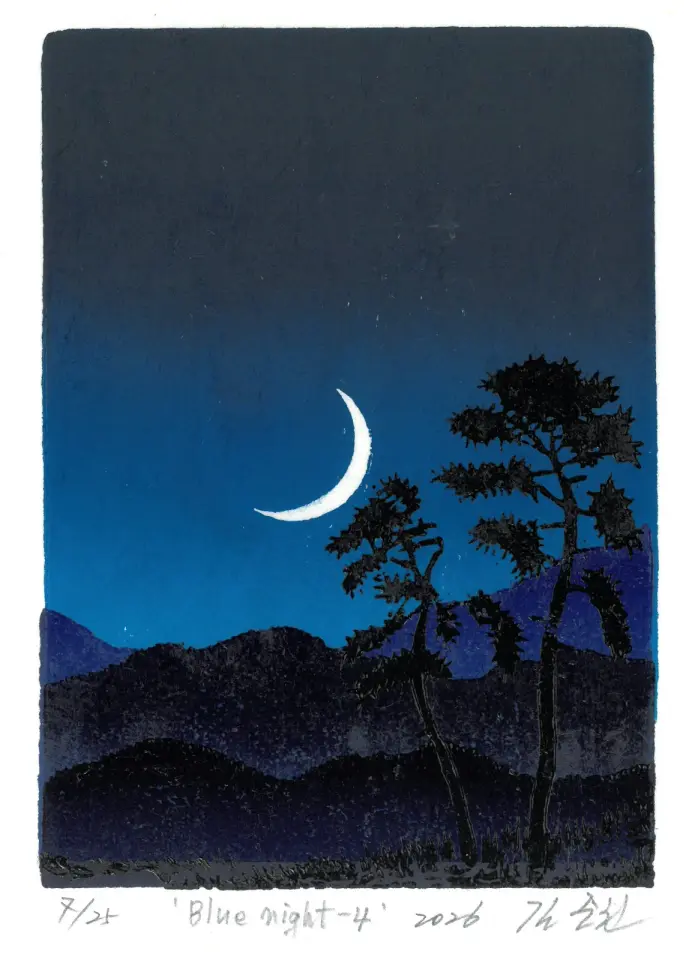
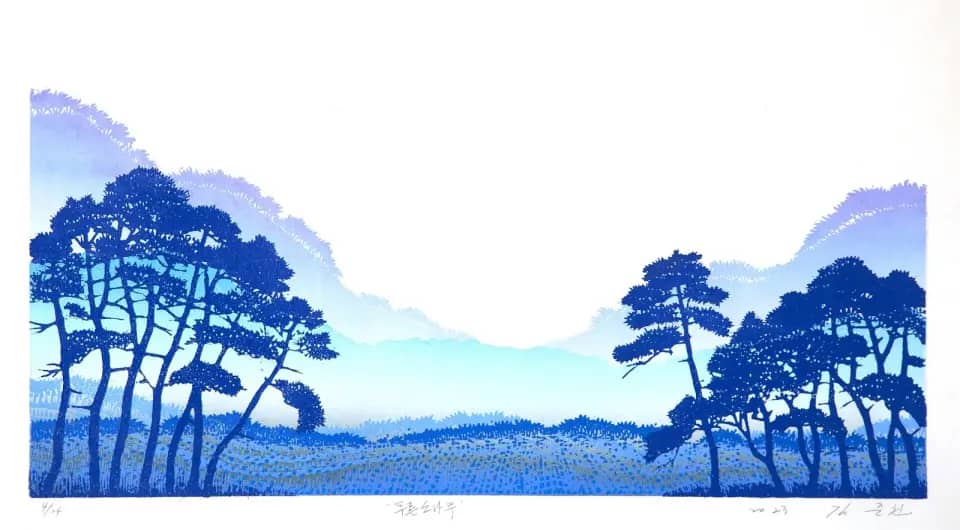
Kim Jungwon's water-based multi-color woodblock technique layers ink-wash tones onto carved wood, building atmospheric depth — mountain mist, ridge shadows, the gradations of light — in the manner of traditional ink-wash painting, but achieved through the physical resistance of the woodblock.
- 2
The Korean landscape as subject
The Baekdudaegan mountain spine — Korea's great ridge running from north to south — is the recurring subject of Kim's major works. His sustained field journeys across Korean mountains accumulate into prints that carry geographical, historical, and political weight in equal measure.
- 3
Tradition renewed by craft
Each major woodblock print requires carving and printing five or more separate blocks. This intense labour is inseparable from Kim's understanding of his art: the woodblock tradition as a living practice, kept alive by the Korea Woodblock Culture Center and Community Woodblock University he founded and leads.
The artist's timeline
- 1956Born in Yeongam, South Jeolla Province.
- 1982Graduates from Hongik University, Dept. of Art Education (Western Painting); works as an art teacher.
- 1989Dismissed from teaching due to membership in the Korean Teachers and Educational Workers Union (전교조); turns to full-time printmaking via the Minjung art movement (민미협, 민예총).
- 1994–97Woodblock researcher and visiting professor at Lu Xun Academy of Fine Arts, China; refines water-based multi-color woodblock technique.
- 1997Establishes the Korean Woodblock Culture Research Institute (한국목판문화연구소) in Baekgok-myeon, Jincheon, North Chungcheong Province.
- 2009Completes 〈Sanuun (山韻)-0901〉 using 48 woodblocks — a large-scale ink-wash depiction of the Baekdudaegan mountain range.
- 2017Appointed Director of the Korea Woodblock Culture Center; launches the Community Woodblock University.
- 2018〈Sanuun (山韻)-0901〉 displayed at Panmunjom Peace House during the inter-Korean summit; seen by a global audience as the backdrop for Kim Jong-un's signing of the visitor's book.
- 2022Solo exhibition 〈Song of the Mountain〉 at Seoul Arts Center; retrospective at Gimhae Culture Center Yunseul Museum (1985–2022).
- 2026Participates in SAF Online in solidarity with fellow artists.
Selected exhibitions & collections
- Song of the Mountain, Seoul Arts Center (2022)
- Kim Joon Kwon: Walking the Motherland, Saenggeo Print Art Museum, Jincheon (2022–2023)
- 1985–2022 Retrospective Song of the Knife, Song of the Block, Song of Life, Gimhae Culture Center Yunseul Museum (2022)
- Collections: MMCA (National Museum of Modern and Contemporary Art), Government Art Bank, Seoul Museum of Art, Gwangju Museum of Art, Cheongju Museum of Art, and other major institutions in Korea and China
- Honorary Associate Professor, Lu Xun Academy of Fine Arts, China (from 1996); Director, Korea Woodblock Culture Center (from 2017)
Three essays —
on ink, land, and the long way
1The spirit of ink-wash carved in wood
Korean woodblock printmaking, in its modern form, inherited two quite different traditions. One was the black-line print of political urgency — reproducible, distributable, made to be held and read quickly. The other was the slow, layered, atmospheric tradition of East Asian ink-wash painting, where tone and gradation matter more than outline. Kim Jungwon's singular contribution has been to bring these two traditions together in a single practice.
The technique he developed — water-based multi-color woodblock printing — works not with the single impression of a block but with successive layerings: carving multiple blocks and printing them in sequence, each layer adding a register of tone. The ink is water-based and therefore responsive: it bleeds slightly, feathers at the edges, creates the atmospheric depth that characterises ink-wash without the spontaneity of the brush. Instead, the gradations are planned and carved — each tonal shift a decision made before the first impression is pulled.
The result is a form of printmaking that the critic Park Young-taek has described as occupying a singular position in Korean contemporary art — comparable in aesthetic lineage to the true-view landscape painting (진경산수) of Jeong Seon and Kim Hongdo in the late Joseon period, but achieved through a medium that carries the physical discipline of carving and the democratic potential of the printed multiple. Water and wood, in Kim's practice, are not opposites but partners.
2The Korean landscape
The subject of Kim Jungwon's mature work is the Korean landscape — specifically the Baekdudaegan, the great mountain spine that runs from Baekdusan in the north to Jirisan in the south, forming the skeletal ridge of the Korean peninsula. His sustained fieldwork — walking, sketching, living inside the terrain — accumulates into prints that are not scenic depictions but topographic arguments: this land exists, in its full geological weight, across the artificial line of division.
The political charge of this subject is inseparable from Kim's biography. A former participant in the Minjung art movement, he came of age politically in a South Korea where the division of the peninsula was a structuring fact of everyday life. To paint the Baekdudaegan as one continuous ridge — to render Baekdusan in ink-wash, when Baekdusan is technically in the North — is an act of artistic reunification. The mountains do not recognise the border.
When his large-scale woodblock print Sanuun (山韻)-0901— completed in 2009 — hung at the Peace House in Panmunjom during the 2018 inter-Korean summit, this political reading became inescapable. The image of the two Koreas' leaders meeting against a backdrop of their shared mountain range, rendered in forty-eight layers of ink-wash woodblock, condensed decades of Kim's practice into a single globally televised moment. The mountain, in ink, said what the diplomats were still negotiating.
3From teacher to printmaker — forty years on one road
Kim Jungwon's path to printmaking began in the classroom. He taught art in secondary school after graduating from Hongik University, and through teaching became part of the art education movement — an effort, in the 1980s, to make art education in Korean schools less rote and more connected to the social reality of students' lives. That involvement led him to the Korean Teachers and Educational Workers Union (전교조), and in 1989, when joining the union became an act of political consequence, he was dismissed.
The dismissal removed one kind of public role and opened another. Through the Minjung art movement's organisational network — the 민미협 (Korean People's Artists Federation) and the 민예총 (Korean Federation of Arts and Culture) — Kim worked as a full-time artist and movement organiser. The printmaking skills he had been developing deepened as a practice of making images that could be circulated, like the ideas the movement was circulating.
The four years in China (1994–1997) were a second turning point: not a departure from commitment but a deepening of craft. On returning, he chose Jincheon, Chungcheong Province, rather than Seoul — a choice that embedded his practice in a particular landscape rather than an art-market geography. The Korean Woodblock Culture Research Institute he established there in 1997 has since become the Korea Woodblock Culture Center: a national institution for the preservation and transmission of woodblock as a living craft. Forty years after his first woodcut, Kim Jungwon is still at the block in Jincheon — carving the mountain, one layer at a time.
From the woodcuts of the 1980s protest movements to the summit wall at Panmunjom, Kim Jungwon has pursued the same practice: carving what Korea looks like — in its mountains, its seasons, its long political weather — into the grain of wood, and pressing it onto paper for others to hold. He joins this campaign not as a subject of financial hardship but as a fellow artist in solidarity — so that those who come after can work with the same freedom that his forty years of carving have been in service of.
Works
4 works are featured here.
Kim Jungwon joined this campaign in solidarity with fellow artists. Every work sold flows directly into the artists' mutual-aid loan fund— a purchase becomes the next month's lifeline for an artist navigating financial exclusion today.