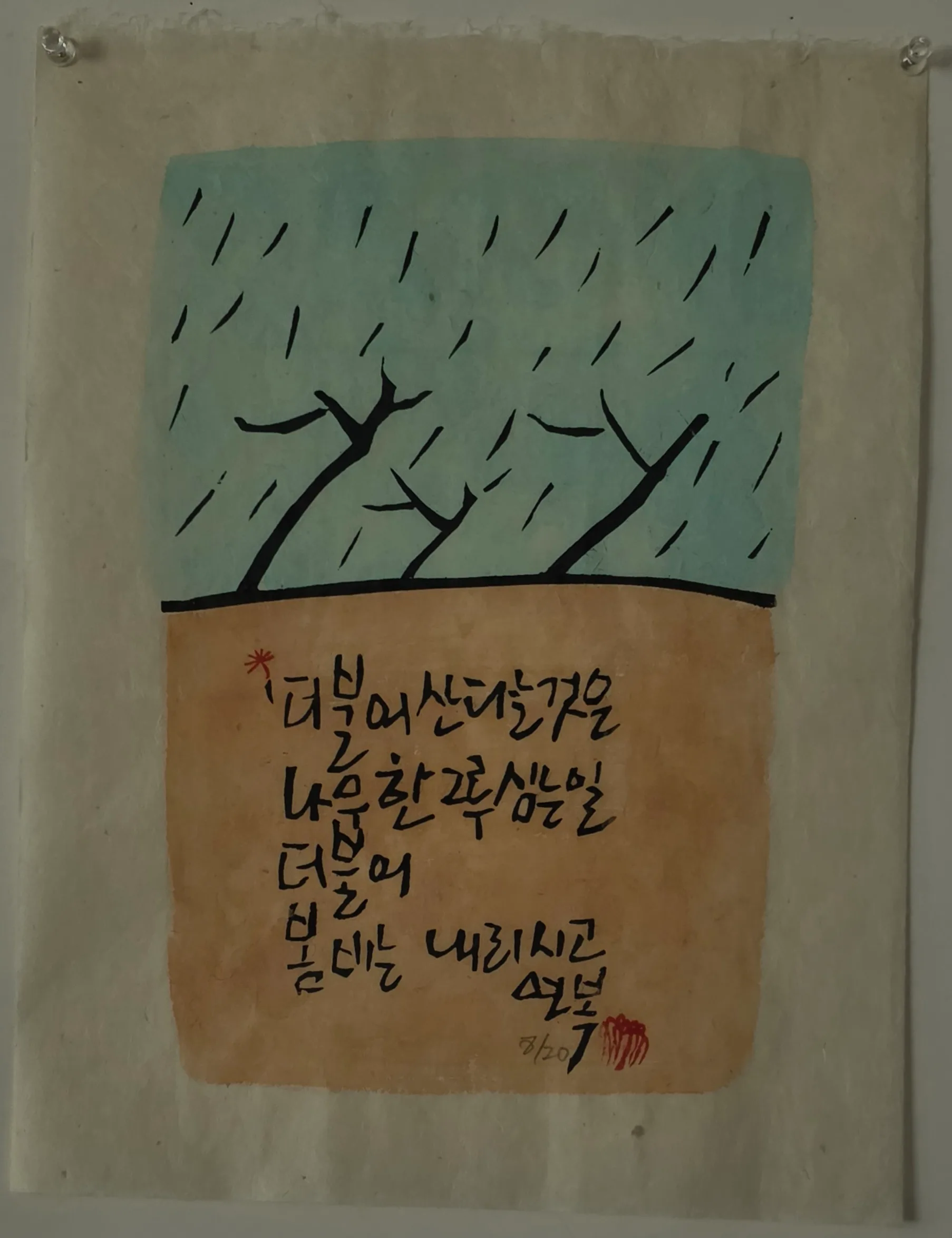
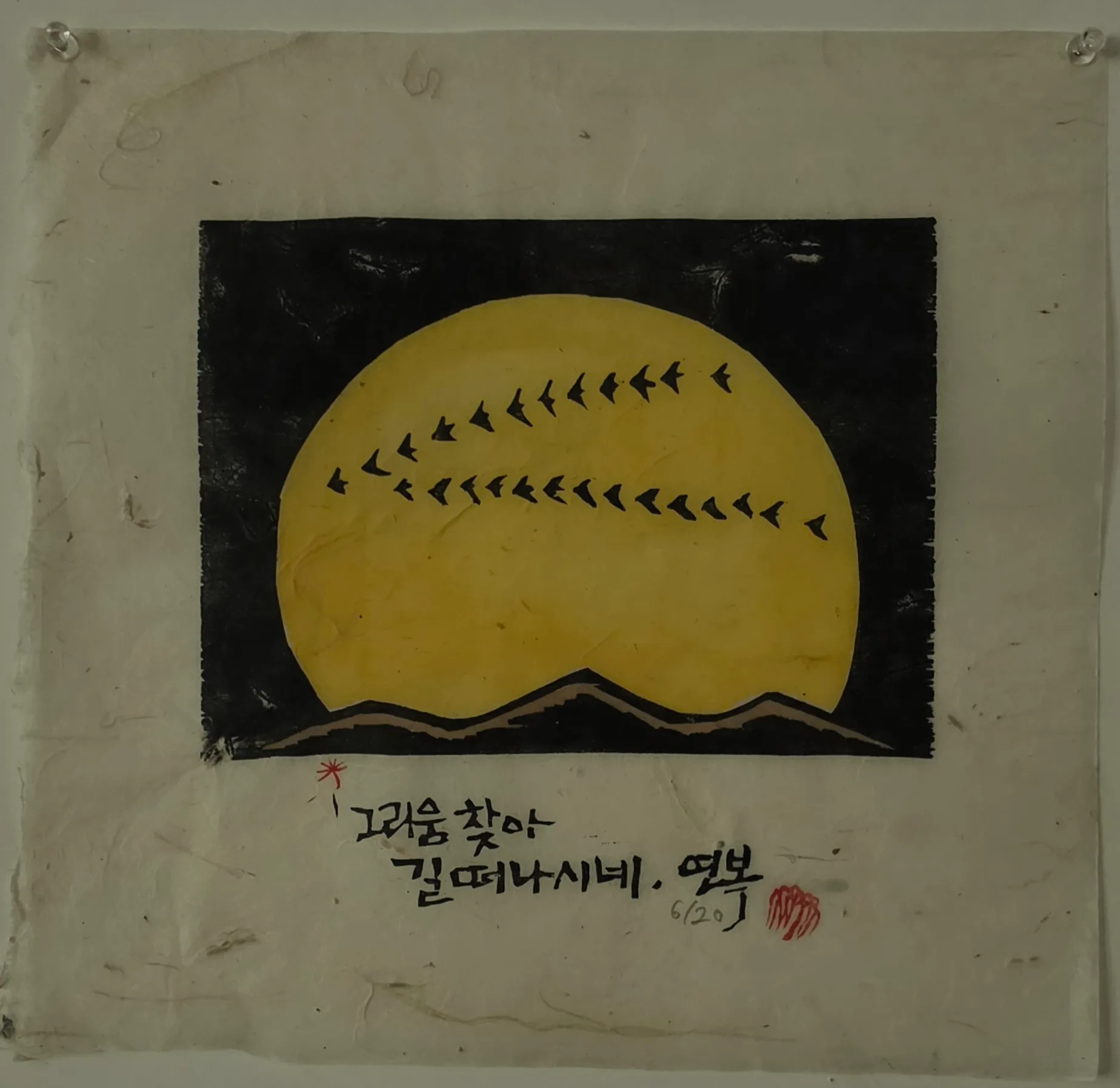
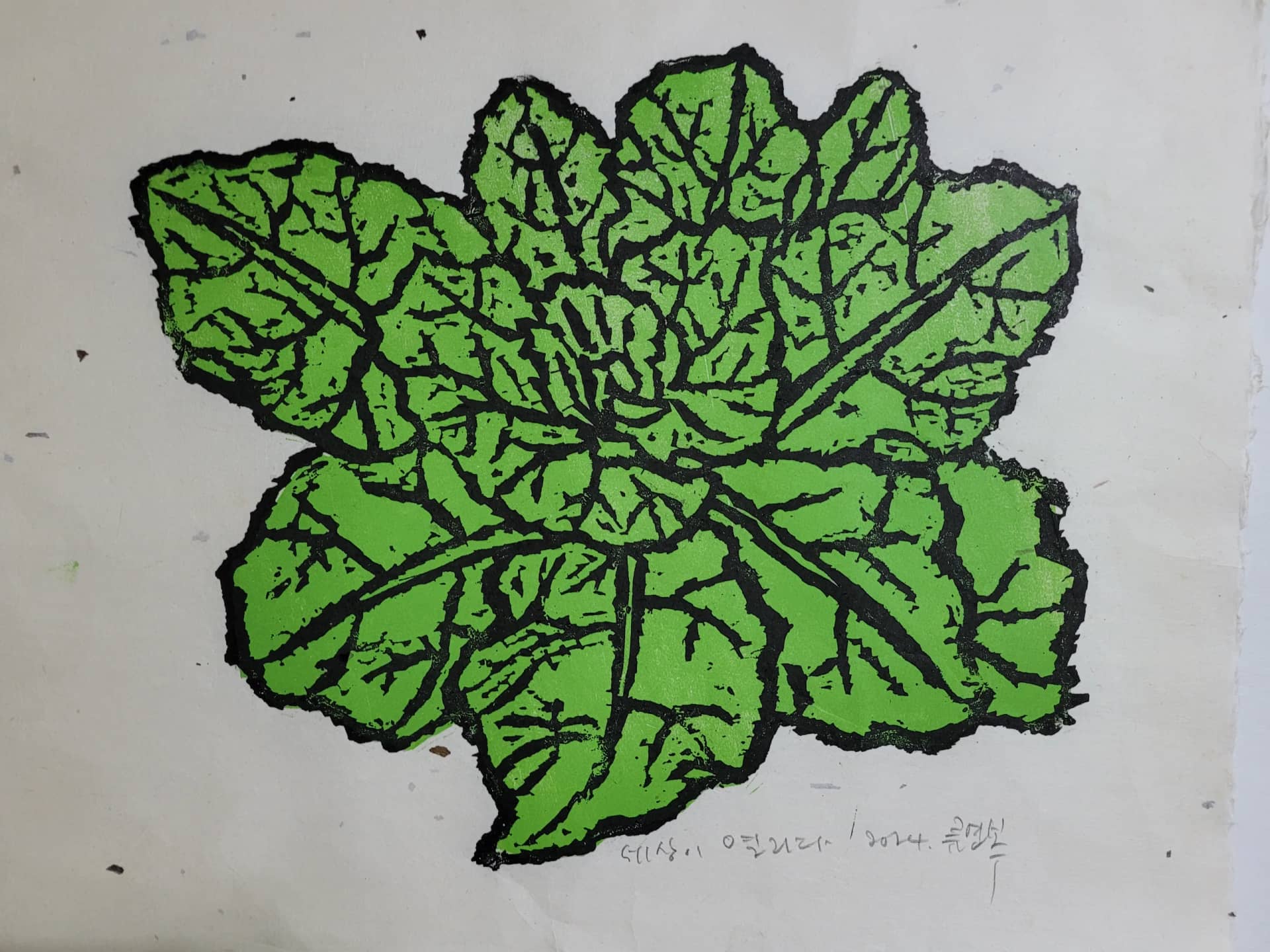
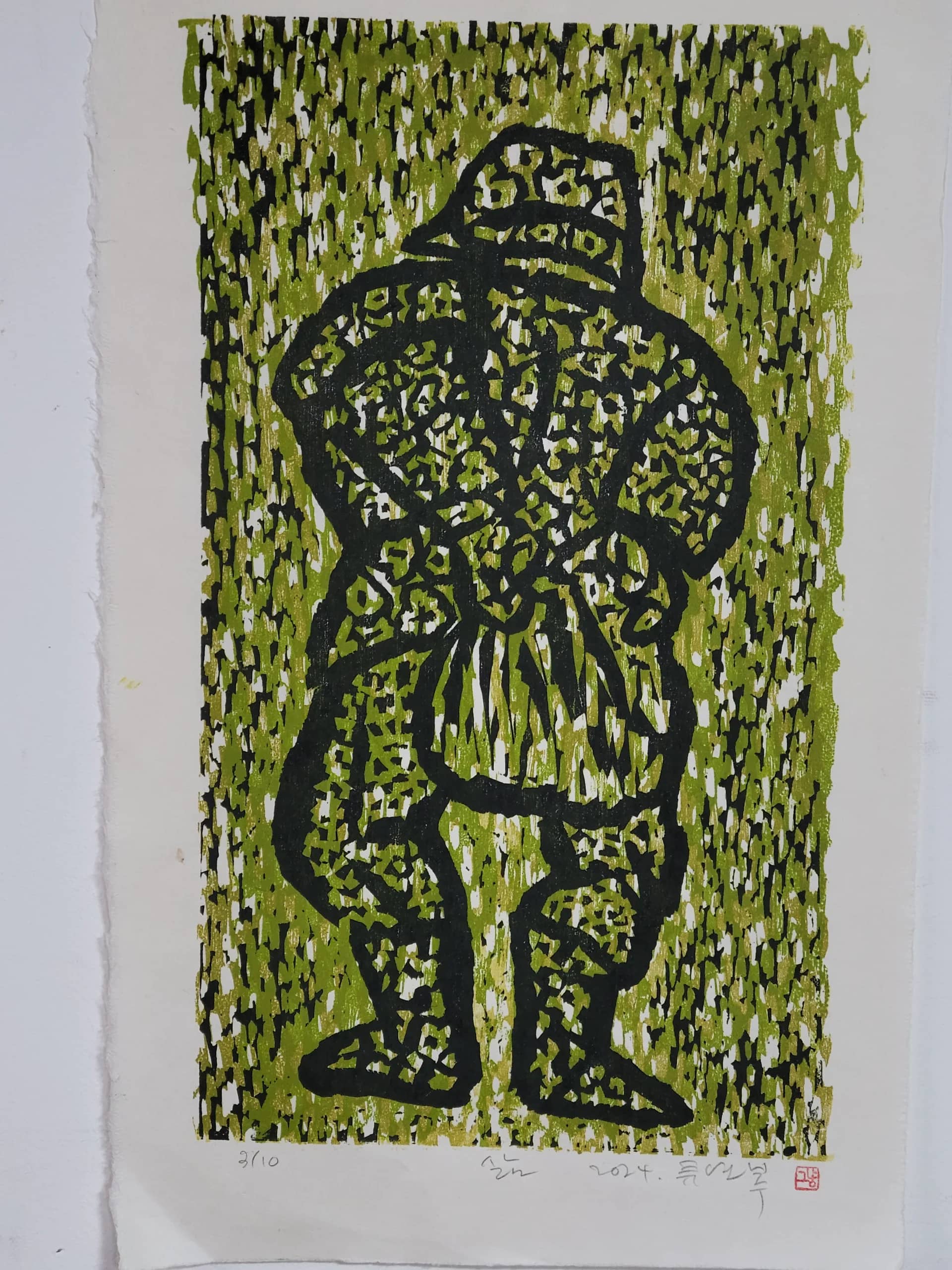
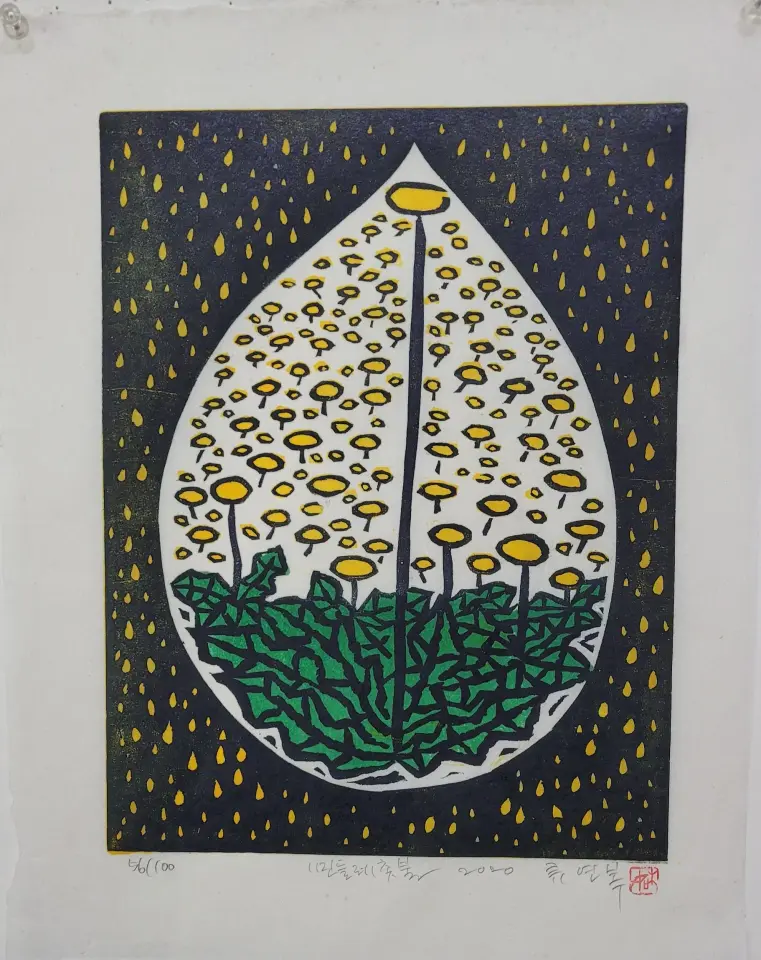
Where the blade has passed,
people live
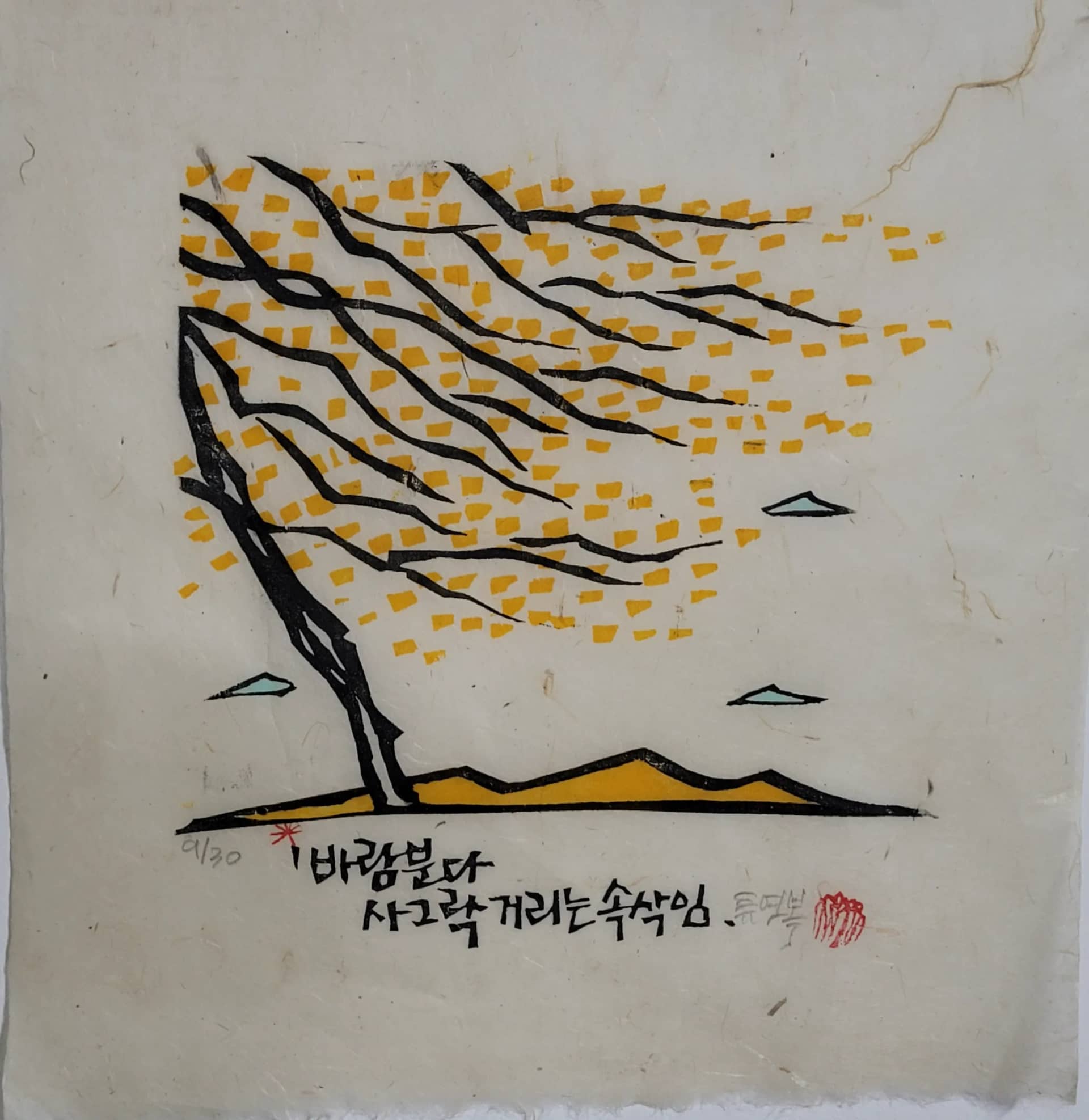
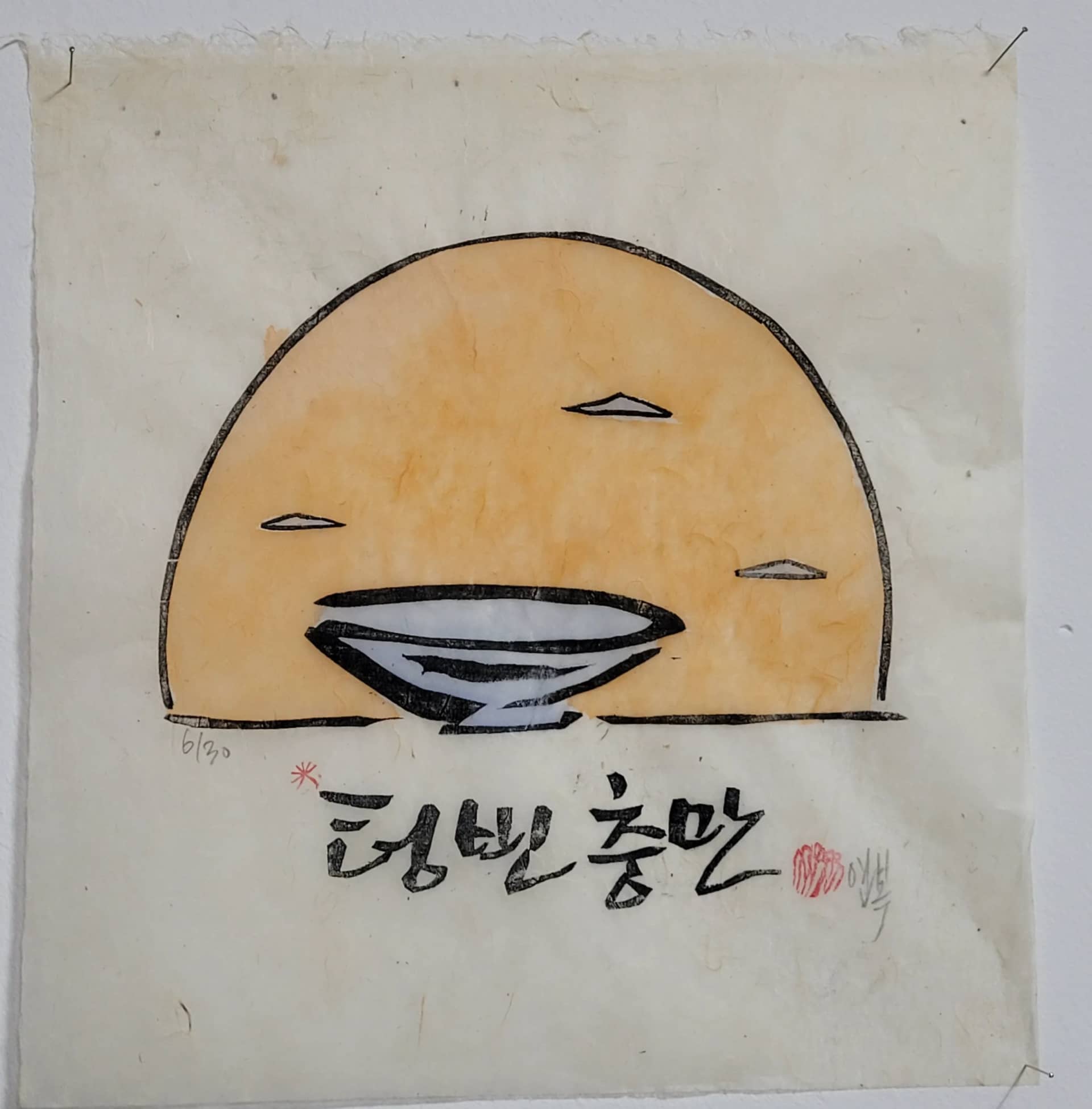
He carves the mountains, rivers, and people of Korea onto wood.A blade, a block, a life — Korean woodblock printmaking rooted in land and solidarity.
The wood remembers —
a printmaker who carves Korea into being
Ryu Yeonbok (b. 1958) studied painting at Hongik University before discovering that the woodblock — its resistance, its grain, its demand for commitment — was the medium that matched his temperament and his times. He came of age as an artist in the 1980s, when South Korea's democratic movement was at its most urgent, and woodblock printmaking had become, for many artists, not merely a technique but a form of public speech.
Through the 1980s and into the mid-1990s, Ryu participated in the minjung (people's) printmaking movement — contributing to wall painting projects and scroll paintings that carried the voice of ordinary Koreans into public space. In this tradition, the woodblock was not a studio object but a social instrument: multiple impressions from a single block meant art that could be distributed, posted, shared. The blade, in this context, was a form of commitment — what you carved could not be erased.
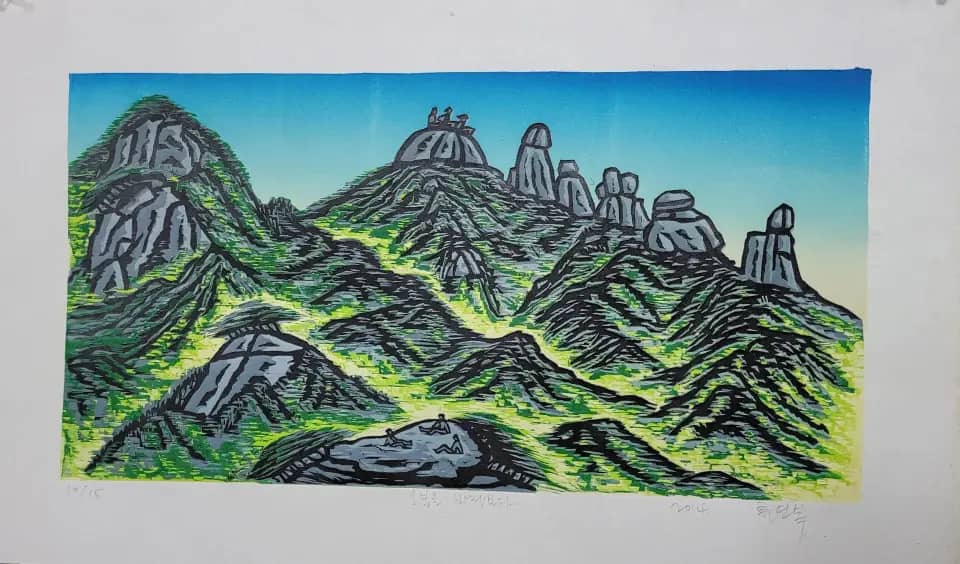
In 1993, Ryu left the city and settled in Anseong, a rural town in Gyeonggi province, where he has remained ever since. The move was not a retreat from subject matter but a shift in its register. Where the 1980s work had addressed the social and political directly, his subsequent practice turned toward a longer time scale — land, seasons, life itself. He began to travel the Korean peninsula systematically, accumulating sketchbooks from Baekdusan, Dokdo, Geumgangsan, and the DMZ, and returning to his studio to carve those landscapes into wood.
The process — sketching in the field, then carving, printing, re-carving, printing again — enacts a kind of double attention: the eye that reads the land, and the hand that interprets it through resistance. Wood does not surrender to the blade passively; the grain pushes back, proposes alternatives, forces decisions. Ryu has described his approach to woodcutting as akin to poetry — shaping and emptying, choosing what to leave and what to remove until the essential image remains.
His work has also been introduced internationally — his woodblock prints are noted as having been featured in Azalea, the Harvard journal of Korean literature and culture (2008), and he is reported to have lectured and exhibited at the College of Fine Arts and Design, University of Sharjah, UAE (2009) — an occasion that demonstrated the legibility of his distinctly Korean sensibility beyond Korean borders. He is a member of the Korean Contemporary Woodblock Printmakers Association and participated in the association's 2026 member exhibition, Asking the Tree (나무에게 묻는다). He was also included in 각인(刻印) — 100 Years of Korean Modern and Contemporary Woodblock Printmaking, a major survey held at Gyeongnam Art Museum (2021–2022).
What the blade does
- 1
The land as subject
Ryu's systematic journeys to Baekdusan, Dokdo, Geumgangsan, and the DMZ transformed field sketches into woodblock prints — making the act of traversing Korea's territory into an artistic practice rooted in physical encounter.
- 2
Carving as commitment
Unlike a brushstroke, a woodcut is irreversible. The resistance of the grain — what Ryu describes as an exchange akin to poetry — forces choices that cannot be undone. What remains after carving is what the artist truly decided to say.
- 3
People and solidarity
From the minjung movement of the 1980s to his current work, Ryu's prints have never left people behind. Landscapes contain the evidence of lives lived on them; life-forms share the frame with mountains. The wood remembers both.
The artist's timeline
- 1958Born in Korea.
- 1980년대Graduates from Hongik University, Dept. of Painting; participates in the minjung printmaking movement — wall painting and scroll painting projects.
- 1993Settles in Anseong, Gyeonggi province; begins sustained practice carving the Korean landscape and life onto woodblocks.
- 2000년대–Undertakes field journeys to Baekdusan, Dokdo, Geumgangsan, DMZ and surrounding territories; translates sketches into large-scale woodblock prints.
- 2008Woodblock prints featured in Azalea — Journal of Korean Literature & Culture (Harvard University).
- 2009Lectures and solo exhibition at College of Fine Arts & Design, University of Sharjah, UAE.
- 2021–22Included in 각인(刻印) — 100 Years of Korean Modern & Contemporary Woodblock Printmaking, Gyeongnam Art Museum.
- 2026Participates in Korean Contemporary Woodblock Printmakers Association member exhibition Asking the Tree (나무에게 묻는다); joins SAF Online in solidarity with fellow artists.
Selected exhibitions & publications
- 각인(刻印) — 100 Years of Korean Modern & Contemporary Woodblock Printmaking, Gyeongnam Art Museum (Oct 2021 – Feb 2022)
- Korean Contemporary Woodblock Printmakers Association — 2026 Member Exhibition Asking the Tree (나무에게 묻는다)
- Woodblock prints featured in Azalea — Journal of Korean Literature & Culture, Harvard University (2008)
- Lecture & exhibition, College of Fine Arts & Design, University of Sharjah, UAE (2009)
- Member, Korean Contemporary Woodblock Printmakers Association
Three essays —
on the blade, the land, and the people
1The blade as people’s voice
In the 1980s, Korean woodblock printmaking was not primarily a medium of gallery art. It was a medium of circulation: prints could be run in quantity from a single block, posted on walls, distributed through movement networks, folded into pamphlets. For artists involved in the minjung movement — committed to making art that spoke to and for ordinary Koreans — this multiplicity was not incidental but essential.
Ryu Yeonbok entered this practice in that context. The subjects of his early work were drawn from the lives and struggles of the people around him, and the making process — carving into wood, removing what was unnecessary, inking and pressing — enacted a kind of discipline: each mark was a decision, irreversible, bearing full weight. Wall paintings and scroll paintings took this public character further, placing images in the spaces where people gathered, worked, and protested.
What distinguished this tradition from mere agitprop was the quality of attention it demanded. To carve a face, a hand, a figure in labour, the artist had to study it — to understand the form well enough to translate it into the resistance of wood grain. The blade pressed against the material asked the same question that good portraiture always asks: what is essential here? What, if removed, would mean that the person is gone?
2The Korean land carved in wood
Since settling in Anseong in 1993, Ryu Yeonbok has pursued a sustained engagement with the Korean landscape — not as scenic background but as subject in its own right, carrying historical, political, and ecological weight. His journeys to Baekdusan, Dokdo, Geumgangsan, and the DMZ were not tourist visits but artistic pilgrimages: the sketchbook accumulated in the field became the source material from which woodblocks were carved.
The landscapes that result are not straightforwardly documentary. The process of carving imposes interpretation: to translate a mountain seen in the field into the grain of a wood block, the artist must decide what belongs to the essential form of that mountain and what does not. The DMZ prints carry the weight of division; the Baekdusan images carry the weight of longing for a unified Korea; the Dokdo works carry the weight of contested sovereignty. The land, for Ryu, is never politically neutral — because Korean land never has been.
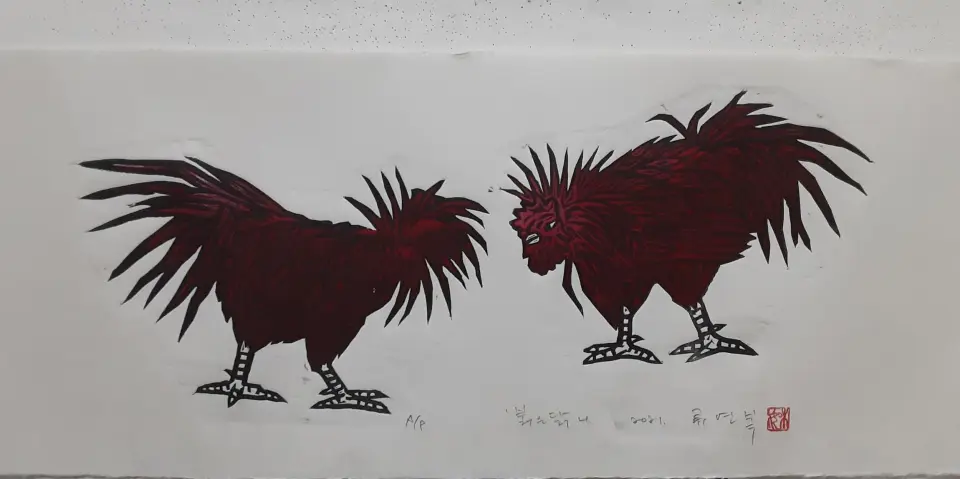
At the same time, since Anseong, his practice has opened toward the biological: insects, plants, the textures of soil and bark, the rhythms of seasons. This is not a departure from the political but an extension of it — an insistence that the life of the land is also the life of the people who inhabit it, and that to carve it with care is already an ethical act.
3The 1980s minjung printmaking movement
The minjung art movement emerged in South Korea in the early 1980s, as artists responded to military rule and the suppression of civil society by making art that was explicitly political and oriented toward a popular audience. Printmaking — especially woodblock — became one of the movement's primary media, for practical as much as aesthetic reasons: prints were reproducible, transportable, and could be produced without gallery infrastructure.
Ryu Yeonbok's participation in this movement placed him in a generation of Korean artists who understood art-making as inseparable from social commitment. Wall paintings and scroll paintings were collective projects, often created collaboratively and displayed publicly — in factories, on university campuses, in the streets during protests. The scale demanded by these formats challenged the woodblock's normal intimacy, expanding the medium into something monumental.
The movement's legacies are multiple. It established woodblock printmaking as a significant strand of Korean contemporary art. It produced a generation of artists — among them Ryu — who had learned to work with urgency and with an audience in mind. And it forged a connection between Korean printmaking and the conditions of ordinary Korean life that Ryu's subsequent landscape work would deepen, rather than abandon. The land he carved after 1993 was the same land the movement had argued belonged to everyone.
From the wall paintings of the 1980s to the mountain summits and river valleys of his Anseong studio practice, Ryu Yeonbok has pursued the same act: carving what matters into wood, so that it can be pressed onto paper and held. He joins this campaign not as a subject of financial hardship but as a fellow artist in solidarity — so that those who come after can work with the same freedom that the blade in his hand has always been in service of.
Works
10 works are featured here.
Ryu Yeonbok joined this campaign in solidarity with fellow artists. Every work sold flows directly into the artists' mutual-aid loan fund— a purchase becomes the next month's lifeline for an artist navigating financial exclusion today.