History stacks vertically
through a single body
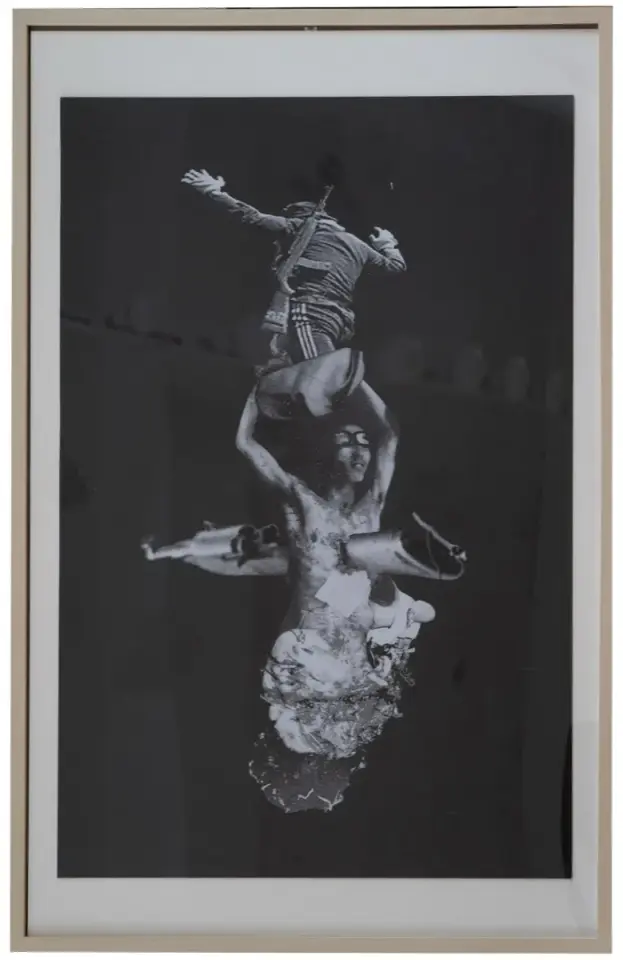
He compressed the weight of a century into a single frame.Bodies and objects stacked like a locomotive of Korean modern history.
History, stacked —
a century compressed into one frame
Shin Hak-chul (b. 1943) was born in Gimcheon, North Gyeongsang province, and graduated from Hongik University's Department of Western Painting in 1968. He entered the art world as a modernist, and from 1970 to 1975 participated in the AG (Korean Avant-garde Association) exhibitions — a crucible for the generation questioning the dominant abstract formalism of the era.
Through the 1970s he moved through objet and collage experiment, contributing to the Seoul Methodexhibitions (1977–1981) and building a practice rooted in photographic and mass-media imagery. Where most of his contemporaries were working in monochrome, Shin was already cutting photographs from newspapers and magazines, using the camera's document as raw material rather than paint.
The decisive turn came in 1978. After the shock of encountering the photo anthology “A Century of Korea in Photographs,” he moved beyond individual formal experiment toward the collective memory of an era. Photographs, he understood, were not decoration — they were evidence. Cutting and pasting images from newspapers, magazines, and textbooks, he arrived at the 〈Korean Modern History〉 and 〈Korean Contemporary History〉 series: photomontages in which bodies and objects compress vertically like a locomotive of history.
This series — spanning forty years from 1980 to 2021, comprising around forty major works — traces Korean history from the Donghak Peasant Revolt through the 1980s democratization movement, placing unnamed figures rather than great men at its center. In his work, history is not laid out flat but stacked vertically. A single body becomes the cross-section of an era; those cross-sections accumulate layer upon layer into the geological strata of Korean modern history.
When the 1987 painting 〈Rice Planting〉 was seized under the National Security Act in September 1989 and Shin was detained, the work became something larger than itself — a test case for the relationship between art and state power. He was acquitted in the first and second trials, yet convicted by the Supreme Court in 1999. In 2004 the UN Human Rights Committee ruled the conviction a violation of freedom of expression under Article 19 of the ICCPR and recommended redress. The painting now rests in MMCA custody (since 2018), its legal status still unrectified — a master who became, by force of circumstance, a symbol of free expression itself.
Major themes
- 1
Vertical montage
Bodies and objects compress like a locomotive — history rendered not as a flat sequence but as vertical strata.
- 2
〈Rice Planting〉 and free expression
His 1987 〈Rice Planting〉 was seized under the National Security Act in 1989. Acquitted twice, convicted in 1999 — yet in 2004 the UN Human Rights Committee ruled it a violation of freedom of expression.
- 3
Historical consciousness
A gaze fixed on the collective and on history rather than the individual — his work stands as testimony to an era.
The artist's timeline
- 1943Born in Gimcheon, North Gyeongsang province.
- 1968Graduates from Hongik University, Dept. of Western Painting.
- 1970–Joins the AG (Korean Avant-garde Association) exhibitions (through 1975); later the Seoul Method exhibitions (1977–1981).
- 1970sExperiments with objet and photographic collage using mass-media imagery.
- 1978Encounters "A Century of Korea in Photographs"; turns toward history.
- 1980sBegins the 〈Korean Modern History〉 & 〈Korean Contemporary History〉 series.
- 1987Paints 〈Rice Planting〉.
- 1989〈Rice Planting〉 seized under the National Security Act; the artist is detained.
- 1999After Supreme Court remand, convicted (10-month suspended sentence); the work is confiscated.
- 1991Solo exhibition at Hakgojae Gallery, Seoul — held to commemorate the inaugural Minjung Art Award.
- 2004The UN Human Rights Committee rules the conviction a violation of free expression under ICCPR Art. 19; recommends redress.
- 2018〈Rice Planting〉 placed in the custody of MMCA; legal status remains unrectified.
- 2024–60-year retrospective 《Shin Hak-chul: Montage of an Era》, Gwangju Museum of Art (Dec 2024 – Mar 2025).
Selected exhibitions & collections
- Group exhibition: 《15 Years of Minjung Art: 1980–1994》, MMCA (1994)
- Solo exhibition, Hakgojae Gallery, Seoul (1991) — inaugural Minjung Art Award commemoration; 2인전 Monumental Landscape of the Body with Fang Lijun, Hakgojae (2016)
- 60-year retrospective Montage of an Era, Gwangju Museum of Art (Dec 2024 – Mar 2025)
- MMCA collection: 〈Korean Modern History — Who Said They Saw the Sky?〉 (1989), 〈Korean Modern History — Synthesis〉 (1982–83), and others
- Seoul Museum of Art collection: 〈Metamorphosis 5〉 (1981), 〈Resurrection 1〉 (1979), and others
Three essays —
on the work and its weight
1From modernist to witness — the 1978 turn
When Shin Hak-chul graduated from Hongik University in 1968, Korean modernism was dominated by monochrome abstraction. He was part of the generation that contested it: joining the AG (Korean Avant-garde Association) exhibitions from 1970, he worked through objet, installation, and photographic collage across the 1970s — a period when using a photograph as raw material was itself a formal provocation.
The turn came not from theory but from a book. Encountering the photo anthology A Century of Korea in Photographs in 1978, he was struck by the accumulated weight of documentary image: this was not aesthetic material but evidence — of colonization, war, and the daily violence of modern Korean history. From that encounter forward, photographic images from newspapers, magazines, and textbooks became the primary medium. The goal was no longer formal innovation but testimony: to show that what happened, happened.
The 〈Korean Modern History〉 series, begun around 1980, is the direct result. Where his peers were refining their monochrome surfaces, Shin was cutting and stacking — bodies, machinery, crowd photographs, maps — into vertical columns that compressed a century of history into a single image. The modernist became a witness, and the witness built archives.
2History stacked vertically — the form of the 〈Korean History〉 series
The key formal choice in the 〈Korean Modern History〉 and 〈Korean Contemporary History〉 series is vertical compression. Western history painting arranges events horizontally — a frieze of time. Shin's photomontages stack them. Bodies occupy the full height of the canvas: a foot planted in the peasant uprisings of the late nineteenth century; a torso bearing the colonial period; a head breaking through the surface of the 1980s. A single body contains multiple eras. Time is not narrated; it is geological.
The series spans forty years from 1980 to 2021 — around forty major works. Among the most significant: 〈Korean Modern History — Who Said They Saw the Sky?〉 (1989, MMCA collection) and 〈Korean Modern History — Synthesis〉 (1982–83, MMCA). In these canvases, unnamed figures — not leaders or heroes — are the protagonists of Korean history, a formal argument about who carries the weight of a nation's past.
Critics have described the series as establishing a new form of critical figuration within Korean art — the photomontage not as experiment but as political archive. For four decades, from the first wave of minjung art through to the 2021 works, the series has remained the most sustained single-artist reckoning with Korean modern history in the medium of painting.
3〈Rice Planting〉 — the trial a single painting received
In 1987, Shin Hak-chul completed 〈Rice Planting〉 — a photomontage depicting farmers bent in the act of planting rice, a scene of collective labour and the desire for reunification embedded in its imagery. It was exhibited at the 1987 National Art Association Reunification Exhibition.
In September 1989, prosecutors determined that the work constituted subversive material in praise of North Korea under the National Security Act. The painting was seized. Shin was detained and charged. He was acquitted in the first trial, and acquitted again on appeal. In 1998 the Supreme Court sent the case back for retrial; in August 1999 he was convicted — ten months, suspended, with the work confiscated.
The case did not end there. In 2004, the United Nations Human Rights Committee — the treaty body monitoring compliance with the International Covenant on Civil and Political Rights — ruled that the Republic of Korea had violated Article 19 of the Covenant (freedom of expression) and recommended redress. It was the first time a UN human rights body had ruled on a South Korean artwork.
The painting has been held in MMCA custody since 2018. Its legal rehabilitation has not been enacted. The work remains a singular case in the global history of art and law: a painting prosecuted, acquitted, convicted, condemned by an international body — and still waiting.
From the AG galleries of the 1970s to the canvases of the 2020s, Shin Hak-chul's work has pursued a single question: how does a body carry the weight of history, and how does a painting carry that body? The answer, built over five decades, is a photomontage archive unlike anything else in Korean art. He joins this campaign not as a subject of its cause but as a fellow artist in solidarity — so that those who come after might work without the weight he has borne.
Selected Works
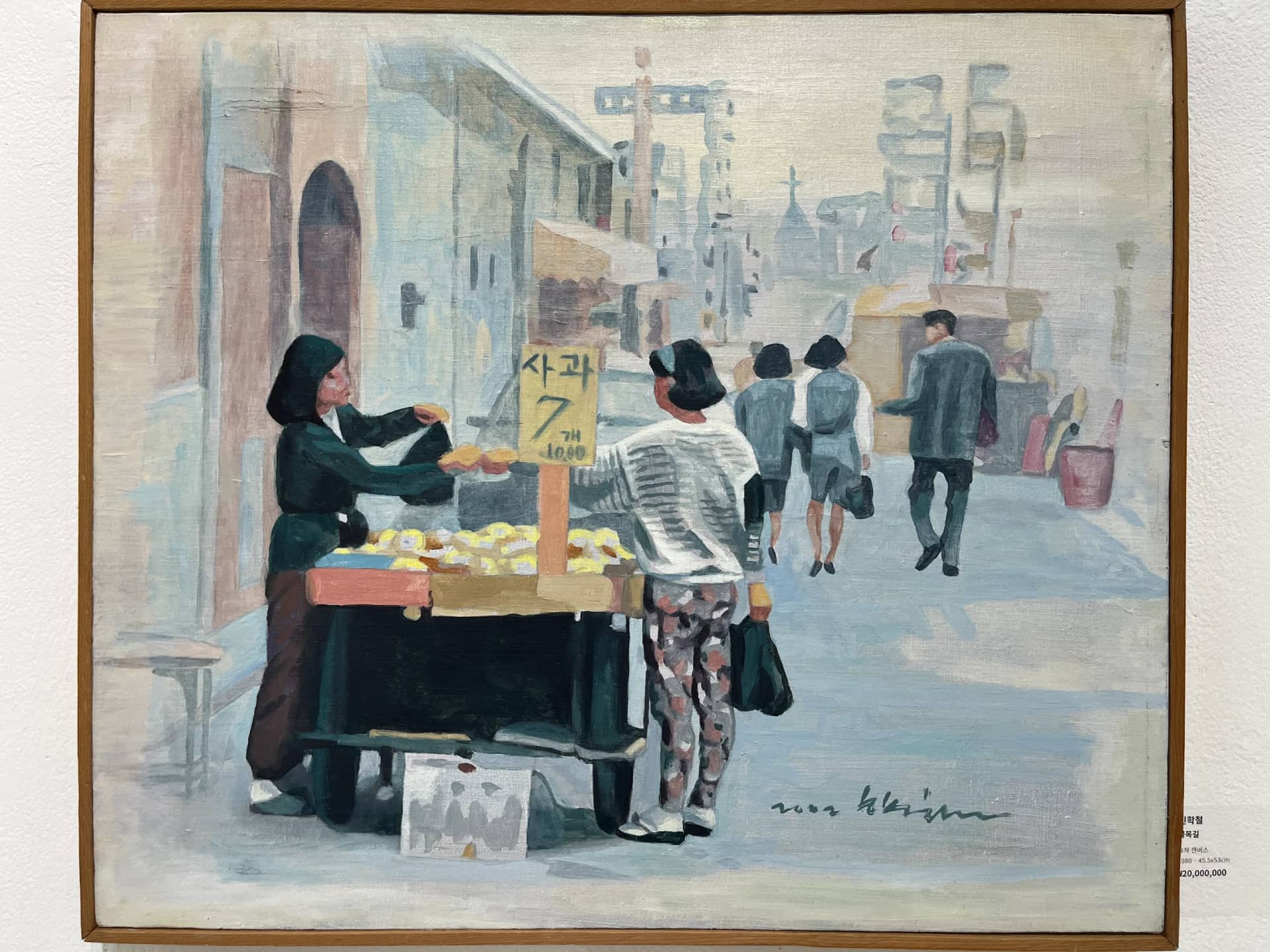
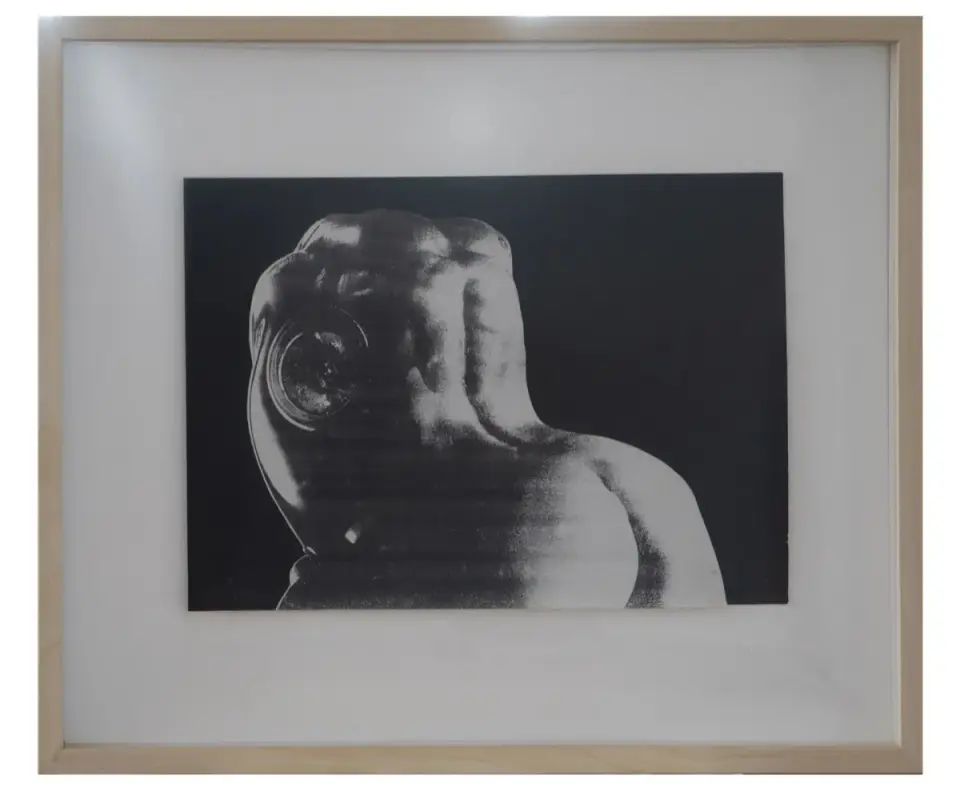
4 works are featured here.
Shin Hak-chul joined this campaign in solidarity with fellow artists. Every work sold flows directly into the artists' mutual-aid loan fund— a purchase becomes the next month's lifeline for an artist navigating financial exclusion today.