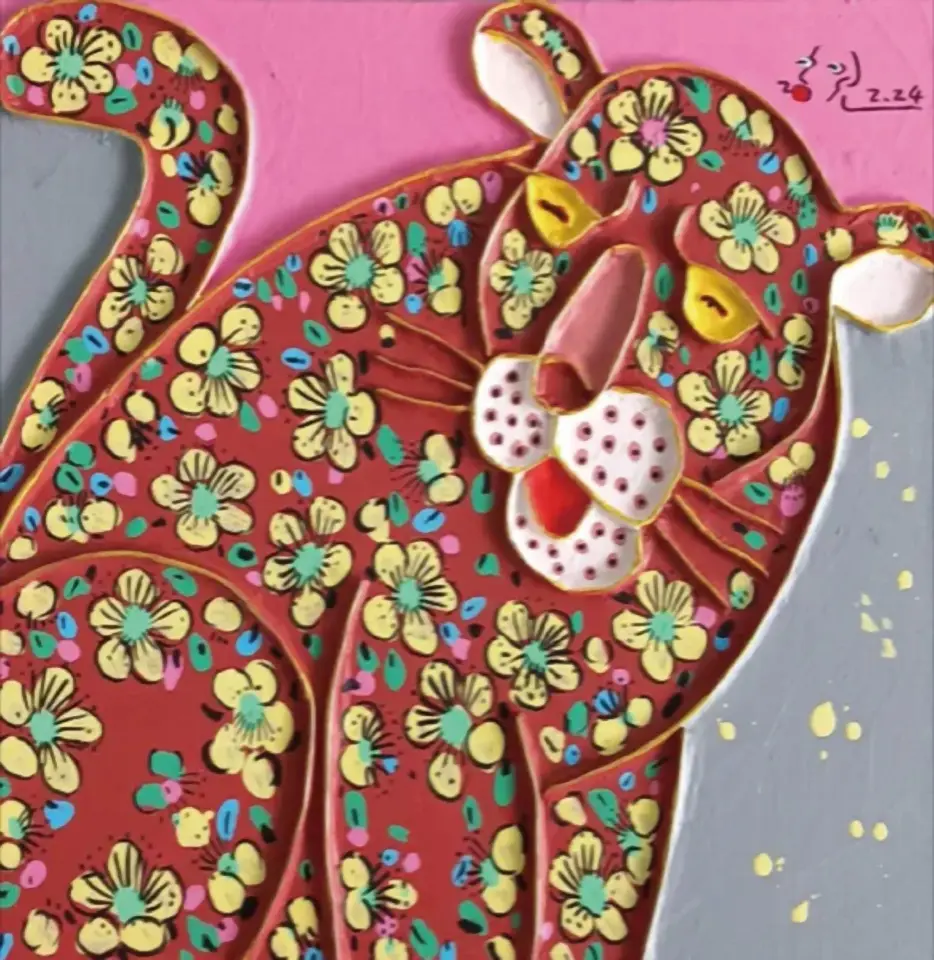
Life, human,
and the song of the forest
Forty years of painting Korean sensibility.The humor and lyricism of tigers, flowers, and nature — in warm, vernacular tones.
A warm, vernacular gaze —
forty years of Korean sensibility
Lee Hongwon studied at the College of Arts, Dongguk University, completing both his undergraduate and graduate degrees there. He made his debut in 1984 with the solo exhibition 〈Life + Human〉 at Gwanhun Gallery in Seoul, and in the same year was selected as a Korean Critics' Recommended Notable Artist.
Across more than four decades since, his work has unfolded a distinctly Korean sensibility through painting. From the early 〈Life + Human〉 to the long-running 〈Song of the Forest〉 series and the recent 〈Moon Jar〉 works, he has rendered the humor and lyricism of tigers, flowers, and the natural world in warm, vernacular tones.
He has held 29 solo exhibitions and participated in over 300 group exhibitions at home and abroad — including at Insa Art Center (2012, 2013), Insa Art Plaza (2023), Morris Gallery in Daejeon, and 419 Verones Gallery in Los Angeles, with international showings in LA, New York, Sarajevo, Peru, China, and Japan.
Beyond his exhibition practice, he produced a portrait of the independence activist Danjae Shin Chae-ho and a presidential record painting at Cheongnamdae — both commissioned works of public record. His paintings are held in the MMCA Art Bank, the Cheongju Museum of Art, the Chungbuk Provincial Office, the Chungbuk Office of Education, and the SK Guest House.
Major themes
- 1
Song of the forest
A long-running series that gathers tigers, flowers, and trees into a warm, vernacular vision of the natural world.
- 2
Humor & lyricism
Tigers and flowers carry the wit and warmth of Korean folk feeling — playful, tender, and rooted in everyday life.
- 3
From 〈Life + Human〉 to 〈Moon Jar〉
A four-decade arc of Korean sensibility — from the 1984 debut through to the recent moon-jar paintings.
The artist's timeline
- 1974–Studies at the College of Arts, Dongguk University (B.F.A. through 1980, M.F.A. through 1983).
- 1984Debut solo exhibition 〈Life + Human〉 (Gwanhun Gallery, Seoul); selected as a Korean Critics’ Recommended Notable Artist.
- 1986Solo exhibition 〈Song of Life I〉 (Arab Gallery, Seoul).
- 2002〈Song of the Forest〉 (Cheongju Arts Center, Cheongju).
- 2011Invitational 〈Song of the Forest〉 (419 Verones Gallery, LA).
- 2012–13〈Song of the Forest〉 exhibitions (Insa Art Center, Seoul).
- 2015Lee Hongwon Invitational (Morris Gallery, Daejeon).
- 2023〈Moon Jar〉 exhibition (Insa Art Plaza, Seoul).
- 40여 년29 solo exhibitions and over 300 group exhibitions at home and abroad.
Selected collections & public works
- Collections: MMCA Art Bank, Cheongju Museum of Art, Chungbuk Provincial Office, Chungbuk Office of Education, SK Guest House.
- Public-record commission: portrait of the independence activist Danjae Shin Chae-ho.
- Public-record commission: presidential record painting at Cheongnamdae (Roh Tae-woo).
- International exhibitions: LA, New York, Sarajevo, Peru, China, Japan.
Three essays —
on the work and its warmth
1〈Life + Human〉 — a 1984 debut
Lee Hongwon trained at the College of Arts, Dongguk University, completing both his undergraduate and graduate studies there through the 1970s and early 1980s. In 1984 he opened his first solo exhibition, 〈Life + Human〉, at Gwanhun Gallery in Seoul — and in the same year was named a Korean Critics' Recommended Notable Artist, a recognition that marked him as a figure to watch at the very outset of his career.
From that beginning, the through-line of his work was clear: a painting rooted in Korean sensibility. Rather than abstraction or theory, he reached for the textures of everyday feeling — the warmth, the humor, the lyricism that runs through Korean folk life. The early 〈Life + Human〉 and 〈Song of Life〉 works set the tone for everything that followed.
2〈Song of the Forest〉 — tigers, flowers, and warmth
The 〈Song of the Forest〉 series is the heart of Lee Hongwon's mature practice. Shown over more than a decade — at the Cheongju Arts Center (2002), the 419 Verones Gallery in Los Angeles (2011), and the Insa Art Center in Seoul (2012, 2013) — it gathers tigers, flowers, and trees into a single warm vision of the natural world.
The tiger, a recurring presence, carries the wit and tenderness of Korean folk imagery: playful rather than fearsome, at home among blossoms. In these canvases nature is not sublime distance but intimate company — a song one hums while walking through it. The vernacular tone, warm and unhurried, is the signature of the series.
3Public records and collections
Alongside his exhibition practice, Lee Hongwon undertook two commissioned works of public record. He produced a portrait (yeongjeong) of the independence activist Danjae Shin Chae-ho, and a presidential record painting at Cheongnamdae depicting Roh Tae-woo. Both are documentary commissions — works made for the public archive rather than the gallery wall.
His paintings have entered significant public collections: the MMCA Art Bank, the Cheongju Museum of Art, the Chungbuk Provincial Office, the Chungbuk Office of Education, and the SK Guest House. Across 29 solo exhibitions and more than 300 group exhibitions — with international showings in LA, New York, Sarajevo, Peru, China, and Japan — his four-decade body of work has steadily carried Korean sensibility into both private homes and public institutions.
From the 1984 debut to the recent moon-jar paintings, Lee Hongwon's work has pursued a single warmth: the humor and lyricism of a Korean sensibility, gathered into the song of a forest. He joins this campaign not as a subject of its cause but as a fellow artist in solidarity — so that those who come after might keep painting.
Selected Works
2 works are featured here.
Lee Hongwon joined this campaign in solidarity with fellow artists. Every work sold flows directly into the artists' mutual-aid loan fund— a purchase becomes the next month's lifeline for an artist navigating financial exclusion today.