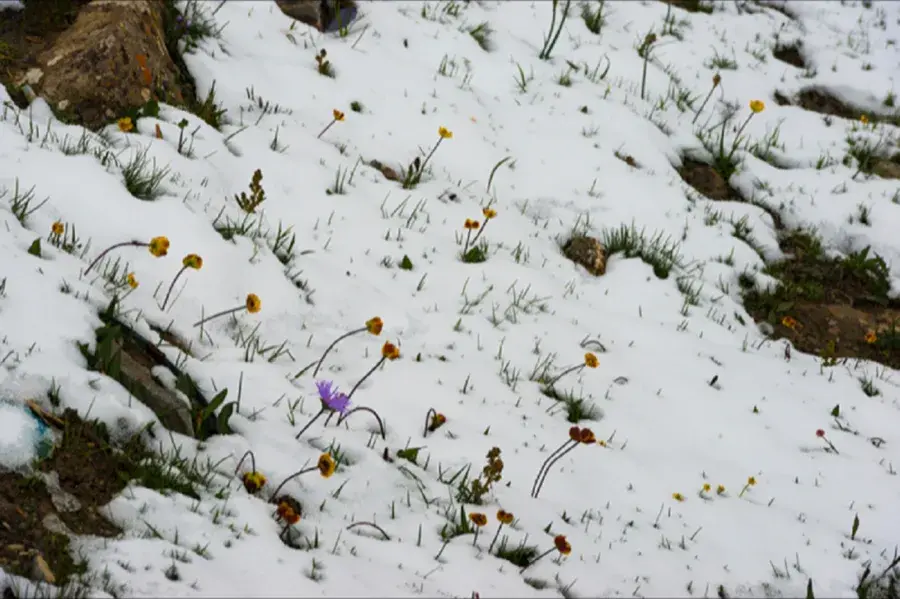
A fallen flower
returns to earth
From Busan, she photographs landscape and the grain of time.A tender gaze fixed on the things that vanish — flowers, stations, history.
Recording the vanishing —
photography and the photobook
Jeong Geumhui works from Busan, recording landscape and the grain of time through photography and the photobook. She earned a doctorate in photography from the graduate school of Hongik University, and her practice carries both the discipline of the long-form study and the patience of the book — images gathered, sequenced, and bound rather than simply shown.
Her most sustained subject is the cycle named in the title of her central series: 〈Hwarak-ito (花落以土)〉 — ‘a flower falls and becomes earth.’ The phrase frames a body of work that looks steadily at impermanence: the moment when a blossom completes its season, drops, and is reabsorbed into the ground from which the next will rise. It is a photography of return rather than arrival.
Alongside it runs her record of the Donghae Line. In ‘Donghae Line — Stations (驛舍), History (歷史),’ she photographs the disused stations of the line as it was rerouted and modernized, holding together the double meaning the title carries in Korean: the station building (驛舍) and the history (歷史) that passed through it. The empty platforms and shuttered ticket windows become a quiet archive of a vanishing infrastructure of memory.
Across solo exhibitions from 2011 onward — ‘BEYOND,’ the ‘Hwarak-ito’ series, the Donghae Line work — and two photobooks, BEYOND (2011) and Hwarak-ito (2024), both from the photography publisher Ryugaheon, her work returns again and again to the same register: a tender, contemplative attention to what time takes away.
Major themes
- 1
Hwarak-ito (花落以土)
A flower falls and becomes earth — a photography of the cycle of impermanence and return.
- 2
The Donghae Line — 驛舍 and 歷史
The disused stations of the Donghae Line, where the building (驛舍) and the history (歷史) it carried share a single word.
- 3
Photography and the photobook
Images gathered, sequenced, and bound — the long-form discipline of the photobook as the natural home of her work.
The artist's timeline
- Edu.Ph.D. in Photography, Dept. of Design & Craft, Graduate School of Hongik University.
- 2011〈BEYOND〉, K.O.N.G Gallery, Seoul; photobook BEYOND (Ryugaheon).
- 2012〈BEYOND〉, Toyota Photo Space, Busan.
- 2017〈Today's Weather〉, Gallery Sujeong, Busan.
- 2018〈Hwarak-ito〉, Busan Alliance Française ART SPACE.
- 2022〈Dong〉, Busan Alliance Française ART SPACE.
- 2023〈Donghae Line — Stations (驛舍), History (歷史)〉, Gallery Lucida, Jinju.
- 2024Photobook Hwarak-ito published (Ryugaheon).
- 2025〈Hwarak-ito (花落以土)〉, Busan Gallery, Busan.
Selected exhibitions & publications
- Solo exhibitions (7 in total): 〈BEYOND〉 (K.O.N.G Gallery 2011 · Toyota Photo Space 2012) · 〈Today’s Weather〉 (Gallery Sujeong 2017) · 〈Hwarak-ito〉 (Busan Alliance Française ART SPACE 2018) · 〈Dong〉 (2022) · 〈Donghae Line — 驛舍, 歷史〉 (Gallery Lucida, Jinju 2023) · 〈Hwarak-ito 花落以土〉 (Busan Gallery 2025)
- Group exhibitions (over 60 in total), including 〈Memory Is an Old Story〉 (Geumsaem Museum, 2025), 〈Our Heterotopia〉 (Gallery Tan, Daejeon, 2025), and the Busan·Ulsan·Gyeongnam photography exchange 〈Afterimage of Memory〉 (Busan City Hall Gallery, 2025).
- Photobooks: Hwarak-ito (Ryugaheon, 2024) · BEYOND (Ryugaheon, 2011).
Two essays —
on the work and its gaze
1Hwarak-ito — a flower falls and becomes earth
The phrase that gives the series its name — 花落以土, ‘a flower falls and becomes earth’ — sets the terms for everything in it. A blossom is not photographed at the height of its bloom but at the edge of its passing: as it loosens, drops, and begins to return to the ground. The work does not mourn this so much as attend to it, with a steadiness that treats decay as part of a longer cycle rather than an ending.
What the series proposes is a way of seeing in which falling and rising are the same motion. The earth that receives a fallen flower is also the earth from which the next will grow; impermanence and renewal are folded into one another. Jeong's photographs hold this quietly — close attention to texture, to the worn surface of a petal or a patch of ground, rather than any large dramatic gesture.
Carried across exhibitions from 2018 onward and gathered into the 2024 photobook Hwarak-ito, published by Ryugaheon, the series reads less as a record of particular flowers than as a sustained meditation on time itself — on the tenderness, and the consolation, of the things that vanish.
2The Donghae Line — where 驛舍 and 歷史 share a word
The title of the Donghae Line series turns on a pun that only Korean can hold. Yeoksa is at once 驛舍 — the station building, the physical house where a train once stopped — and 歷史 — history, the time that passed through it. As the line was rerouted and modernized, its older stations fell out of use; Jeong photographs them in that condition, empty and shuttered, when the building has outlived its function but not yet its meaning.
These are not nostalgic images so much as careful ones. A disused platform, a closed ticket window, a name-board for a stop no train serves: each is a small monument to an infrastructure of memory that is quietly disappearing. The series asks what a place holds once its use is gone — and answers, gently, that it holds history, in both senses of the word at once.
Shown as ‘Donghae Line — Stations (驛舍), History (歷史)’ at Gallery Lucida in Jinju in 2023, the work sits naturally beside Hwarak-ito. Where one series watches a flower return to earth, the other watches a building return to silence — two studies in the same subject, the time of vanishing things.
Between a fallen flower and a shuttered station, Jeong Geumhui has built a quiet, sustained body of work about the time of vanishing things — and about the tenderness it asks of us. She joins this campaign in solidarity with fellow artists, so that those who come after might keep gathering, sequencing, and binding their own images of the world before it changes.
Selected Works
2 works are featured here.
Jeong Geumhui joined this campaign in solidarity with fellow artists. Every work sold flows directly into the artists' mutual-aid loan fund— a purchase becomes the next month's lifeline for an artist navigating financial exclusion today.